Showing posts with label Western. Show all posts

Friday, March 6, 2015

The Homesman

The Homesman - Dir. Tommy Lee Jones (2014)


Judging by outward appearances, Tommy Lee Jones doesn't seem to be a jolly old fellow. No surprise that Jones has chosen rather dour material for his directorial efforts. His first film as director, The Three Burials of Melquiades Estrada, was a somber modern-day Western about a rancher making his way to Mexico with the corpse of a ranch hand and the Border Agent who killed him. You could hardly call Jones' sophomore feature, The Homesman, a traditional Western. Sure, the period is appropriate, but white hats don't shoot it out with black hats and the hero doesn't triumphantly ride off into the sunset.

The Homesman takes place during the mid-1800's in the desolate territory now known as Nebraska. Life has been harsh, especially for three women driven insane by the rigors of the frontier and an overbearing patriarchal society. Arabella Sours (Grace Gummer) hasn't even hit her 20's and has already lost her three children to diphtheria. Gro Svendsen (Sonja Richter) went mad due to the death of her mother and repeated sexual abuse by her husband. Theoline Bellknapp (Miranda Otto) suffered such a nervous breakdown that she does something unthinkable. In the movie's most harrowing moment, Theoline stumbles towards an outhouse and tosses her newborn infant into the latrine.

The burgeoning town is hardly equipped to handle this pitiable trio, but a church in Iowa has agreed to care for them. When it's clear their husbands are either unable or unwilling to take them, Mary Bee Cuddy (Hilary Swank) volunteers to embark on the journey. Perhaps, she feels a kinship to these women as she hides her own crushing loneliness. Cuddy is 31 and unwed, making her a spinster in everyone's eyes. She's been sharply turned down for marriage because she's too "bossy" and too "plain."

As strong-willed as she is, Mary Bee knows she cannot make the trip on her own. Due to happenstance, she comes across George Briggs (Jones), a buffoonish claim jumper left to hang. Briggs agrees not so much out of chivalry, but to get out of the noose along with $300 and a jug of whiskey.

The Homesman was based on a novel by Glendon Swarthout, who also wrote The Shootist, which was adapted into a film starring a grizzled John Wayne in what would be his final role. Of course, Jones brings grizzled to a whole new level. He's not exactly the most amiable of travel partners. The prim and proper Mary Bee does not end up falling for the gruff Briggs the way Katherine Hepburn did with Bogart in The African Queen. In fact, The Homesman never goes where you expect. The protagonists and their charges are outsiders in a rigid culture. They don't find redemption, happiness or sanity.

Jones turns in a fine performance that goes beyond his trademark surliness. He is able to go to dark place while playing the buffoon. Swank's success ratio hasn't been that spectacular, but her work in The Homesman ranks right up there with Million Dollar Baby and her breakout role in Boys Don't Cry. It's a fierce and heartbreaking performance.


The Homesman has been called an anti-western and a feminist revision of the genre. Jones' sophomore effort certainly has more in common with the existentialism of McCabe and Mrs. Miller and the beautiful bleakness of No Country for Old Men. He unravels the romanticism of the Old West by presenting its ugliness without restraint. One of the more underrated films of 2014.


Rating: *** ½ (*****)

Sunday, October 19, 2014

A Million Ways to Die in the West

A Million Ways to Die in the West - Dir. Seth MacFarlane (2014)


The ubiquitous Seth MacFarlane has branched out far beyond his animated empire of Family Guy, American Dad, and the recently cancelled Cleveland Show. He's the closest thing we have these days to an old-fashioned song and dance man. He's hosted the Oscars, performed a concert tour, released a jazz album, and even executive produced the educational science series Cosmos: A Spacetime Odyssey. In 2012, MacFarlane wrote and directed his first feature film, Ted, the story about a man and a talking teddy bear who has long worn out his welcome. MacFarlane also performed the voice work and motion capture for the titular Ted. For his second feature, A Million Ways to Die in the West, we get MacFarlane in all his live-action glory as meek sheep farmer Albert Stark.

It's the year 1882 and Stark lives in the little town of Old Stump. He spends most of his time bemoaning how just about everything can kill you in the Wild West, from wild animals to unsanitary medical care. The most dangerous of all just might be murderous gunfighters. Albert is a sheep farmer and a pretty lousy one at that. His flock is scattered all over the place and when one of them grazes on another man's property, Albert is challenged to a showdown. Albert chickens out, much to the chagrin of his girlfriend Louise (Amanda Seyfried), who promptly for Foy (Neil Patrick Harris), the proprietor of the local Moustachery.

Albert thinks about packing it up and moving to San Francisco when he meets the gorgeous Anna (Charlize Theron). Both of them share a common disdain for everything dirty and backwards about the West. Anna also teaches Albert how to shoot a gun in order to challenge Foy and win back the fickle heart of Louise. Unfortunately, it turns out Anna is married to Clinch Leatherwood (Liam Neeson), a notorious outlaw who doesn't like anyone making moves with his wife.

A Million Ways to Die in the West wears its influences on its sleeve. Naturally, MacFarlane shoots quite a bit in Monument Valley, the gorgeous setting for so many classic John Ford Westerns. There's a nod to Terror in Tiny Town, an infamous 1938 movie starring an entire cast of little people and a lively dance number honoring facial hair that recalls Oklahoma. Of course, as a Western comedy, A Million Ways to Die in the West is cut from the same cloth as Blazing Saddles. Whereas Mel Brooks chose to do one long fart joke during the campfire sequence, MacFarlane spreads his flatulent humor throughout the film. And while Brooks was focused on race relations, MacFarlane takes a decidedly de-romanticized look at the Old West. He borrows the fish out of water aspect from Paleface and Son of Paleface starring Bob Hope. If you've watched Family Guy, then you'll know MacFarlane's reverence for hook nosed comedian thanks to the "Road to…" episodes with Stewie and Brian as Hope and Bing Crosby.

Albert makes numerous anachronistic observations about the time period. He looks at the violence and disease through modern eyes. He's reminiscent of Frank Grimes, the tightly wound character driven mad by the absurdity of The Simpsons. Sure, MacFarlane is a bit one-note in the lead, but he makes it work with his wry observations and off-the-cuff non sequiturs. Luckily, Million Ways has itself a terrific supporting cast with Neil Patrick Harris really asserting himself in the role of an annoying fop. Sarah Silverman is perfectly cast as Ruth, the proverbial hooker with the heart of gold, but with a twist. Silverman made a name for herself on the stand-up circuit with bawdy material that belied that sweet, pixie voice. Here, she's a prostitute openly engaged in outlandish sexual acts, yet she's in a chaste relationship with Albert's best friend, the virginal Edward (Giovanni Ribisi).

There are cameos galore in Million Ways. Blink and you might miss Ewan McGregor, Ryan Reynolds or Kaley Cuoco. Being set in the 1800's means MacFarlane can't rely on his usual arsenal of pop culture references. His one indulgence is the appearance of a certain time-traveling doctor and not the one who rides around in a police box.


Rating: *** (*****)

Saturday, August 31, 2013

The Lone Ranger

The Lone Ranger - Dir. Gore Verbinski (2013)


Nobody expected Pirates of the Caribbean to be a hit. It was a movie based on a ride at Disneyland. The star, Johnny Depp, was a respected actor, but not a box office draw. Plus, the last pirate movie to hit screens was the abysmal Cutthroat Island, a notorious flop that hastened the demise of Carolco, the production company responsible for Terminator 2 and Basic Instinct. Pirates was not only a triumph, it spawned one of the biggest money making franchises in movie history. Each of the three sequels is ranked in the top 20 of highest worldwide grosses, plus Depp received an Oscar nomination for his memorable portrayal of Capt. Jack Sparrow.

While Hollywood has produced several quality Westerns over the last several years (3:10 to Yuma, Django Unchained), it wasn't a genre considered to be a huge attraction. Disney was looking to change that perception with The Lone Ranger. They put the Pirates band back together including Depp, producer Jerry Bruckheimer, director Gore Verbinski, composer Hans Zimmer, and screenwriters Ted Elliot & Terry Rossio (with a rewrite by Justin Haythe).

The Lone Ranger and his faithful sidekick, Tonto, debuted on a 1933 radio drama, but his most popular incarnation is the ABC television series that aired from 1949 to 1957 with Clayton Moore and Jay Silverheels in the lead roles. The least popular version would have to be The Legend of the Lone Ranger, a live-action film released in 1981 to capitalize on the success of the Superman movies. Legend was a critical and commercial failure and immediately sank the career of its star, Klinton Spilsbury, who never acted again. Spilsbury was no Christopher Reeve. He upset many crewmembers with his egotistical behavior, his drinking, and a mediocre performance that led producers to dub over his voice. Disney's Lone Ranger was also plagued with production woes. Filming was delayed due to the studio wanting to trim the bloated budget of $225 million. They cut it down to a mere $200 million. Not that it mattered because the picture wound up spending the difference and then some. Remember when Westerns didn't cost the GNP of a small country because all you needed was a horse, a desert, and a guy with a gun?

John Reid (Armie Hammer) returns to his dusty hometown of Colby, Texas after studying law back east. His brother, Dan (James Badge Dale), is a member of the Texas Rangers and Colby's primary lawman and is married to John's former girlfriend, Rebecca (Ruth Wilson). Progress is about to transform Colby into a vital hub thanks to the construction of the Transcontinental Railroad overseen by tycoon Latham Cole (Tom Wilkinson). The Reids and a team of Rangers set out into the desert to capture a recently escaped outlaw named Butch Cavendish (William Fichtner). An ambush by Cavendish and his gang leaves everyone dead, except for John who is rescued by Tonto (Depp), a Comanche on his own mission of vengeance.

Anything unique Verbinski and Depp had to say about the Western, they told it all in the delightfully quirky Rango. The Lone Ranger is painfully formulaic in spite of Verbinski quoting from the works of John Ford and Sergio Leone. He even throws in a visual reference to The Flight of the Red Balloon. The beautiful shots of Monument Valley aren't nearly enough to distract from a bloated runtime of nearly two and a half hours. Borrowing from Little Big Man, Verbinski employs a framing device in which an elderly Tonto, posing as a mannequin in a traveling sideshow, recounts his tale to a young boy. These sequences are one of many that attempt to deal with America's bloody history and the indignant treatment of Native Americans, along with Chinese rail workers. However, the movie never digs deeper into those topics because it is a Disney movie. Thus, we get a brutal scene where a Comanche tribe is massacred by machine gun fire that is completely undercut by Laurel & Hardy-style slapstick involving the Ranger and Tonto on a seesaw cart. There's no payoff to the sideshow scenes either. Too bad Sony has the rights to the Green Hornet, otherwise the kid could have been revealed to be Britt Reid, the Hornet's alter-ego and Dan's grand-nephew.

The tonal inconsistencies are a major problem beyond the failed blend of violence and humor. Throughout the picture, the Ranger is a source of derision in spite of the studio's desire to make him into a modern, bad-ass character. There's a constant mocking of the Ranger iconography with people asking, "What's with the mask," as a bad running joke. When the Ranger shouts his catchphrase, "Hi-yo, Silver! Away!," Tonto emphatically tells him to never do it again.

The Lone Ranger falls into the same trap of many origin stories in that the protagonist doesn't become the hero we know until the end. The final act is the best part of the movie with a pair of runaway trains on parallel tracks. It's the same type of outlandish set piece that the Pirates series did so well. The film is almost invigorated when the Ranger's theme, the William Tell Overture, finally kicks in and the masked man rides to the rescue of Rebecca, who is in full Perils of Pauline mode.

Although the movie is entitled, The Lone Ranger, Johnny Depp's Tonto is the obvious star. Depp tries to recapture the magic of Jack Sparrow with another idiosyncratic performance, but there isn't anything particularly memorable about his Tonto. The same goes for Armie Hammer, who was great in The Social Network, but is given nothing but the blandest material to work with. As brothel owner, Red Harrington, Helena Bonham Carter seems to have wandered off a Tim Burton set and is more than welcome though she could have been easily cut.

The Lone Ranger is an indulgent mess that failed to achieve a fraction of the success of the first Pirates movie. In the end, it will go down as another costly failure for Disney alongside Mars Needs Moms and John Carter.

Rating: * ½ (*****)

Friday, April 19, 2013

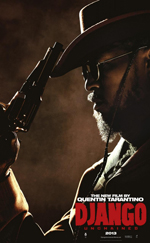
Django Unchained

Django Unchained - Dir. Quentin Tarantino (2012)


Django…Django, have you always been alone?
Django…Django, have you never loved again?

Film geeks had to be on pins and needles when word got out that Quentin Tarantino would write and direct a Western. The Spaghetti Western was a tremendous influence on Kill Bill and Inglourious Basterds so fans were eager to see QT tackle the genre outright. He does not disappoint with the vibrant and violent Django Unchained.

The titular Django (Jamie Foxx) is a runaway slave separated from his wife Broomhilda (Kerry Washington) by their wicked master. He is rescued from a chain gang by German bounty hunter Dr. King Schultz (Christoph Waltz), who requires Django's assistance in tracking down a trio of outlaws known as the Brittle Brothers. A newfound friendship quickly blossoms and Schultz agrees to help Django find his wife. Unfortunately, she is now in the possession of a particularly nasty plantation owner named Calvin Candie (Leonardo DiCaprio).

Just as he has done in the past, Tarantino litters the narrative with references to the movies he loves with Django Unchained serving as a fusion of Westerns and blaxploitation. Tarantino specifically riffs on Sergio Corbucci, director of the original Django, which was a classic Spaghetti Western. Much like Inglourious Basterds, Tarantino took the title and barebones premise of an older Italian picture and injected it with his own unique vision. Franco Nero, the original Django, makes a cameo appearance and receives special thanks in the opening credits. Django isn't the only Corbucci flick Tarantino pays homage to. The montage where Schultz trains Django in the snow covered mountains is a reference to The Great Silence, a rarity of the genre in that it was set during the dead of winter and not under a scorching desert sun. The theme of revenge recalls Navajo Joe, starring Burt Reynolds, as well as Giulio Petroni's Death Rides a Horse, which played a huge part in the genesis of Kill Bill. Another film Tarantino owes a debt to is the controversial Mandingo with its brutal depiction of slaves forced to fight one another. In true Tarantino fashion, Broomhilda's full name is Broomhilda von Shaft, after the German family that previously owned her, which points to her and Django being the ancestors of blaxploitation icon John Shaft.

Tarantino isn't known for providing his films with an original score. He prefers using existing music and the soundtrack is an eclectic collection of anachronistic pop tunes like Jim Croce's "I Got a Name" with hip-hop tracks by Tupac and Rick Ross. In addition, there are the usual pieces from Ennio Morricone and Luis Bacalov whose compositions are synonymous with the Western genre. The opening credits are set to the theme song of the original Django while the end credits use "Trinity (Titoli)," the theme from They Call Me Trinity, a comedic take on the Western starring Terence Hill, who also appeared in the similar My Name is Nobody.

Django Unchained isn't without its problems, not the least of which is Tarantino's atrocious attempt at an Australian accent. The movie certainly feels like one of his messiest works, which could be explained by several factors. QT reportedly took a lax attitude when it came to production and the picture fell behind schedule. The death of Tarantino's long-time editor Sally Menke has to be factored in as well. This is his first picture without Menke and her presence in the editing room is missed. Finally, a lot of material was cut from the original screenplay, including extended backstories for Broomhilda and some of Candieland's denizens. Django's wife suffers the most from these trims as she is reduced to a damsel in distress. It is truly disappointing to see her as such a cipher compared to the strong female characters Tarantino has written before (Jackie Brown, The Bride, etc.). Tarantino does manage to inject his own flair for dark and over-the-top humor exemplified by a Blazing Saddles-style sequence involving the Regulators, the precursors to the KKK.

All those faults are easily overlooked by a winning performance from Christoph Waltz, who earned a second Academy Award for Best Supporting Actor. Django Unchained lives and dies at the feet of the loquacious Dr. King Schultz. Never has the marriage between auteur and thespian been so perfect. Waltz was born to breathe life into Tarantino's stylish dialogue. He exudes an inordinate amount of charisma in every scene. At the same time, there's a subtle layer of shock and seething anger underneath Schultz's whimsical nature due to the prejudice he witnesses. Every hero needs a strong villain to face and Calvin Candie serves that role thanks to Leonardo DiCaprio, who is cast against type as the sinister Southerner. Much like Waltz as Hans Landa, DiCaprio possesses a disarming charm and cherubic visage that belies his propensity for sadism. However, the true antagonist in Django Unchained may just be Samuel L. Jackson as Stephen, the faithful servant to the Candie family. Judging by outward appearances, Stephen could be dismissed as a comical stereotype in the vein of Uncle Remus from "Song of the South." But, his hateful nature is quickly revealed to be downright frightening. In addition the leads, Tarantino rounds out his rich supporting cast with regular collaborators like Zoe Bell, Tom Savini, and Michael Parks alongside Jonah Hill, Walt Goggins, Don Johnson, Bruce Dern, James Remar, John Jarratt, and Tom Wopat.

Django Unchained is a vibrant example that Quentin Tarantino doesn't just make movies, he makes pop art. The film soars on the back of Tarantino's intricately written dialogue and a bravura performance from Christoph Waltz until it builds to a bloody crescendo. "Django Unchained" is my pick for the best film of 2012.

Rating: **** (*****)

Monday, August 29, 2011

Cowboys & Aliens

Cowboys & Aliens - Dir. Jon Favreau (2011)


Cowboys & Aliens has one of those high-concept titles that tells you exactly what you're going to get. Just like Snakes on a Plane had snakes on a plane, Cowboys & Aliens has cowboys and aliens. It should have been a cool mish-mash of Western and sci-fi genres, but, again, like Snakes on a Plane worked better as a joke on paper. Based loosely on a graphic novel published by Platinum Studios, Cowboys & Aliens had all the makings of a successful summer blockbuster. It had two renowned leading men together for the first time in Daniel Craig and Harrison (James Bond and Indiana Jones!). It had a talented director with a proven track record in Jon Favreau (Iron Man). Steven Spielberg, Ron Howard, and Brian Grazer were among the producers. Credited screenwriters included Roberto Orci & Alex Kurtzman (Transformers), Damon Lindelof (Lost), Mark Fergus & Hawk Ostby (also of Iron Man), and Steve Oedekerk (Kung Pow: Enter the Fist), who was attached to write and direct way back in 1997. Hmm…okay that last one was odd, but you can hardly hang the film's failures on a singular man.

Cowboys & Aliens opens with an unidentified man (Craig) awakening in the desert with no memory of who he is or where he came from. There's also a bizarre bracelet attached to his wrist. After killing a trio of assailants, he makes his way to the small town of Absolution where we learn he is a wanted outlaw named Jake Lonergan. The whole town lives in fear of local cattle baron, Col. Woodrow Dolarhyde (Ford), whose sniveling son, Percy (Paul Dano), has also arrived to drunkenly shoot up the place and bully the barkeep Doc (Sam Rockwell). When the Colonel learns Percy and Lonergan have been arrested, he rides into Absolution with the intent of taking them both. Just as the six-shooters are about to be drawn, mysterious lights flash in the sky. The aliens have arrived on crab-like vessels destroying everything below and snatching up innocent people left and right. Among those taken are Percy, Sheriff Taggart (Keith Carradine), and Doc's wife Maria (Ana de la Reguera). Lonergan discovers his bracelet is actually an advanced weapon capable of detecting the aliens and destroying their ships.

Lonergan and Dolarhyde reluctantly form a posse to rescue their people and stave off the alien invasion. Among their group include Doc, Dolarhyde's Native American servant Nat Colorado (Adam Beach, the Sheriff's grandson Emmett (Noah Ringer), the gruff reverend Meacham (Clancy Brown), and a mysterious woman named Ella (Olivia Wilde). Eventually they are all forced to team up with a tribe of Apaches and a band of ruthless outlaws in a final showdown with the extraterrestrials.

The film starts with a strong first act mimicking all the standard tropes of the Western with the taciturn hero and Mexican standoffs. Favreau does his best to ground the story in some semblance of reality even after the outlandish introduction of space invaders. Then, things start going off the rails. The momentum built up at the beginning drops into a second act lull as the plot takes its time to develop its thinly drawn characters. The narrative is clumsily dotted with flashback sequences of Lonergan's fuzzy past. Ford is initially cast against type as a gruff and slightly racist antagonist, but he's Harrison Ford and can't stay that way the whole movie. He's significantly softened with two cheesy subplots of Dolarhyde acting as a surrogate father to Nat and Emmett. The movie also gets taken down a notch with the early loss of Paul Dano, who served as an excellent whipping boy to Craig's Lonergan. Despite her insane gorgeousness, Olivia Wilde appears only as a functionary character to deliver helpful exposition and act as a deus ex machine to defeat the aliens. Also wasted are great character actors like Keith Carradine, Walt Goggins, and Clancy Brown.

Favreau is a solid director with a knack for handling large ensembles, but he's not the flashiest when it comes to action. His finales (both Iron Man movies, for example) tend to build up strong and then fizzle out towards the end. Cowboys & Aliens suffers from an anti-climatic finish as the final battle between the humans and aliens becomes monotonous and easily forgettable.

While classic Westerns like The Searchers served as inspiration, Cowboys & Aliens (with its wooden dialogue and silly plot contrivances) recalls the B-movie productions of Roger Corman. There is an underlying irony beneath the pedestrian narrative about our nation's history of genocide and Manifest Destiny, but don't think for an instance this movie is an allegory for American imperialism. Cowboys & Aliens isn't a game changing genre bender. It is summer entertainment. Mindless escapism in its purest form.

Rating: ** (*****)

Sunday, March 20, 2011

Rango

Rango - Dir. Gore Verbinski (2011)


Imagine if Hunter S. Thompson and Sergio Leone dropped acid together and had a baby. That mutant freak baby would probably be Rango. Throw in healthy doses of Salvador Dali and Tex Avery and you have an animated film that stands apart from the homogenized CG kids movies flooding multiplexes across the country.

Johnny Depp has been praised for his chameleon-like qualities as an actor so it comes as no surprise when he's called upon to play an actual chameleon. As the titular Rango, he is a pet lizard (with a flair for the theatrical) living inside a glass aquarium struggling to define his own identity. When we meet Rango, he is performing Shakespeare with his only friends a dead fly, a plastic wind-up fish named Mr. Timms, and the naked torso of a Barbie doll. Oh, the movie hasn't even begun to get weird yet.

A car accident sends the aquarium tumbling out of the car where it's smashed into a million pieces across the asphalt road. Rango finds himself lost in the middle of the desert and the first creature he comes across is a Don Quixote-esque armadillo named Roadkill (Alfred Molina). He is so named because he was clearly run over by a car, yet somehow survived. Practically bisected, the poor armadillo still has the tire marks across his flattened stomach. Nope, the movie gets weirder still.

Rango wanders through the scorching desert and finds a dusty Old West town appropriately named Dirt. Through sheer dumb luck, he kills a predatory hawk plaguing the town and re-imagines himself (like any good chameleon) as a deadly gunfighter and becomes the sheriff of Dirt. Rango also romances Beans (Isla Fisher), a desert iguana prone to random spells of catatonia. Her farmland is sought after by the seemingly benevolent Mayor of Dirt, a wheelchair bound desert tortoise voiced by Ned Beatty. It shouldn't be much of a spoiler that the Mayor will be revealed as primary antagonist since Beatty also portrayed the similar Lotso Hugging Bear in Toy Story 3. There's also an owl mariachi band who act as a Greek chorus narrating the journey of Rango.

Rango was produced by Nickelodeon Movies and is the first film fully animated by Industrial Light & Magic with Roger Deakins serving as visual consultant (as he did on Wall-E and How to Train Your Dragon). The animation is impeccable including a gorgeous shot of infinite reflections of the characters inside a giant eyeball. The performances were uniquely captured as well with director Gore Verbinski, working from a script by John Logan (Gladiator, The Last Samurai), using a process he dubbed 'emotion capture.' This is a decidedly low-tech method with the actors performing the scenes on a soundstage. The voices were recorded there and the video tapes were viewed by the animators to properly render movement and facial expressions.

While the majority of animated films tend to look the same, Rango dares to be original. There's no attempt to make the creatures cute and cuddly so the studio can sell them as Happy Meal toys. Even generally adorable animals like rabbits are rendered as mangy oddballs. One character has an arrow going through his eyeball and out the side of his head. Rango himself is hardly the lovable little chameleon from Tangled, his Hawaiian shirt and smashed, lopsided head is meant to evoke the artwork of Ralph Steadman, the long-time collaborator of the late-Hunter S. Thompson.

The subversive humor of Rango is another element that makes the film so successful. The movie is filled with pop culture references which will likely go over the heads of the children in the audience as well as some of the parents accompanying them. Rango makes several references to Fear & Loathing in Las Vegas such as the visual callbacks to Steadman and a cameo from two humans resembling Thompson and Dr. Gonzo. The primary plot point of the movie (involving a water shortage) is lifted straight out of Chinatown while much of the imagery is borrowed from iconic Westerns like High Noon, The Wild Bunch, and A Fistful of Dollars while the score by Hans Zimmer is cribbed from the work of Ennio Morricone. Rango's eventually nemesis, Rattlesnake Jake (Bill Nighy), has a Gatling gun for a tail and a flat-brimmed hat borrowed from Lee Van Cleef. Rango also goes on a vision quest where he meets the Spirit of the West (Timothy Olyphant) and I won't spoil who he's clearly modeled after.

One spectacular action sequence finds the protagonists riding a wagon and being chased by a clan of rodents riding bats ("We can't stop here. This is bat country!"). Somehow the filmmakers weave together references to Apocalypse Now, The Road Warrior, 2001: A Space Odyssey, and Star Wars (it is an ILM production). However, none of the references are thrown in simply to show off how clever and hip everyone is. Neither are they Family Guy gags where they pop up randomly and have nothing to do with the plot. The references don't draw attention to themselves so children won't be scratching their heads while those in the know will get an additional layer of joy. The voice acting doesn't draw attention to itself either as the filmmakers chose the best actors, instead of stunt casting A-list talent. This leads to the casting of great character actors like Ray Winstone, Stephen Root, and Harry Dean Stanton.

Rango earned a PG rating and contains some decidedly adult humor. One of the townsfolk mentions how he found a human spinal column in his feces. So parents should be warned in case their child asks them questions about prostate exams.

The year may have barely begun, but Rango is already the frontrunner for Best Animated Film of 2011. With Pixar releasing the anemic looking sequel, Cars 2, it is hard imagine another picture knocking Rango off the pedestal. The fact that a movie so strange and trippy was made in the Hollywood system is astounding. Most likely it exists solely because of Verbinski and Depp's success on the Pirates of the Caribbean series. The story may be familiar, but the film is a unique and witty take on the classic hero's journey.

Rating: ***½ (*****)

Saturday, January 1, 2011

True Grit

True Grit - Dirs. The Coen Brothers (2010)


From the Duke to the Dude, the Coen Brothers put their own indelible stamp on the Western in this latest adaptation of the 1968 novel, True Grit, by Charles Portis. Portis's book was previously brought to the screen a year after publication in a film directed by Henry Hathaway with John Wayne as Rooster Cogburn, a surly, one-eyed U.S. Marshal. It was a role that earned Wayne his one and only Oscar.

The Coens' remake goes back to the source material to create a darker film, but one that is not nearly as nihilistic as their previous works like No Country For Old Men, Burn After Reading, and A Serious Man. While Hathaway's film was set in the Colorado Rockies during autumn, the Coens take their story back to the frontiers of Arkansas (though it was shot in New Mexico and Texas) during the cold winter. The Coens' long-time D.P. Roger Deakins skillfully manages to capture the desolation and loneliness of this world. The only way to describe Deakins' cinematography would be beautiful bleakness. It is a harsh world that young Mattie Ross (Hailee Steinfeld) finds herself.

Mattie arrives in the town of Ft. Smith to collect the body of her father, who was murdered by a drifter in his employ named Tom Cheney (Josh Brolin). Only 14 years of age, Mattie carries herself with more confidence, and intelligence than most of the adults she encounters. Mattie will need all the stern maturity she can muster as she embarks on a startling rite of passage. By the end of her first day in Ft. Smith, Mattie witnesses the hanging of three men and spends the night in the undertaker's parlor amidst the company of some newly arrived corpses. The next morning, Mattie sets about finding a lawman with "grit" to hunt down Cheney and bring him to justice. To do this, Mattie seeks out the meanest, orneriest cuss around. She finds him in Reuben "Rooster" Cogburn (Jeff Bridges) with a patch over his right eye (the opposite of Wayne) and a belly full of whiskey.

Cogburn reluctantly accepts the job to find Cheney who is hiding out in Indian Territory with a band of outlaws led by "Lucky" Ned Pepper (Barry Pepper). However, he draws the line when it comes to young Mattie accompanying him on the quest. Undeterred, Mattie follows to ensure the deed is done joined by another tagalong in LaBeouf (Matt Damon), a Texas Ranger who has hunted Cheney for months for the murder of a senator.

True Grit isn't an outright revisionist film as it is a twist on classic Western iconography. It is grimier and, yes, grittier where the lush visuals of Monument Valley disappear in favor of barren country landscapes and dead trees. The heroes' journey is dotted with the surreal touches that are par for the course in a Coen Brothers film, such as an encounter with a hanging body and a frontiersman in a bearskin. As portrayed by Bridges, Rooster Cogburn gives a whole new meaning to the term grizzled. Yes, Wayne did play him as something of a past-his-prime drunk, but he never lost the trademark swagger that made him a movie legend. With a gruff growl to his voice, Bridges isn't afraid to make his Cogburn look foolish from time to time. He doesn't get the grand entrance like Wayne in Stagecoach or Charles Bronson in Once Upon a Time in the West. The first time we meet Cogburn, his voice bellows from inside an outhouse as he tends to "prior business." But, damn if Cogburn still doesn't look badass with the reins in his mouth riding into a gun blazing showdown with the bad guys ("Fill your hands, you son of a bitch.")

Not to be outdone is Matt Damon, an upgrade from the inexplicable casting of the "Rhinestone Cowboy" crooner, Glen Campbell. Damon's LaBeouf (or as he pronounces it, Le Beef) is a bit of a Southern dandy, clad in jangling spurs and a fringed jacket. A play on the virtuous white hats, LaBeouf is overly sensitive to the jabs of his companions at his overinflated opinion of himself. So too is Brolin's Cheney an atypical black hat. He's more of a coward and a whiner than he is the frighteningly skillful gunhand in the vein of Jack Palance in Shane or Michael Biehn in Tombstone. At one point, an exasperated Cheney pathetically mopes and mutters to himself, "Everything is against me."

Therein lies another uniquely Coen touch to True Grit, the dialogue. Many lines are lifted directly out of the original novel and Portis's idiosyncratic lines feel as if they come right out of Joel and Ethan's playbook. In their vision of the Old West, nobody uses contractions.

True Grit is a rare confluence of talent where the acting, the writing, and the direction all come together to create a fantastic film. Yet, none of that would mean anything if the central role of Mattie Ross was improperly cast. Where Hathaway went with an older actress in the then 20-year old Kim Darby, the Coens discovered 13-year old newcomer Hailee Steinfeld. To use a well-worn cliché, Steinfeld is a revelation, able to convey poise beyond her years. She also displays the same gift of gab possessed by other Coen-created protagonists. Her unwavering logic and firm grasp of language enable her to verbally emasculate a horse trader, who has underestimated this pre-pubescent customer. Mattie's thrust upon adulthood is symbolized when she sheds her schoolmarm black dress and dons her late-father's coat and hat, both of which are two sizes too big for her. Yet, she never sheds her tightly braided pigtails thus maintaining an innocence about her.

Joel & Ethan Coen return to form with a rousing crowd pleaser in True Grit. This is one of the best films of 2010.

Rating: **** (*****)

Thursday, December 23, 2010

The Warrior's Way

The Warrior's Way - Dir. Sngmoo Lee (2010)


Sometimes fanboy cinema can be a bad thing. The Warrior's Way is a curious blend of Kurosawa and Leone, a cross between 300, Lone Wolf & Cub, and A Fistful of Dollars. The Warrior's Way comes to us from first-time director, Lee Sngmoo, who studied cinema at NYU and currently teaches at the national film school in South Korea. Lee isn't the first to come up with the idea of fusing the Western with the martial arts film. We've already seen Jackie Chan's Shanghai Noon, Takashi Miike's Sukiyaki Western Django, and another South Korean export, The Good, the Bad, and the Weird. So how does Lee's movie stack up?

Jang Dong-gun, from the incredible Tae Guk Gi: The Brotherhood of War, makes his English language debut as Yang, the greatest swordsman in the world. How do we know he's the greatest swordsman in the world? He kills the guy who used to be the greatest right at the beginning of the movie. As a member of the ninja clan known as the Sad Flutes, Yang has been charged with wiping out a rival. The former number one was penultimate member, leaving behind only a baby girl. Yang balks at killing a child and together they seek refuge in America.

Yang and the baby make their way to a tiny town in the middle of the desert known as Lode. The eccentric inhabitants of the town include your usual gallery of slack-jawed yokels and a traveling circus that decided to move on in. Yang settles in, running the laundry and befriending Lynne (Kate Bosworth), a comely knife throwing lass. As a young girl, Lynne's entire family was murdered The Colonel (Danny Huston), a sadistic and disfigured Confederate officer. Under Yang's tutelage furthers her abilities with the blade. Lynne finally gets her chance for revenge when the Colonel and his henchmen ride back into Lode. Yang must rally a ragtag force of cowboys, clowns, firebreathers, and the town drunk (Geoffrey Rush), who turns out to be a helluva sharpshooter. And then the ninjas arrive.

The climax is where The Warrior's Way truly shines as it descends into a bloody free-for-all of samurai swords versus six-shooters. While Lee tends to copy Zack Snyder's slow-motion accentuated style, the fight scenes are the type of brainless fun that action junkies eat up. If only the rest of the picture was on the same level. The lead up into the action-packed third act is full of stilted dialogue and empty attempts at character development. The extensive green screen work adds a cartoonish feel that Lee heightens by using a comic book font. It's too artificial looking to truly be an old-fashioned Spaghetti Western. Shooting the film on an actual set would have lent a strong sense of personality and authenticity.

Jang Dong-gun learned English for the movie and his delivery is passable, if wooden. Lee wisely has him play the taciturn hero who rarely speaks. The rest of the international cast include Kate Bosworth whose spunky Southern belle act feels like an audition for Hee-Haw and Bad Santa's Tony Cox as the circus's ringmaster. Danny Huston hams it up as the villain as does Geoffrey Rush. His signature line, "Ninjas…damn," was a highlight of the trailer, but is conspicuously absent from the final cut. The leader of the Sad Flutes is played by Ti Lung, the star of classic Hong Kong action films like A Better Tomorrow and Drunken Master II.

The Warrior's Way is the type of genre fare usually reserved for the direct-to-video market. Somehow it managed a theatrical release and disappeared from multiplexes almost as soon as it arrived. It's silly and dumb and if that's all you're looking for, give it a rent.

Rating: * ½ (*****)

Friday, June 25, 2010

Jonah Hex

Jonah Hex - Dir. Jimmy Hayward (2010)


Comic book movies are now a staple of the summer blockbuster season. This modern age of the comic book film can be traced back to an unlikely source in Blade. For decades, Marvel had attempted to turn their characters into successful feature films. Yet, all they had to show for it are a pair of awful direct-to-video movies based on Captain America and the Punisher and a Roger Corman-directed Fantastic Four that was never even released. With top properties like Spider-Man and the X-Men languishing in development hell, it was an unknown vampire slayer that broke through for Marvel and set the stage for Iron Man and others.

In recent years, Marvel’s main competitor, DC Comics, has had massive success with its rebooted Batman franchise. However, Superman Returns was a failure and they’ve struggled to get other A-list characters like Wonder Woman and the Flash off the ground while Green Lantern finally hits screens next year. It only makes sense for DC to exploit its lesser known characters or creator-owned properties to fill the void. And along rides Jonah Hex.

Hex was created by John Albano and Tony DeZuniga and first appeared in 1971 in All-Star Western #10. Set in the Old West, Hex was a bounty hunter with half his face hideously scarred. He was sold into slavery to the Apache as a child and fought for the Confederacy in adulthood. Later, he was revamped with a supernatural bent as part of DC’s Vertigo imprint. The movie version combines a little bit of both, but is a very loose adaptation of the character.

Josh Brolin stars as Jonah Hex; a Civil War veteran who surrendered to the Union inadvertantly resulting in the death of his best friend Jeb Turnbull (an uncredited Jeffrey Dean Morgan). In revenge, Jeb’s father, Quentin Turnbull (John Malkovich) forces Hex to watch helplessly while his wife and son are murdered. Left for dead with his face branded, Hex is saved by Indians and the ordeal leaves him the power to temporarily speak with the dead.

Since then, the disfigured anti-hero has made his mark as a renowned bounty hunter and gunfighter of exceptional skill. Meanwhile, Turnbull has become a terrorist striking out against the American government. He steals a massive supergun, dubbed the ‘Nation Killer,’ in order to destroy Washington during the country’s centennial celebration.

Jonah Hex endured a problematic journey into the theaters. The script was originally written by Neveldine & Taylor, the team behind the Crank films and Gamer, who were also attached to direct. Brolin signed onto the project supposedly because he loved its atrociousness. The pair left the project and was eventually replaced by the oddball choice of Jimmy Hayward whose only previous experience was the animated Horton Hears a Who. The project saw last minute reshoots under the supervision of Francis Lawrence (Constantine, I Am Legend) and a massive retooling of the plot.

What’s left is a complete mess that is barely 80 minutes long, not counting the credits. Jonah Hex is like two fractured films hastily duct taped together. There is a strange battle on a metaphysical plain between Hex and Turnbull that was once set to be the climax of the movie. Instead, it’s clumsily and confusingly intercut with two major sequences of the final product. The mystical elements are excised and in their place we find ludicrous weaponry like saddle-mounted Gatling guns, dynamite launching crossbows, and a monstrous cannon powered by glowing orange orbs invented by Eli Whitney, the creator of the cotton gin. No, really.

Some of the cast seem to realize what a colossal turd they’re in and play along. Brolin tries to rise above it all as the gravelly voiced Hex while Michael Fassbender goes over-the-top as a knife-wielding Irish henchman. Megan Fox also appears as a tough hooker with a lilting Southern accent and an impossibly thin hourglass waist. She seriously looks like she’ll snap in half at any second. For some reason, Fox almost always appears in close-ups with soft lighting no matter what the situation. Will Arnett is woefully miscast as a straight-laced Union officer while Michael Shannon pops in for one and only one scene as the ringleader of an underground fight club. Both actors are victims of the reshoots and slapdash editing.

Jonah Hex never purports to be anything more than a low-grade B-movie. Some might be able to enjoy it on a ‘so bad, it’s good’ level, but not me. Jonah Hex makes no attempt to remain faithful to the source material. It’s a shame really as the character had the potential to star in a Leone-style Spaghetti Western. The movie isn’t so much A Fistful of Dollars as it is Wild Wild West. In the pantheon of DC adaptations, it ranks at the bottom of the pile alongside Catwoman and Steel.

Rating: * ½

Sunday, November 16, 2008

Appaloosa

Appaloosa - Dir. Ed Harris (2008)


Ed Harris & Viggo Mortensen as a pair of lawmen cleaning up a small town under the iron fist of a greedy landowner.

Appaloosa isn’t the artsy Western (The Proposition, Seraphim Falls) or the shoot ‘em up Western like last year’s 3:10 to Yuma. It lies somewhere in the middle, focusing on characters and relationships. In the parlance of the time, it’s a film that moseys along at a comfortable pace.

Is there anybody better to play the gruff, taciturn sheriff than Ed Harris? He has great chemistry (and a wealth of one-liners) with co-star Viggo Mortensen as his square-jawed deputy. Jeremy Irons rounds out the main cast with an always welcome turn as the murderous villain. If there is a weak spot to Appaloosa, it lies with Renee Zellweger as a piano playing widow who latches on to Harris’ Vigil Cole (and anyone else she deems the alpha male). Zellweger is usually a competent actress, but struggles whenever she’s cast in these period pieces. She doesn’t fit and I don’t buy for one second that every man in the film wants her.

Appaloosa is old hat, but it’s a well-worn and comfortable hat.

Rating: ***

Sunday, July 13, 2008

3:10 To Yuma

3:10 To Yuma - Dir. James Mangold (2007)

Has none of the gritty realism of The Proposition or artsy existentialism of Seraphim Falls or The Assassination of Jesse James. But, that's just fine for this action-packed, gun-slinging affair.

The genre archetypes of hardened outlaw and emasculated frontiersman are dusted off and given a renewed lease on life.

Saturday, June 7, 2008

The Assassination of Jesse James

The Assassination of Jesse James by the Coward Robert Ford - Dir. Andrew Dominik (2007)

Brad Pitt's biopic is nearly as long as its title.

Western epic by way of Terrence Malick with touches of Altman's McCable & Mrs. Miller and Peckinpah's Pat Garrett & Billy the Kid.

Career best performance for Casey Affleck. His Ford is an awkward, overgrown kid who finds the fame he so desperately seeks a bitter pill.

Thursday, May 15, 2008

High Plains Drifter

High Plains Drifter - Dir. Clint Eastwood (1973)

Clint Eastwood is 31 flavors of badass in this one.

He rides in, kills three people, then rapes a woman. So, of course, the town puts him in charge.

How awesomely awesome is that?