Showing posts with label Christoph Waltz. Show all posts

Sunday, June 2, 2013

Epic

Epic - Dir. Chris Wedge (2013)


Epic is the latest CG feature from Blue Sky Studios, the animation studio behind the Ice Age series and Rio. Epic is better than any of their previous efforts, save for the first Ice Age, but it doesn't hold a candle to even the most modest Pixar production.

Mary Katherine (Amanda Seyfried), who prefers to be called 'M.K.,' reluctantly moves back in with her father, Professor Bomba (Jason Sudeikis), following the death of her mother. Dad lives in the middle of nowhere and believes a civilization of miniature people dwell in the forest. His crackpot theories have cost him his credibility in the scientific community as well as his marriage. Any chance of repairing his familial bonds is dashed as the Professor ignores his daughter in favor of chasing down evidence. But, Bomba has been right along because deep within the forest is a peaceful population of plant-like beings protected by an army known as the Leaf Men. They are at war with the Boggans and their leader Mandrake (Christoph Waltz), who is vowed to bring about death and decay. Whatever they destroy is easily brought back to life by the magical powers of Queen Tara (Beyoncé Knowles).

The two worlds collide following a Boggan ambush that mortally wounds the Queen just as M.K. wanders into the forest. She is shrunk down and thrust with the responsibility to protect a bulb that will select a new queen under the moon of the summer solstice. Joining M.K. on her quest are Ronin (Colin Farrell), the commander of the Leaf Men; Nod (Josh Hutcherson), a brash youngster who quit the service; and Mub & Grub (Aziz Ansari & Chris O'Dowd), a slug and snail tending the Queen's gardens.

Epic was loosely based on the children's book, The Leaf Men and the Brave Good Bugs, by William Joyce, author of Rise of the Guardians. Joyce was one of five credited screenwriters on Epic, which is never a good sign. The film holds no real surprises and borrows a number of recognizable elements from movies like FernGully, Lord of the Rings, Star Wars, and Avatar. The spine of the story follows the traditional hero's journey with Nod learning the importance of teamwork and responsibility. Other standard elements include the stoic mentor figure, the comic relief sidekicks, and the celebrity voiceover talent. Christoph Waltz as the villain isn't anything new, but even in animated form Waltz stands out as a fresh voice while other actors (Beyoncé and Steven Tyler) feel like stunt casting. Equally charming is a one-eyed, three-legged pug by the name of Ozzie.

The animation is beautifully rendered and the film shines during its many grand action sequences that include a climatic aerial battle with characters astride hummingbirds and bats as well as the ambush with Boggans camouflaged as tree bark.

When you title your film, Epic, you are setting high standards for yourself. The title is simultaneously grand and generic, which sufficiently describes the movie to a tee. It may be lacking in inventiveness, but kids will more than enjoy the wonderful animation and lighthearted humor.

Rating: ** ½ (*****)

Friday, April 19, 2013

Django Unchained

Django Unchained - Dir. Quentin Tarantino (2012)


Django…Django, have you always been alone?
Django…Django, have you never loved again?

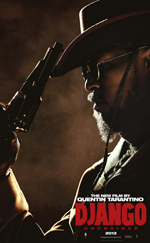
Film geeks had to be on pins and needles when word got out that Quentin Tarantino would write and direct a Western. The Spaghetti Western was a tremendous influence on Kill Bill and Inglourious Basterds so fans were eager to see QT tackle the genre outright. He does not disappoint with the vibrant and violent Django Unchained.

The titular Django (Jamie Foxx) is a runaway slave separated from his wife Broomhilda (Kerry Washington) by their wicked master. He is rescued from a chain gang by German bounty hunter Dr. King Schultz (Christoph Waltz), who requires Django's assistance in tracking down a trio of outlaws known as the Brittle Brothers. A newfound friendship quickly blossoms and Schultz agrees to help Django find his wife. Unfortunately, she is now in the possession of a particularly nasty plantation owner named Calvin Candie (Leonardo DiCaprio).

Just as he has done in the past, Tarantino litters the narrative with references to the movies he loves with Django Unchained serving as a fusion of Westerns and blaxploitation. Tarantino specifically riffs on Sergio Corbucci, director of the original Django, which was a classic Spaghetti Western. Much like Inglourious Basterds, Tarantino took the title and barebones premise of an older Italian picture and injected it with his own unique vision. Franco Nero, the original Django, makes a cameo appearance and receives special thanks in the opening credits. Django isn't the only Corbucci flick Tarantino pays homage to. The montage where Schultz trains Django in the snow covered mountains is a reference to The Great Silence, a rarity of the genre in that it was set during the dead of winter and not under a scorching desert sun. The theme of revenge recalls Navajo Joe, starring Burt Reynolds, as well as Giulio Petroni's Death Rides a Horse, which played a huge part in the genesis of Kill Bill. Another film Tarantino owes a debt to is the controversial Mandingo with its brutal depiction of slaves forced to fight one another. In true Tarantino fashion, Broomhilda's full name is Broomhilda von Shaft, after the German family that previously owned her, which points to her and Django being the ancestors of blaxploitation icon John Shaft.

Tarantino isn't known for providing his films with an original score. He prefers using existing music and the soundtrack is an eclectic collection of anachronistic pop tunes like Jim Croce's "I Got a Name" with hip-hop tracks by Tupac and Rick Ross. In addition, there are the usual pieces from Ennio Morricone and Luis Bacalov whose compositions are synonymous with the Western genre. The opening credits are set to the theme song of the original Django while the end credits use "Trinity (Titoli)," the theme from They Call Me Trinity, a comedic take on the Western starring Terence Hill, who also appeared in the similar My Name is Nobody.

Django Unchained isn't without its problems, not the least of which is Tarantino's atrocious attempt at an Australian accent. The movie certainly feels like one of his messiest works, which could be explained by several factors. QT reportedly took a lax attitude when it came to production and the picture fell behind schedule. The death of Tarantino's long-time editor Sally Menke has to be factored in as well. This is his first picture without Menke and her presence in the editing room is missed. Finally, a lot of material was cut from the original screenplay, including extended backstories for Broomhilda and some of Candieland's denizens. Django's wife suffers the most from these trims as she is reduced to a damsel in distress. It is truly disappointing to see her as such a cipher compared to the strong female characters Tarantino has written before (Jackie Brown, The Bride, etc.). Tarantino does manage to inject his own flair for dark and over-the-top humor exemplified by a Blazing Saddles-style sequence involving the Regulators, the precursors to the KKK.

All those faults are easily overlooked by a winning performance from Christoph Waltz, who earned a second Academy Award for Best Supporting Actor. Django Unchained lives and dies at the feet of the loquacious Dr. King Schultz. Never has the marriage between auteur and thespian been so perfect. Waltz was born to breathe life into Tarantino's stylish dialogue. He exudes an inordinate amount of charisma in every scene. At the same time, there's a subtle layer of shock and seething anger underneath Schultz's whimsical nature due to the prejudice he witnesses. Every hero needs a strong villain to face and Calvin Candie serves that role thanks to Leonardo DiCaprio, who is cast against type as the sinister Southerner. Much like Waltz as Hans Landa, DiCaprio possesses a disarming charm and cherubic visage that belies his propensity for sadism. However, the true antagonist in Django Unchained may just be Samuel L. Jackson as Stephen, the faithful servant to the Candie family. Judging by outward appearances, Stephen could be dismissed as a comical stereotype in the vein of Uncle Remus from "Song of the South." But, his hateful nature is quickly revealed to be downright frightening. In addition the leads, Tarantino rounds out his rich supporting cast with regular collaborators like Zoe Bell, Tom Savini, and Michael Parks alongside Jonah Hill, Walt Goggins, Don Johnson, Bruce Dern, James Remar, John Jarratt, and Tom Wopat.

Django Unchained is a vibrant example that Quentin Tarantino doesn't just make movies, he makes pop art. The film soars on the back of Tarantino's intricately written dialogue and a bravura performance from Christoph Waltz until it builds to a bloody crescendo. "Django Unchained" is my pick for the best film of 2012.

Rating: **** (*****)

Saturday, November 12, 2011

The Three Musketeers

The Three Musketeers - Dir. Paul W.S. Anderson (2011)


Paul W.S. Anderson is a name feared by all right-thinking film critics. Much like Michael Bay, M. Night Shyamalan, and Uwe Boll, when Anderson's name appears in the credits, nothing good can come of it. Anderson takes time away from video game adaptations for The Three Musketeers, in which he turns Alexandre Dumas's seminal swashbuckling adventure into a garish and modernized thrill ride.

The story begins in Venice with Athos (Matthew Macfadyen), Aramis (Luke Evans), and Porthos (Ray Stevenson) breaking into the vault of Leonardo da Vinci in order to steal blueprints for an airship. They are betrayed by Athos's paramour, Milady de Winter (Milla Jovovich), who steals the plans for Lord Buckingham (Orlando Bloom) in order to build a fleet of flying war machines.

A year later, the Musketeers are now living in disgrace. Athos has become a drunkard, Aramis is relegated to being a glorified meter maid, and Porthos lives off richer women. Along comes the hotshot D'Artagnan (Logan Lerman) who hopes to follow in his father's footsteps as a Musketeer. They band together and uncover a plot by Cardinal Richelieu (Christoph Waltz) and Milady to plunge France into war against England by fabricating an illicit affair between Buckingham and the Queen (Juno Temple).

The Three Musketeers lives up to the reputation of its director as a mindless spectacle that is light on intelligence and heavy on action. There's plenty of lavishly choreographed swordfights such as when the Musketeers face the Cardinal's guards with the odds ten to one. These clashes are broken up with slow motion flourishes in the vein of Zack Snyder or the Wachowskis. Anderson's wife, Milla Jovovich, gets her chance to shine once again performing Resident Evil-style stunts while wearing ornate 17th century gowns and tight corsets. Her Milady is part-Mata Hari and part-ninja assassin. It's all so ludicrous, but the movie is pushed into absurd boundaries when a steampunk element is introduced through the use of flying pirate ships armed with turrets and flamethrowers. And just when all this action builds to a crescendo, it sinks like the Hindenburg thanks to a non-ending that shamelessly sets up a sequel.

Matthew Macfadyen and Luke Evans give solid performances as Athos and Aramis while Ray Stevenson follows Thor by once again playing the boisterous member of a trio of warriors. Logan Lerman is far too white bread to leave any impression as D'Artagnan and his romance with Gabriella Wilde as one of the Queen's ladies in waiting is equally bland. Christoph Waltz is never given the chance to really shine as one of the movie's many villains. As the Cardinal's henchman, Rochefort, Mads Mikkelsen is easily the best thing in Musketeers, playing a one-eyed man for the third time after Casino Royale and Valhalla Rising. Orlando Bloom is the worst thing in the movie. His attempts at playing an over-the-top bad guy are awful and thoroughly unconvincing.

As he did with Resident Evil: Afterlife, Anderson shot The Three Musketeers in 3D, but the process hardly adds anything to the experience aside from a dimmer picture and the occasional blade pointed at your face.

The Three Musketeers cost $75 million and has so far barely scrapped together $20 million in box office gross. Surely, Summit Entertainment can find better uses for all those piles of Twilight money. Even with a strong ensemble cast, Musketeers can't offer the empty excitement expected of shallow popcorn fare.

Rating: * (*****)

Thursday, January 27, 2011

The Green Hornet

The Green Hornet - Dir. Michel Gondry (2011)


In the pantheon of superhero movies, The Green Hornet ranks above the atrocities known as Steel and Catwoman, but never reaches the heights of Iron Man. Therein lays the dilemma with The Green Hornet, it is a film that seems happy to remain in the middle of the pack, content with its own mediocrity.

The Green Hornet began life not as a comic book character, but as a 1936 radio serial created by George W. Trendle and Fran Striker, who also created The Lone Ranger. In fact, the Hornet was meant to be a direct descendent of the masked gunfighter. Perhaps, the most well-known incarnation of the emerald vigilante was a brief television series that aired on ABC from 1966 to 1967. That series starred Van Williams as the Green Hornet and introduced the world to Bruce Lee as the kung fu fighting sidekick, Kato.

A feature film version has been in development for nearly two decades with the property bouncing around from Universal to Miramax to Sony. George Clooney, during the early days of his fledgling movie career, was attached to star before making the fateful decision to film Batman & Robin instead. Both Jason Scott Lee (who ironically played Bruce Lee in Dragon: The Bruce Lee Story) and Jet Li were attached as Kato at one point or another while the studio looked at Greg Kinnear and Mark Wahlberg as possibilities before landing in the hands of the Weinsteins. Kevin Smith was brought on to write and direct, but his version never came to fruition though his script eventually resurfaced as a comic book published by Dynamite Entertainment. This brings us to Seth Rogen and co-writer Evan Goldberg who are white hot following the success of Superbad. The duo surprisingly chooses The Green Hornet as a future project. Fanboys are skeptical about Rogen dipping his feet into the action realm, but perk up when Rogen's first choice for Kato is Stephen Chow. The star of Shaolin Soccer and Kung Fu Hustle not only signs on to play the crimefighter chauffeur, but to direct as well. Sadly, Chow eventually parted ways due to the lack of creative control he was used to in the Hong Kong film industry. Michel Gondry (who was actually attached to direct back in 1997) is brought on board to replace him as director while Taiwanese pop star/actor Jay Chou is cast as the new Kato.

Rogen plays Britt Reid, the spoiled son of newspaper mogul, James Reid (Tom Wilkinson). Growing up under the harsh hand of his father, Reid has become the male equivalent of Paris Hilton, wasting his life away on an endless parade of parties, booze, and loose women. Everything changes when James dies due to a bee sting. Britt befriends Kato, who worked for his father as a mechanic and barista. Yep, this Kato not only kicks ass, but makes a mean cup of coffee too.

Britt and Kato bond over their mutual dislike for the elder Reid and engage in a night of debauchery and vandalism. They wind up saving a couple from an attack by a gang of hoodlums and decide to mask up as a pair of costumed vigilantes. Britt also hits on the idea to pose as villains in order to get closer to the criminals while preventing them from using innocents as bargaining chips. In his civilian guise, Britt uses his late-father's newspaper, the Daily Sentinel, to publicize the Green Hornet's exploits as he wrecks havoc across Los Angeles.

Though Gondry has proven to be an incredibly imaginative and playful filmmaker, The Green Hornet is Seth Rogen's show through and through. Flashes of Gondry's signature style emerge here and there, such as in clever split screen sequence that breaks into a cluttered mosaic of assassins hunting for the Hornet. Gondry's largest contribution to the film is the use of "Kato-Vision," taking the audience into the mind's eye of the Hornet's sidekick during his fight sequences. It isn't simply slow motion, but slow motion and fast motion simultaneously as Kato moves at lightning speed before the bad guys even have a chance to react. We see Kato zeroing in on critical attack points, charting out his strategy within a split second. Alas, these moments are fleeting as Green Hornet drudges along as a formulaic buddy comedy.

The joke has always been that Kato does most of the work and the movie plays into that. Kato is the ultimate fighting machine and he creates the team's entire arsenal, including a gas gun. The crown jewel is definitely the Black Beauty, '65 Chrysler Imperial tricked out with bulletproof windows, machine guns, and rocket launchers. Meanwhile, Britt Reid stumbles around throughout the film as an obnoxious doofus. All well and good if he goes through a character arc and learns to grow as a person. He doesn't and neither does Rogen grow as an actor. Yes, Rogen is a funny guy, but he continues to play the same frat boy man-child he has in previous pictures like Knocked Up and Pineapple Express.

The burden is left to Rogen's co-stars to carry the weight. Jay Chou isn't up to the task, however. As the silent straight man, he plays well against the glib Rogen, but his iffy English is painfully obvious when given any substantial dialogue. Chou delivers his line with wooden conviction and little screen presence. Cameron Diaz pops in as Lenore Case, Britt Reid's new secretary who is originally assigned from a temp agency. I'd love to know what temp agency sends you Cameron Diaz. Unlike most obligatory love interests, Lenore has little tolerance for Britt's horndog flirtations. In fact, she seems to be more intrigued by Kato, but that subplot never leads anywhere. She winds up being nothing more than a throwaway character, a far cry from Gwyneth Paltrow's Pepper Potts. Tom Wilkinson and Edward James Olmos (as the Perry White-esque editor are equally wasted in bit roles.

The biggest waste, without a doubt, is Christoph Waltz, still fresh off his Academy Award winning turn as Col. Hans Landa in Inglourious Basterds. Here, Waltz is Chudnofsky, a gangster who has risen to control the entire underworld of L.A. His ruthlessness is matched only by his insecurities. He is constantly worried that other people don't find him scary enough. Chudnofsky also arms himself with a custom-made double barreled Desert Eagle. Waltz's brilliant portrayal of the Nazi officer was helped by Quentin Tarantino's amazing script. He truly sunk his teeth into the role, but Rogen and Goldberg are unable to offer anything as meaty. Aside from an early scene opposite an uncredited James Franco, Waltz is never given the proper material to create something more than a run-of-the-mill villain.

Once slated as a summer tentpole film, The Green Hornet was pushed back to a holiday release before quietly being scuttled off into the doldrums of January. Despite Gondry's best efforts, his unique visual style is crushed underneath the heel of committee filmmaking and Rogen's unconvincing attempt at playing the action hero. While the film is hardly the stinker many predicted, the final product is ultimately generic and forgettable.

The Green Hornet was pointlessly converted to 3D in post-production. It looks better than the hackjobs of previous conversions like Clash of the Titans and The Last Airbender, but the 3D adds nothing to the experience.

Rating: ** (*****)

Saturday, August 29, 2009

Inglourious Basterds

Inglourious Basterds - Dir. Quentin Tarantino (2009)


”…And when the Germans close their eyes at night and their subconscious tortures them for the evil they’ve done, it will be with thoughts of us that it tortures them with…Sound good?”

Quentin Tarantino has dabbled in a variety of genres and given each his own unique stamp. He’s tackled the heist film (Reservoir Dogs), the gangster pic (Pulp Fiction), blaxploitation (Jackie Brown), the drive-in B-movie (Death Proof) and though he only wrote the screenplay, Tarantino has stated that True Romance was his take on the love story. Kill Bill was his stab at the martial arts epic and Spaghetti Western. Now, Tarantino adds his signature to the war movie with the long in development, Inglourious Basterds. More specifically, I’m speaking of the ‘bunch of guys go on a mission during World War 2’ subgenre, taking inspiration from similar films like The Dirty Dozen and Enzo G. Castellari’s original Inglorious Bastards.

With scars around his neck and a country fried hillbilly accent, Brad Pitt becomes Lt. Aldo Raine, the commander of a Jewish unit dropped into enemy territory. Their mission is to kill every Nazi they find. Known as the Bastards, Lt. Raine’s company has put the fear of God into the enemy due to their brutal methods including scalping their victims and carving Swastikas into the lucky few who escape. Also in Lt. Raine’s unit are Sgt. Donny Donowitz (Hostel director Eli Roth), a baseball bat wielding Bostonian, and Hugo Stiglitz (Til Schweiger), a former German soldier imprisoned for murdering Gestapo officers in their sleep. Two unlikely members of the Bastards are B.J. Novak (best known as Ryan on The Office) and the 5’4 Samm Levine from Freaks & Geeks.

Though the Bastards are the title characters of Tarantino’s picture and the centerpiece of the film’s advertising, they really aren’t the main characters. In fact, many of the Bastards disappear without much word about their fates. The lion’s share of the attention belongs to Shoshanna Dreyfus (Melanie Laurent), a Jewish fugitive who survived the massacre of her family, and Col. Hans Landa (Christoph Waltz), nicknamed the Jew Hunter. Having a nickname like that, it’s easy to guess who the villain of the piece is. Shoshanna is the heart of the film and there’s real heartbreak and tragedy throughout her arc. Inglourious Basterds opens with the chilling account of Col. Landa discovering her family’s hiding place underneath the floorboards of a French dairy farm.

Has there ever been a movie villain like Hans Landa? Someone so deliciously evil? The late-Heath Ledger blew audiences away with his Joker and the little known Christoph Waltz appears to be doing the same with his Landa. This is a multi-faceted character that goes beyond simple mustache twirling. His Landa greets you with a smile and friendly chit-chat and somehow it’s both humorous and unnerving. He possesses a disarming charm that actually makes you like him one minute, but then he does something monstrous and you remember he’s a fucking Nazi. Landa is also smart, quite possibly the smartest guy in the movie. His intellect and deductive abilities remind one of Sherlock Holmes and Tarantino plays those allusions up when Landa pulls out a comically large pipe.

As the Bastards cut through the Nazi ranks, Shoshanna has made her way to Paris where she now owns and operates a movie theater. The venue was left to her by an “aunt” who was to be played by Maggie Cheung before her scenes were excised from the final cut. Laurent actually learned how to operate a projector for her role and even screened a print of Reservoir Dogs along with trailers and cartoons. Much to Shoshanna’s chagrin, she is pursued romantically by an overzealous German soldier named Frederick Zoller (Daniel Bruhl) who has become the subject of his own picture after killing hundreds of American soldiers single-handedly. The Nazi high command (including Hitler) will screen the film at Shoshanna’s theater. It is here that both she and the Bastards make their plans to assassinate Hitler and all his cronies.

While Inglourious Basterds is nominally a war movie, Tarantino once again throws in a heavy dash of the Spaghetti Western into the mix. It shouldn’t surprise anyone that he fills Basterds’ score with compositions by Ennio Morricone and other pieces culled from Westerns such as The Alamo and The Big Gundown. The film’s opening chapter feels just like a prologue out of a Sergio Leone movie and is packed with Western iconography from its title (“Once Upon a Time in Nazi-Occupied France”) to a John Ford-style shot through the doorway. During a jailbreak sequence, the Bastards emerge from their hiding spots in a scene reminiscent of the way Henry Fonda and his men were revealed in Once Upon a Time in the West. He finds inspiration of a different sort in a projecting booth shoot-out that ends in a fashion that draws obvious allusions to John Woo’s The Killer.

No matter who Tarantino casts, sometimes the real star of his films is the dialogue. Often, Tarantino’s penchant for pop culture references and long conversations derail the actual plot and come off as self-indulgent. Take a look at the never ending breakfast conversation in Death Proof for a perfect example of that. You’re just waiting for them to shut up so we can get to the car chase. Here, Tarantino leaves you wanting more. He writes his characters like real, three-dimensional characters rather than characters that sound like they’re written by Tarantino, if that makes any sense. Yes, a few times the dialogue could have been easily trimmed, but the majority of the time, he’s able to weave the words in a way that builds the kind of tension I haven’t felt at the movies in a long time. He finds incredibly clever ways to juggle the various languages (French, German, English) that once again works to enhance the overall story. The titular Bastards are the only ones who feel one-dimensional, but that’s not a knock at all. They are cartoon characters (especially Brad Pitt), but damned if they aren’t entertaining.

Writing and directing a period piece certainly helped in reining in Tarantino though he still manages to make plenty of other references that fit the time period and the story. Shoshanna’s theater, for example, screens films from directors like G.W. Pabst and Henri-Georges Clouzot. He also manages to drop in the obligatory references to Leni Riefenstahl.

Despite all the scalping and machine gunning, the film’s highlight for me was a sequence involving Michael Fassbender (fresh off his amazing performance in Hunger) as Sgt. Archie Hicox, a stiff-upper lip British paratrooper and former film critic; Mike Myers under heavy make-up as his commanding officer, and veteran Rod Taylor in a quick cameo as Winston Churchill. There was just something so joyous to this film geek about hearing these men explain UFA in hoity toity aristocratic accents.

Tarantino does get a little too cute with a pair of anachronistic moments. He uses a 70’s style title to introduce Stiglitz that was actually rather amusing. Tarantino also chooses David Bowie’s “Cat People (Putting Out the Fire)” for a sequence with Shoshanna getting all dolled up (applying her own brand of war paint) for the film premiere. The song is the theme from Paul Schrader’s remake of Cat People, a film only Tarantino could like.

Even at a length of two and a half hours, Inglourious Basterds feels like an appetizer for a much bigger film. I don't think QT has ever been able to manipulate the wide range of emotions that he does with Basterds. He brings the action and the funny while never letting us forget the tragic ugliness of war. He's made a fantastic hybrid of the war & Western genres that alternately acts as a love letter to movies, one where two of its heroes are a film critic and a film projectionist. Imagine Cinema Paradiso with machine guns and explosions. Tarantino has already mentioned the possibility of a prequel to flesh out the backgrounds of the Bastards. Whether or not this project will ever see the light of day or fall to the wayside (i.e. The Vega Brothers, Kill Bill anime prequel) remains to be seen. This is easily one of Tarantino’s best films and one of the best releases of 2009.

Also in the picture are the gorgeous Diane Kruger as actress/spy Bridget Von Hammersmark and in voice-over cameos by Samuel L. Jackson (as the narrator) and Harvey Keitel (as Lt. Raine’s commanding officer).

Rating: ****