Showing posts with label Samuel L. Jackson. Show all posts

Saturday, May 31, 2014

Captain America: The Winter Soldier

Captain America: The Winter Soldier - Dirs. Joe & Anthony Russo (2014)


The merry Marvel movie making machine chugs along as Phase 2 is fully underway. Iron Man 3 and Thor: The Dark World scored at the box office as they capitalized on the runaway success of The Avengers, the third highest grossing film of all time. If you had told a comic book fan decades ago that Iron Man, Thor, and Captain America would be at the center of a billion dollar franchise, they would probably think you were crazier than Deadpool. Despite being integral parts of the Marvel Universe for nearly half a century, they were considered B-list characters while Spider-Man and the X-Men were the publisher's big sellers. The landscape of the comic book and movie industries has changed.

Captain America: The First Avenger wasn't as critically praised as some of Marvel Studios' other releases, but it stood out in the deluge of superhero movies thanks to a period setting and a strong nostalgic feel courtesy of director Joe Johnston, who also helmed the underrated Rocketeer. Since then, Captain America (Chris Evans) has been thawed from his icy slumber, joined the Avengers, and emerged victorious against an alien invasion. In The Winter Soldier, he still finds himself acclimating to a modern world where black and white has merged into shades of gray. After rescuing a freighter ship from a band of pirates, Cap is disgusted to learn that the vessel was a SHIELD installation covertly spying on other nations. He's even less pleased when Nick Fury (Samuel L. Jackson) and his superior Alexander Pierce (Robert Redford) drop the bombshell of a new operation that will launch additional Helicarriers into a connected network of surveillance and devastating weaponry.

Cap's concerns are validated when Fury is attacked by a masked mercenary known as The Winter Soldier, who is revealed to be best friend Bucky Barnes (Sebastian Stan), left for dead after a raid on a HYDRA train. Barnes has been brainwashed by the secret organization that has infiltrated SHIELD at the highest levels. Hunted down by nearly every resource at SHIELD's disposal, Cap must rely on a skeleton crew of allies that includes Black Widow (Scarlett Johansson), Maria Hill (Cobie Smulders), and pararescue trooper Sam Wilson (Anthony Mackie) aka The Falcon.

Marvel made a risky choice when they selected Joe and Anthony Russo as the directing team. The only substantial credits on the resume of the Brothers Russo were several episodes of Arrested Development and Community. Despite a background in sitcoms, the Russos excelled at creating a vibrant superhero film. Unfortunately, Winter Soldier suffers from an overreliance on shaky cam and rapid editing when it comes to hand to hand fight scenes. Luckily, the camera is allowed to breathe during many of the more elaborate set pieces and there are plenty of them. This time around, Captain America proves why he is a super-soldier during the opening prologue as he takes down a team of mercenaries before a showdown with MMA fighter Georges St. Pierre as Batroc the Leaper. Cap sends a man flying into the air with one kick while slinging his trademark shield off parts of the ship to knock out numerous opponents. He also fights a dozen HYDRA agents inside an elevator and single-handedly destroys a quinjet. Cap's supporting cast also gets their chance to shine with Black Widow kicking ass and the Falcon soaring through the sky with a winged jet pack. Mackie, by the way, is exceptionally charismatic.

Samuel L. Jackson gets more to do here than in past pictures, including an exhilarating car chase through the streets of Washington D.C. Even the use of technology has added to the cool factor with Fury driving an SUV with a heads-up display and automated driving system. There's also a face reveal that puts anything in Mission: Impossible to shame.

Make no mistake, Winter Soldier isn't a hollow series of explosions, there's a lot of heart and gravitas underneath all the CGI. Screenwriters Christopher Markus and Stephen McFeely have imbued the film with the gritty nature of a 70's political thriller. The casting of Robert Redford from All the President's Men and 3 Days of the Condor will certainly attest to that. The geeks have truly won when you have Robert Redford in a Marvel movie saying, "Hail Hydra." Hot button topics like the war on terror, the use of drones, government surveillance of its citizens, and Edward Snowden have inspired the crux of the plot.

In the face of all this turmoil stands the unwavering integrity of Steve Rogers. It's refreshing to see a protagonist who is so earnest and filmmakers who do not shy away from those traits. This is a stark contrast to Warner Bros' attempt to darken the image of the Big Blue Boy Scout, Superman. Though there's an added dimension of humor to Cap through his banter with Widow and Falcon, Chris Evans has truly grown into the role of the super-soldier. The most heartbreaking moment where Cap visits the bedside of an elderly Peggy Carter (Hayley Atwell) and you discover that she has Alzheimer's. Evans and Atwell are excellent in the scene and the CG used to age Atwell is utterly convincing, light years ahead of the shoddy make-up in Prometheus or J. Edgar. At the same time, producers have not forgotten this is a comic book movie. The story takes a turn for the bizarre when Cap and Widow find a hidden chamber containing an archaic computer system housing the consciousness of Arnim Zola (Toby Jones). Thanks to a little voice modulation and a cartoonish accent by Jones, the scene becomes a distinctive method to dump exposition.

Without a doubt,
Captain America: The Winter Soldier is the best film rolled out by Marvel in the second phase of their slate. It could easily be considered one of the best overall, right alongside Iron Man and The Avengers.


Rating: **** (*****)

Friday, April 19, 2013

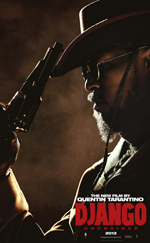
Django Unchained

Django Unchained - Dir. Quentin Tarantino (2012)


Django…Django, have you always been alone?
Django…Django, have you never loved again?

Film geeks had to be on pins and needles when word got out that Quentin Tarantino would write and direct a Western. The Spaghetti Western was a tremendous influence on Kill Bill and Inglourious Basterds so fans were eager to see QT tackle the genre outright. He does not disappoint with the vibrant and violent Django Unchained.

The titular Django (Jamie Foxx) is a runaway slave separated from his wife Broomhilda (Kerry Washington) by their wicked master. He is rescued from a chain gang by German bounty hunter Dr. King Schultz (Christoph Waltz), who requires Django's assistance in tracking down a trio of outlaws known as the Brittle Brothers. A newfound friendship quickly blossoms and Schultz agrees to help Django find his wife. Unfortunately, she is now in the possession of a particularly nasty plantation owner named Calvin Candie (Leonardo DiCaprio).

Just as he has done in the past, Tarantino litters the narrative with references to the movies he loves with Django Unchained serving as a fusion of Westerns and blaxploitation. Tarantino specifically riffs on Sergio Corbucci, director of the original Django, which was a classic Spaghetti Western. Much like Inglourious Basterds, Tarantino took the title and barebones premise of an older Italian picture and injected it with his own unique vision. Franco Nero, the original Django, makes a cameo appearance and receives special thanks in the opening credits. Django isn't the only Corbucci flick Tarantino pays homage to. The montage where Schultz trains Django in the snow covered mountains is a reference to The Great Silence, a rarity of the genre in that it was set during the dead of winter and not under a scorching desert sun. The theme of revenge recalls Navajo Joe, starring Burt Reynolds, as well as Giulio Petroni's Death Rides a Horse, which played a huge part in the genesis of Kill Bill. Another film Tarantino owes a debt to is the controversial Mandingo with its brutal depiction of slaves forced to fight one another. In true Tarantino fashion, Broomhilda's full name is Broomhilda von Shaft, after the German family that previously owned her, which points to her and Django being the ancestors of blaxploitation icon John Shaft.

Tarantino isn't known for providing his films with an original score. He prefers using existing music and the soundtrack is an eclectic collection of anachronistic pop tunes like Jim Croce's "I Got a Name" with hip-hop tracks by Tupac and Rick Ross. In addition, there are the usual pieces from Ennio Morricone and Luis Bacalov whose compositions are synonymous with the Western genre. The opening credits are set to the theme song of the original Django while the end credits use "Trinity (Titoli)," the theme from They Call Me Trinity, a comedic take on the Western starring Terence Hill, who also appeared in the similar My Name is Nobody.

Django Unchained isn't without its problems, not the least of which is Tarantino's atrocious attempt at an Australian accent. The movie certainly feels like one of his messiest works, which could be explained by several factors. QT reportedly took a lax attitude when it came to production and the picture fell behind schedule. The death of Tarantino's long-time editor Sally Menke has to be factored in as well. This is his first picture without Menke and her presence in the editing room is missed. Finally, a lot of material was cut from the original screenplay, including extended backstories for Broomhilda and some of Candieland's denizens. Django's wife suffers the most from these trims as she is reduced to a damsel in distress. It is truly disappointing to see her as such a cipher compared to the strong female characters Tarantino has written before (Jackie Brown, The Bride, etc.). Tarantino does manage to inject his own flair for dark and over-the-top humor exemplified by a Blazing Saddles-style sequence involving the Regulators, the precursors to the KKK.

All those faults are easily overlooked by a winning performance from Christoph Waltz, who earned a second Academy Award for Best Supporting Actor. Django Unchained lives and dies at the feet of the loquacious Dr. King Schultz. Never has the marriage between auteur and thespian been so perfect. Waltz was born to breathe life into Tarantino's stylish dialogue. He exudes an inordinate amount of charisma in every scene. At the same time, there's a subtle layer of shock and seething anger underneath Schultz's whimsical nature due to the prejudice he witnesses. Every hero needs a strong villain to face and Calvin Candie serves that role thanks to Leonardo DiCaprio, who is cast against type as the sinister Southerner. Much like Waltz as Hans Landa, DiCaprio possesses a disarming charm and cherubic visage that belies his propensity for sadism. However, the true antagonist in Django Unchained may just be Samuel L. Jackson as Stephen, the faithful servant to the Candie family. Judging by outward appearances, Stephen could be dismissed as a comical stereotype in the vein of Uncle Remus from "Song of the South." But, his hateful nature is quickly revealed to be downright frightening. In addition the leads, Tarantino rounds out his rich supporting cast with regular collaborators like Zoe Bell, Tom Savini, and Michael Parks alongside Jonah Hill, Walt Goggins, Don Johnson, Bruce Dern, James Remar, John Jarratt, and Tom Wopat.

Django Unchained is a vibrant example that Quentin Tarantino doesn't just make movies, he makes pop art. The film soars on the back of Tarantino's intricately written dialogue and a bravura performance from Christoph Waltz until it builds to a bloody crescendo. "Django Unchained" is my pick for the best film of 2012.

Rating: **** (*****)

Sunday, May 13, 2012

The Avengers

The Avengers - Dir. Joss Whedon (2012)


"You think you're the only superhero in the world? Mr. Stark, you've become a part of a bigger universe…I'm here to talk to you about the Avenger Initiative.

Back in 2008, moviegoers patient enough to sit through the end credits of Iron Man heard those fateful words. Marvel Comics laid out the foundation for a shared cinematic universe that would bring to life some of their most iconic creations. Marvel was doing the unprecedented by launching their characters into their own franchises while building to one uber-franchise in The Avengers. Though it's been five years in the making, it seems like a comic book fans have been waiting a lifetime for Marvel's premiere super-team (sorry, X-Men) to finally arrive. Iron Man director Jon Favreau was given first dibs, but couldn't reconcile how to unite such disparate personalities. Luckily, Marvel found their man in Joss Whedon, the creator of Buffy the Vampire Slayer and Firefly. He's also had previous experience working for Marvel as the writer of Astonishing X-Men and The Runaways. Indeed, his geek credibility made him a popular choice with the notoriously picky fanbase.

Be warned, The Avengers may be difficult to follow if you haven't seen the previous films. It wastes no time in kicking off the plot.

When last we left him, the Norse god of mischief, Loki (Tom Hiddleston), plummeted into the never-ending abyss of space. Rescued by a mysterious cosmic puppet master, Loki arrives on Earth seeking the Tesseract. With it, he hopes to open a portal to transport an alien race known as the Chitauri to conquer the world. SHIELD Director Nick Fury (Samuel L. Jackson) gathers together the only force capable of stopping him, the Avengers, comprised of Iron Man (Robert Downey Jr.), Captain America (Chris Evans), Thor (Chris Hemsworth), the Hulk (Mark Ruffalo), the Black Widow (Scarlett Johansson), and Hawkeye (Jeremy Renner). Loki's job may be easier than he imagined since none of the heroes can get along.

The Avengers is exactly the type of widescreen action expected from a big-budget summer blockbuster.  Fanboys will drool at the chance to watch Iron Man clash with Thor, the SHIELD Helicarrier lifting into the air, and the Hulk attempting (and failing) to lift Mjolnir. The third act of the film features a spectacular battle as alien invaders lay waste to midtown Manhattan. While the idea of extraterrestrials flooding through a portal into a crowded city is reminiscent of Transformers: Dark of the Moon, Whedon is able to craft an exciting action sequences in a way Michael Bay never will. It's not just visual noise and empty spectacle, but a thrilling series of mini-battles. Thor and Cap fighting back-to-back as hammer and shield fly back and forth. Iron Man and Cap tag teaming against the Chitauri with the Armored Avenger bouncing his repulsor rays off the Sentinel of Liberty's shield. Whedon even breaks out a tracking shot done in one uninterrupted take that rivals the intro from Serenity. The camera glides through the air and up the side of a skyscraper as it follows each of the Avengers in their struggles. Most importantly, Whedon makes sure you are emotionally invested in every character.

The majority of superhero films make the mistake of bogging down the narrative with too many characters and The Avengers could have fallen into that habit. But, Whedon is no stranger to working with a large ensemble and nearly everyone brings something unique to the table. No doubt, Robert Downey Jr. is one of the highlights of The Avengers, his quick-witted demeanor is the perfect match for Whedon's jokey, pop culture infused sensibilities. As Tony Stark, Downey gets off some of the funniest lines from calling Thor "Point Break" to pointing out a SHIELD agent is secretly playing Galaga. Iron Man is the most well-known and most successful of the heroes and there was a danger that The Avengers would devolve into the Iron Man Show. Instead, Whedon finds the right balance and plays everyone else (especially the straight-laced Cap) against Stark's snarky demeanor. It's also nice to see Gwyneth Paltrow for a little while as Pepper Potts, especially when she's padding around Tony's penthouse barefoot and in jean shorts.

Chris Evans gives his best performance yet as Captain America. Much like Ryan Reynolds, Evans was known more as a good-looking guy able to pull off comedic roles, but lacking dramatic chops. Unlike Reynolds' flat turn as Green Lantern, Evans gives Cap the pathos of a man, who has lost his family and friends after spending seventy years on ice. He possesses a commanding presence that makes you believe he can bark orders at his teammates and they will follow without question. Cap really is the heart of the film. 

Mark Ruffalo takes over the role of Bruce Banner from Edward Norton. Ruffalo is credited by many critics and fans as giving the best interpretation of Hulk/Banner yet and it's hard to disagree. Here, Banner isn't on a quixotic quest to find a cure, but has embraced a fatalistic acceptance of his curse as the Hulk. Ruffalo is warmer and fuzzier than Norton and brings a dry wit. He shares some fantastic scenes with Downey. As Banner and Stark, they are the two smartest guys on the planet and you can tell they enjoy finally being in the company of an intellectual equal. The Hulk, meanwhile, is the unstoppable engine of destruction and the source of two great punchlines.

Whedon manages to make the Black Widow even more interesting here than her appearance in Iron Man 2. This shouldn't be surprising as Whedon is the master at writing strong female characters. He hints at an intriguing backstory to the former KGB assassin with only a handful of scenes. Unfortunately, her counterpart, Hawkeye, doesn't get anything meaty to do until the final act. Still, Whedon makes you believe a girl with a gun and a guy who shoots arrows belong on the team. Then, there's Clark Gregg as Agent Coulson, who has been the glue uniting the film series. He's mostly been a run-of-the-mill man in black. In Avengers, Coulson is humanized as a giddy admirer of Captain America, gladly bragging about his complete set of vintage Cap trading cards. They are in near mint condition, except for some "slight foxing around the edges."

As Thor, Chris Hemsworth doesn't get as much screen time as his co-stars, but he does give another solid performance as the god of thunder. His "brother," Tom Hiddleston, has a lot more scenes and he chews them up every chance he gets. Loki isn't as nuanced here and he's given a lot of corny supervillain dialogue ("I am burdened with glorious purpose") Yet, Hiddleston is a good enough actor to make it work.

The Avengers isn't a perfect film. There are weaknesses if you search hard enough for them. Though he's revealed to be more of a shady manipulator, Samuel L. Jackson's Nick Fury hasn't grown much since his initial cameo and Jackson is somewhat stiff. Marvel also introduces How I Met Your Mother's Cobie Smulders as Fury's second-in-command, Maria Hill. Unfortunately, she's not given much to do other than spout exposition or have exposition spouted to her. The opening prologue doesn't exemplify the greatness that would come later. It's a clunky beginning with some stiff dialogue. The alien menaces aren't the most compelling villains and are only there as cannon fodder for the Avengers. It's obvious they needed something for the good guys to fight without taking away too much screen time or too much demand from the audience. The score by Alan Silvestri is generic and slightly disappointing after his excellent work on Captain America: The First Avenger. The Avengers was going out for a memorable score in the vein of John Williams' theme for Superman or Danny Elfman's Batman theme.

In Joss, we trust. The Avengers isn't just the best Marvel movie made thus far. It's the best comic book ever and one of the best blockbusters in recent memory. Whedon brings the action and his trademark knack for lively dialogue and unexpected twists. Marvel has accomplished an incredible feat and I cannot wait for the next series of movies. Maybe then, we can finally hear the war cry of "Avengers assemble."

Rating: **** ½ (*****)

Sunday, August 7, 2011

Captain America: The First Avenger

Captain America: The First Avenger - Dir. Joe Johnston (2011)


"What makes you so special?"
"Nothing. I'm just a kid from Brooklyn."


If the interpretations of Mayan calendars turn out to be false and the world doesn't end in 2012, fanboys will rejoice as they'll be able to witness the glory of The Avengers, in which Marvel's greatest superheroes join forces for the first time in live-action. Before the premiere comic book team (sorry, Justice League) makes its debut, Marvel Studios must place the pieces into play. They laid the foundation with Iron Man and continued to build upon it with The Incredible Hulk and Iron Man 2. This summer, Marvel Studios had the daunting task of breathing life into two of their more challenging characters. One was a Norse god with a magical hammer. Thor was successfully realized in an epic fantasy with just the right amount of fish-out-of-water humor. Next up was Captain America, a product of World War II jingoism that leapt from the minds of creators Joe Simon and Jack Kirby.

The character made his debut in Captain America Comics #1, published by Marvel (then known as Timely) in March of 1941, a year before Pearl Harbor plunged the United States into WWII . The cover famously depicted Captain America punching Adolf Hitler right in the face. It would be easy to ridicule his unwavering patriotic beliefs, his star-spangled spandex, and a garish code-name. William Klein did just that with the absurdist Mr. Freedom, a biting Cold War satire of American culture. Yet, Captain America: The First Avenger deftly deals with those issues without a hint of cynicism and celebrates the Captain's old fashioned values.

It is 1942 and a 98-pound asthmatic named Steve Rogers (Chris Evans) is rejected from enlisting in the Army for the umpteenth time. His best friend, Sgt. James "Bucky" Barnes (Sebastian Stan), tries to console him, but Rogers simply wants to serve his country. He gets his chance when Dr. Abraham Erskine (Stanley Tucci) chooses him as part of a clandestine super-soldier program. The project's overseer, Col. Phillips (Tommy Lee Jones) has serious doubts about this human toothpick, but Dr. Erskine believes in him and so does British liaison, Peggy Carter (Hayley Atwell). Thanks to Erskine's serum and vita-ray procedure, Rogers is transformed into a buff beefcake with strength, speed, and agility beyond those of normal human beings. Erskine takes the secrets of the process to his grave when a Nazi saboteur (Richard Armitage) murders him immediately following the experiment.

The assassin was sent by Johann Schmidt (Hugo Weaving), the recipient of an early version of the serum, which gave him super-strength, a crimson cranium, and the nickname of The Red Skull. Schmidt has formed his own splinter group called Hydra, which employs high-tech weaponry powered by the Tesseract (or Cosmic Cube to the comic book fans), a mystical object said to be from Odin's treasury. Knowing Rogers is their only super-soldier; the government hones his identity as a symbol of national pride as he performs in propaganda reels and USO shows. Dressed in a wool costume, the Captain pleads for citizens to buy war bonds while leggy dancers belt out a show tune penned by lyricist David Zippel and Alan Menken, the composer of classic Disney movies like The Little Mermaid and Aladdin. In a clever meta-textual gag, the comic book character becomes a comic book character with issues of Captain America being read by children and servicemen alike. The Captain eventually makes his way to the frontlines where he battles Hydra alongside Bucky and the internationally diverse Howling Commandos.

There has been a glut of comic book films this year and Captain America lies somewhere in the middle of the pack. It's leaps and bounds above The Green Hornet and Green Lantern, but it's not as strong as Thor or X-Men: First Class. Much like Thor, the story is rushed with the filmmakers primarily concerned with setting up The Avengers than crafting a stand-alone picture. Just when you think you've reached the midpoint of Captain America, you're actually at the climax. There's a lot stuffed into this origin story that introduces numerous characters and builds subplots for later movies. Minor spoilers: Captain America is bookended with the discovery and revival of the Star-Spangled Avenger after spending decades in deep freeze. That's a lot to handle for a single two-hour film. So much so that the movie employs three montage sequences to pare down the narrative. But, the strengths of Captain America outweigh its weaknesses.

Director Joe Johnston has bounced back from last year's critically derided Wolfman with an exciting, four-color adventure that recalls the most underrated comic book adaptation, The Rocketeer, which he also directed. Captain America has a vintage quality that the captures the tone of Raiders of the Lost Ark and the Republic movie serials that inspired it. Not much of a surprise as Johnston studied under the tutelage of George Lucas and Steven Spielberg as a special effects artist on Raiders and Star Wars. There is even a sly Indiana Jones reference ("The Fuhrer digs for trinkets in the desert…"). Johnston isn't a strong action director, but the battle sequences in Captain America are exciting, despite an anti-climactic finale. There's a Where Eagles Dare-style raid in the Alps and it's a joy to see Cap slinging his shield. The screenplay was written by Christopher Markus and Stephen McFeely (The Chronicles of Narnia) with an uncredited rewrite by Avengers director Joss Whedon. Though it tends to fall on the bloated side, the script has plenty of sharp humor and the kind of wicked one-liners that could have only sprung from the Whedon's mind.

The production design is impeccable. It doesn't attempt to faithfully replicate the period, but replicate an exaggerated Marvel-ized version of the times, which could only be described as Art Deco Retro-Futurism, what people of the past thought the future would look like. The highlight is an early staging of the Stark Expo from Iron Man 2 with a mannequin of the Golden Age Human Torch (one of Marvel's first heroes) on display. This isn't the WWII from Saving Private Ryan or Band of Brothers, but a PG accounting with Hydra foot soldiers vaporizing their enemies with chrome-plated laser cannons.

Chris Evans takes on his toughest and highest-profile role to date as the title character. Evans is already known to comic book fans as the Human Torch in Fantastic Four and the skateboarding Lucas Lee in Scott Pilgrim vs. The World. As Johnny Storm, Evans brought a charismatic flair to the otherwise abysmal Fantastic Four. The same can be said for his role in another comic book adaptation, The Losers. Evans had turned down Captain America multiple times before revealing he was simply afraid of playing the part. It's lucky he changed his mind as Evans is excellent in the role. Not only does he have the All-American good looks to play Captain America, he brings the right amount of gravitas. Using the magic of CGI, Evans begins the film as a scrawny weakling constantly beating up by bullies, but never backing down. He is actually more interesting as Steve Rogers than he is as Cap, partly because the majority of Cap's scenes are action-driven rather than dramatic. The most refreshing trait of the character was the fact that he didn't go through an obligatory character arc. The majority of recent comic book films revolve around an arrogant protagonist who must learn humility and responsibility en route to becoming a bona fide hero. Steve Rogers is honorable and virtuous throughout First Avenger, yet that didn't make him any less compelling. Secondly, Cap doesn't treat his newfound powers as a burden. Thus, he does not go through the clichéd turning point of quitting only to take up the mantle again after ten minutes.

The supporting cast is equally good with even the smallest role performed memorably. Hugo Weaving is villainously over-the-top as Cap's arch-enemy, employing the distinctive inflections of eccentric auteur Werner Herzog to his cartoonish German accent. The make-up is excellent too, making the Red Skull a hideous by-product of Aryan genetic engineering. Toby Jones plays the Red Skull's right-hand man, Arnim Zola. Jones subverts the cliché of the sycophantic henchman by injecting a sense of apprehension in the face of the Skull's overwhelming evil. Tommy Lee Jones essentially does Tommy Lee Jones as the Captain's gruff and grizzled commanding officer. Dominic Cooper also turns in a great performance as Iron Man's father, Howard Stark, a Howard Hughes-esque playboy industrialist.

This isn't Captain America's first film. The character was previously brought to life in a pair of 70's made-for-TV movies with Reb Brown as a motorcycle helmet wearing Captain America. There was also a direct-to-video cheapie with Matt Salinger (son of J.D. Salinger) as rubber-eared Captain America who fought an Italian Red Skull. Captain America: The First Avenger is the version fans have been waiting for.

Rating: *** (*****)

Saturday, May 7, 2011

Thor

Thor - Dir. Kenneth Branagh (2011)


Whosoever holds this hammer, if he be worthy, shall possess the power of Thor.

Summer movie season arrives with the booming sound of thunder and the blinding crackle of lightning. That raging storm heralds the arrival of Thor, the latest Marvel superhero to hit the silver screen. This isn't the Mighty Thor's first foray into live-action. He made a laughable guest appearance in the 1988 made-for-TV, Return of the Incredible Hulk, alongside Lou Ferrigno and the late-Bill Bixby. At one point there was talk of another made-for-TV picture with former pro wrestler and one-time Sabretooth, Tyler Mane, in the lead role. Thankfully, the project (which likely would have lived on in infamy next to David Hasselhoff as Nick Fury) never came to fruition.

Thor is arguably one of the trickiest comic book characters to bring to life. You can buy into a rich genius who builds a high-tech suit of armor. Even scientist who mutates into an irradiated monster is somewhat believable. A mythical god of thunder empowered by a magical hammer is a tough nut to crack. Marvel Studios proved they were up to the task by crafting a rousing adventure that seamlessly integrates into their shared cinematic universe.

In Thor, the Asgardians are re-imagined as an advanced civilization inhabiting a wonderland far off in the cosmos, rather than an ethereal realm. Eons ago, their king Odin (Anthony Hopkins) led the Asgardians into battle against the Frost Giants, driving them back to their icy homeworld of Jotunheim. An uneasy truce is established but threatened when a trio of Frost Giants sneaks into Asgard in an attempt to steal an ancient weapon known as the Casket of Ancient Winters. Disobeying his father, Thor (Chris Hemsworth) violently confronts their ruler, King Laufey (Colm Feore) and plunges both races into all-out war.

As punishment, Odin strips Thor of his powers and banishes him to Earth where he is to learn humility. He learns it in spades as the former godling suffers one indignity after another from getting tasered to being struck by a car twice. Thor is found outside a tiny New Mexico town by Jane Foster (Natalie Portman), an astrophysicist working in the fringes of science. She studies wormholes and alternate realities with her mentor, Dr. Erik Selvig (Stellan Skarsgard), and hipster research intern, Darcy (Kat Dennings). Meanwhile, Thor's brother, Loki (Tom Hiddleston), makes his play for the throne when Odin falls into a deep coma (the Odinsleep).

Marvel has enlisted their most accomplished filmmaker to date in Kenneth Branagh, an actor and director known primarily for his Shakespearean adaptations. The gods of Norse mythology are not too far removed from the words of the Bard with themes of patricide, betrayal, and jealousy running throughout the film. Much like Iron Man director Jon Favreau before him, Branagh is more concerned with the emotional core with special effects used as an enhancement and not a crutch. The current thought process with developing comic book movies is to utilize a realistic approach to the outlandish characters. Thor embraces its four-color roots and finds plenty of drama and humor from the culture clash between mortals and super-powered beings, from Asgardians in full battle armor walking a dusty Main Street to Thor's anachronistic bouts of gallantry.

As a first foray into big-budget blockbusters, Branagh equates himself well with some thrilling fight sequences and dynamic canted angles. The phenomenal special effects effortlessly capture the majesty of Asgard, which looks like a futuristic take on Lord of the Rings. In fact, an earlier draft of the script by Mark Protosevich set the picture entirely in Asgard and the Viking era. This is the genre ascended onto an epic scale. Asgard is a realm beyond mortal imaginings. The skyline is dominated by the golden, ornate halls of Odin's palace, which is complimented by the shimmering rainbow bridge known as Bifrost and the spinning observatory of Heimdall (Idris Elba), the near-omniscient watchman of the gods.

In the title role, Chris Hemsworth shines just as much as the Asgardian architecture. Primarily known for his brief role as Captain Kirk's father in Star Trek, Hemsworth gives a star-making performance as the impetuous and hot-headed Odinson. He follows a similar trajectory as Tony Stark in that Thor starts off as an arrogant jerk, yet conveys a boisterous charm throughout the story. Tom Hiddleston also gives a breakout performance as the scheming god of mischief. His Loki has much in common with Shakespearean antagonists like Richard III and Iago. This is a master of Machiavellian machinations who is always thinking several steps ahead of his opponents, building layers of lies upon lies. With only a cocked eyebrow and subtle eye movements, you can see the wheels spinning inside his head. Yet, at the heart, he is still a tragic character. He is the overlooked son, living in the shadow of a beloved older brother and desperate to live up tot the high expectations of a demanding father. Hiddleston's Loki is one of the best comic book movie villains, ranked right up there with Heath Ledger's Joker and Terence Stamp's General Zod.

Natalie Portman puts on one of her liveliest performances highlighted by unique line readings that breathe life into some rather pedestrian dialogue. The supporting cast is all excellent with Anthony Hopkins exuding the perfect bluster of the All-Father. As Thor's compatriots, there's Jaimie Alexander as the warrior woman Sif, Ray Stevenson as the hearty Volstagg, Joshua Dallas (channeling Errol Flynn by way of Cary Elwes) as the swashbuckling Fandral, and Tadanobu Asano from Ichi the Killer and Takeshi Kitano's Zatoichi as Hogun the Grim.

Marvel sprinkles in plenty of Easter eggs for the fanboys, such as references to Bruce Banner and Thor's comic book alter-ego, Donald Blake. Stan Lee makes his obligatory cameo as does J. Michael Straczynski, one of the credited screenwriters whose run on Thor was heavily influential to the film. SHIELD Agent Coulson (Clark Gregg) returns, picking right up from the Iron Man 2 coda. He is joined by SHIELD agents Jasper Sitwell (Maximiliano Hernandez) and Jeremy Renner in an uncredited appearance as Clint Barton aka Hawkeye. Despite his brief screen time, Renner deftly exhibits the roguish charm needed to play the Avengers' ace archer. A billboard hangs in the background emblazoned with the motto, "Land of Enchament…Journey Into Mystery," a reference to the title in which Thor made his debut. And was that the Eye of Agamotto displayed in Odin's treasure room? Of course, be sure to sit through the ending credits to catch a glimpse of just where Marvel is going with The Avengers.

If Thor has a weak spot, it is that the story feels as if there is a vital chunk missing. The movie unfolds in such a brisk pace that just when you think you've reached the midpoint, the film is already at the climax. There are moments when it seems as if Marvel is more focused on building towards their grand finale, instead of laying the foundation for a Thor franchise. These are only middling quibbles. Thor may not be on par with Iron Man, but it is the action-packed spectacle expected of a summer blockbuster. Long-time comic book fans will regress into giddy little children at the mere sight of Thor swinging his enchanted Uru hammer, Mjolnir. The beauty of Asgard glimpsed here will only serve to whet their appetites for the possibilities of future installments: Surtur the Fire Demon, Valkyrie, the Enchantress, the Executioner, the Absorbing Man, the Wrecking Crew, and maybe even Beta Ray Bill.

Bring it on Marvel!

Rating: *** ½ (*****)

Monday, August 9, 2010

The Other Guys

The Other Guys - Dir. Adam McKay (2010)


Riggs and Murtaugh. Tango and Cash. Add Hoitz and Gamble to the buddy cop pantheon.

The Other Guys opens in true action film fashion with a rousing car chase through the streets of New York City as top cops, Danson (Dwayne Johnson) and Highsmith (Samuel L. Jackson), run down the perpetrators. A massive amount of property damage is done to bring in a few crooks possessing a miniscule amount of marijuana. Back at the station house, Danson and Highsmith are greeted with a hero’s welcome. None of the accolades are thrown the way of Terry Hoitz (Mark Wahlberg) and Allen Gamble (Will Ferrell). They don’t blow shit up, they don’t get the girls, nor do they make the big arrests.

Hoitz could be doing those things, if not for an embarrassing shooting mishap, which relegated him to desk duty. His partner, Gamble, is a forensic accountant who gleefully enjoys paperwork and has no desire to see any action in the field. While investigating a minor oversight in construction permits, Gamble and Hoitz uncover a Bernie Madoff-style plot by millionaire mogul David Ershon (Steve Coogan) to embezzle $32 billion.

The main cast also features Michael Keaton as the precinct captain who moonlights as the manager of a Bed Bath and Beyond, Eva Mendes as Gamble’s inexplicably hot wife, Ray Stevenson as an Australian mercenary, and an uncredited Anne Heche as a corrupt CEO employing Ershon.

The Other Guys is the fourth collaboration between director Adam McKay and Will Ferrell following Anchorman, Talladega Nights and Step Brothers. Other Guys isn’t as hilarious as the first two films, but it’s several notches above the somewhat crass Step Brothers. As a spoof of buddy cop films, it works better than Kevin Smith’s Cop Out. However, the genre has become such a self-parody of itself that McKay is simply beating a dead horse. Seeing Wahlberg in a slow-mo John Woo shootout isn’t as funny as it should be because the gag has been done to death.

Where the film excels is in the interactions between the lead actors. Wahlberg has given some terribly wooden performances recently in The Happening and The Lovely Bones. He’s better suited for action and comedy and he’s excellent as the hotheaded straight man. Ferrell’s idiot man-child routine wears thin so he wisely tones it down for Other Guys. There’s a slow burn for his character as they slowly reveal the darker side he’s hidden.

McKay tops it off with his own brand of absurdist humor displayed in many hysterical gags sprinkled throughout the film. Some of the funniest bits include: Coogan bribing our heroes with tickets to Jersey Boys, a run-in with a group of horny hobos led by a fellow named Dirty Mike (played by McKay himself), an ending credits sequence utilizing Powerpoint-style animation to explain Ponzi schemes and government bailouts, and Ferrell constantly being hit on by gorgeous women like Brooke Shields (wife of co-writer Chris Henchy).

Rating: ***

Wednesday, August 4, 2010

Astro Boy

Astro Boy - Dir. David Bowers (2009)


Osamu Tezuka has widely been considered to be the god of manga. His dynamic art style and penchant for drawing characters with large, expressive eyes are the images immediately associated with Japanese comics and animation. One of Tezuka’s most beloved creations was the rocket-propelled robot, Astro Boy, who starred in a long-running manga series and several animated shows. Unfortunately, whatever charms Astro Boy possessed were lost in translation for Summit Entertainment’s CG remake.

Set in the year 2108, a privileged few live in the shining metropolis of Metro City, a high-tech city floating above Earth where robots serve the human population. In other words, they live just like the Jetsons. One of the most brilliant minds in Metro City is Dr. Tenma (Nicolas Cage), the head of the Ministry of Science. Along with Dr. Elefun (Bill Nighy), Tenma works under the auspices of the militaristic President Stone (Donald Sutherland) who is constantly ready to go to war.

Tenma has recently discovered a blue energy source and its opposite and far more unstable red energy. While experimenting with the latter, a tragic accident occurs when Tenma’s son, Toby (Freddie Highmore), is completely vaporized. A mournful father tries to replace his dead child by creating a robot duplicate who, at first, believes he is the real Toby. Soon, Tenma realizes Astro Boy will never be able to replace Toby and casts him out just as Pres. Stone demands he be turned over to create new weapons. Astro Boy is cast out and falls to the world below where he’s taken in by a group of orphans scavenging the scraps tossed away by Metro City.

Animation-wise, Astro Boy has been crafted well with some cool visuals and action sequences. However, it lacks any discernable style or charm to set it apart from the rest of the computer animated films being pumped out every year. It doesn’t have the uniqueness or depth that Pixar has achieved on countless occasions. The quirky and squat look of Tezuka’s characters has been washed away in order to placate mainstream Western audiences. The big eyes are gone, but the machine guns in his buttocks are still there.

The formulaic plot is further hampered by heavy-handed political overtones pounded in with the hammer of obviousness. President Stone is pure Neo-Con odiousness who dismisses the namby pamby blue energy for the ruthless and erratic red.

Astro Boy is bland, inoffensive entertainment, but you could do better watching the works of Miyazaki or Brad Bird’s The Iron Giant.

Rating: **

Friday, May 7, 2010

Iron Man 2

Iron Man 2 - Dir. Jon Favreau (2010)


”If you make God bleed, people will cease to believe in him. There will be blood in the water and the sharks will come. All I have to do is sit here and watch as the world consumes you.”

Iron Man was never Marvel’s premiere superhero on the comic book page, but on the big screen he’s their centerpiece. 2008’s Iron Man was a rousing success and set the foundation for creating a singular cinematic universe where Marvel’s heroes exist side-by-side. As with the majority of sequels, Iron Man 2 ups the ante with more action, more FX, and more characters as Marvel Studios marches ever closer to the magnum opus of The Avengers.

Set a mere six months after the original film, Tony Stark (Robert Downey Jr.) is riding high on a wave of newfound fame as Iron Man. He’s more than eager to feed our ultra-modern society’s hunger for celebrity. He stages the Stark Expo, an elaborate science fair, appearing in front of thousands of adoring fans and backed up by a bevy of gorgeous Ironette dancers. But, underneath that flippant, care-free demeanor, all is not well in the House of Stark.

The power core within Tony Stark’s chest is keeping his heart pumping, but is also poisoning his blood, the toxicity levels increasing with each usage of the Iron Man armor. A government subcommittee headed up by the officious Sen. Stern (Garry Shandling) demand that Stark turn over the Iron Man technology to them. Meanwhile, in Russia, a downtrodden physicist named Ivan Vanko (Mickey Rourke) builds his own miniaturized reactor feeding energy into a pair of tendrils. Turns out, Vanko’s father Anton helped Tony’s father, Howard (John Slattery), build the original Arc reactor before being deported back to Russia to live and die in abject poverty.

Vanko fails to kill Stark on a Monaco racetrack, but manages to attract the attention of rival industrialist Justin Hammer (Sam Rockwell). Hammer desperately wants to be Tony Stark, except he lacks the smarts. So he hires Vanko to build him an army of armored warriors and make Iron Man “look like an antique.” Taking hits on all sides, Tony shirks responsibility, handing the company over to Pepper Potts (Gwyneth Paltrow) and finding solace at the bottom of a bottle. After Tony shows up drunk in full armor at his birthday party, his best friend Rhodey (Don Cheadle) steals the Mark II suit and turns it over to the military. Fanboys will giggle with glee as it’s pimped out with an arsenal of weapons into War Machine.

Bolstering this cavalcade of characters is Scarlett Johansson as Tony’s new personal assistant who is actually an undercover SHIELD agent. Fans will know her as the Black Widow. Scarlett busts out an array of MMA and Lucha Libre maneuvers while almost busting out of her skin-tight leather leotards. Samuel L. Jackson’s Nick Fury (who first appeared in a post-credits scene in the preceding film) gets a meatier role as does director Jon Favreau as Tony’s driver/bodyguard Happy Hogan.

Clark Gregg returns as SHIELD Agent Coulson as do Leslie Bibb as reporter Christine Everhart and Paul Bettany as the voice of Tony’s artificial intelligence, JARVIS. Kate Mara makes a one scene appearance as a federal marshal and not as Bethany Cabe as previously rumored. Plus, there’s the obligatory cameo by Stan Lee (one of the best yet).

An ensemble of A-list actors were gathered together for the Iron Man and Iron Man 2 is no different. Mickey Rourke already looks like a comic book character so casting him as Ivan Vanko (a combination of supervillains Whiplash and Crimson Dynamo) was a no-brainer. A tried and true method actor, Rourke researched his role by visiting a Russian gulag and speaking with gangsters and criminals. As Vanko, he’s covered in tattoos and sports a shit-eating grin full of gold teeth. He just may be the most bad-ass physicist to walk the planet. Yes, even more than Stephen Hawking.

Sam Rockwell, who was once in the running to play Tony Stark, is another welcome addition. A master of the art of the smarmy, Rockwell absolutely excels as the underhanded Hammer. He’s one of the few actors who can go tit-for-tat with both Downey and Rourke. Also thrown into the mix is Don Cheadle, replacing Terrence Howard amidst rumors of dissention on the set and an escalating salary. Cheadle fits seamlessly into the cast, confronting Tony at the senate hearing with the meta-textual line, ”I’m here now. Deal with it and move on.”

The excellent performances are not just due to a talented cast, but also to a talented director. As a writer/director/actor, Favreau cut his teeth on the independent film Swingers, which he starred in and wrote. Owning to those indie roots, he knows the importance of story and characters above all else. Favreau has also cited Robert Altman as an influence for giving his actors free reign to improvise during filming. The improvisation is never more evident than in the Howard Hawksian interplay between Tony and Pepper. That freedom has allowed Robert Downey Jr. to bring Tony Stark to life as a deep and fully realized character. He’s also kept Favreau and screenwriter Justin Theroux on their toes with both men having to rewrite the script on the fly throughout production. Theroux is also an actor turned writer. He made a memorable appearance playing a filmmaker in David Lynch’s mindbender Mulholland Drive. He also co-wrote Tropic Thunder which impressed Downey enough to bring him on to the sequel.

The use of such a multitude of actors and characters may be a little worrisome. The downfall of many superhero sequels (Spider-Man 3, X-Men: The Last Stand) is throwing in too many characters and too many plotlines. Thankfully, Iron Man 2 isn’t muddied up by an unwieldy amount of personalities. Each character and subplot is melded into the central narrative and converges towards the climax and resolution. They do not all get the appropriate screen time they deserve, but it works. Well, for the most part…

If Iron Man 2 has any faults, they lie in the saggy middle section. After a rousing racetrack battle between Iron Man and Vanko, the film pumps on the brakes for the second act. Tony alienates those around him while dealing with his illness and issues with his later father who appears in vintage film reels like a hybrid of Howard Hughes and Walt Disney. Whenever superhero sequels come along, those involve always mention how the second movie will be even better because they’ve gotten the origin story “out of the way.” However, Iron Man deftly weaved the origin story into the picture thus making the hero’s journey of Tony Stark making it every bit as important as the action scenes. With the origin out of the way, it seems the filmmakers were unclear as to where to go with Tony Stark. The second act of the sequel treads familiar territory as Tony works in his lab while his enemies scheme behind his back. It unfolds a little too much like the original film.

Favreau may not have the greatest command over action, but what he does here gets the job done. For a big-budget spectacle, Iron Man 2 is surprisingly light on action with only three major set pieces in the film. The opening fight on the racetrack is pulled off well and the final showdown is a wondrous multi-tiered battle with a picture perfect melding of practical and CG effects. The only drawbacks with each sequence are the anti-climactic endings. They build and build then fizzle out at the finish. Iron Man has yet to face a foe that is on equal footing. I suppose we have to wait for inevitable debut of arch-nemesis, the Mandarin, in Iron Man 3 to finally find someone who can really menace our hero.

Iron Man is the crown jewel of the Marvel movie oeuvre. Along with The Dark Knight, it made 2008 the pinnacle year for the comic book movie. If it is all downhill from there, Iron Man 2 makes sure it isn’t a steep drop, but a slight stumble. By the lofty standards of the original film, the sequel doesn’t quite live up to its predecessor. Iron Man 2 feels more like a stepping stone to further the Marvel’s movie universe (which I’ll spoil below) rather than a film to stand on its own. However, it’s still damned good entertainment. Damn, damn good entertainment.

Rating; *** ½

WARNING: SPOILERS AHEAD!

Want to find out what all that talk about New Mexico meant? Stick around until after the credits for a glimpse of Mjolnir, the mighty hammer of Thor.

There are more Easter Eggs to be found in Iron Man 2. The most obvious is the appearance of an incomplete version of Captain America’s shield which could be glimpsed very briefly in the first film.

Look closely at the news report Tony Stark is watching in the SHIELD briefing room. It’s the same report from The Incredible Hulk following his clash with the army on the college campus. Even better, re-watch Hulk and you’ll notice the reporter mentions something about thunderstorms. Hmm…

Saturday, August 29, 2009

Inglourious Basterds

Inglourious Basterds - Dir. Quentin Tarantino (2009)


”…And when the Germans close their eyes at night and their subconscious tortures them for the evil they’ve done, it will be with thoughts of us that it tortures them with…Sound good?”

Quentin Tarantino has dabbled in a variety of genres and given each his own unique stamp. He’s tackled the heist film (Reservoir Dogs), the gangster pic (Pulp Fiction), blaxploitation (Jackie Brown), the drive-in B-movie (Death Proof) and though he only wrote the screenplay, Tarantino has stated that True Romance was his take on the love story. Kill Bill was his stab at the martial arts epic and Spaghetti Western. Now, Tarantino adds his signature to the war movie with the long in development, Inglourious Basterds. More specifically, I’m speaking of the ‘bunch of guys go on a mission during World War 2’ subgenre, taking inspiration from similar films like The Dirty Dozen and Enzo G. Castellari’s original Inglorious Bastards.

With scars around his neck and a country fried hillbilly accent, Brad Pitt becomes Lt. Aldo Raine, the commander of a Jewish unit dropped into enemy territory. Their mission is to kill every Nazi they find. Known as the Bastards, Lt. Raine’s company has put the fear of God into the enemy due to their brutal methods including scalping their victims and carving Swastikas into the lucky few who escape. Also in Lt. Raine’s unit are Sgt. Donny Donowitz (Hostel director Eli Roth), a baseball bat wielding Bostonian, and Hugo Stiglitz (Til Schweiger), a former German soldier imprisoned for murdering Gestapo officers in their sleep. Two unlikely members of the Bastards are B.J. Novak (best known as Ryan on The Office) and the 5’4 Samm Levine from Freaks & Geeks.

Though the Bastards are the title characters of Tarantino’s picture and the centerpiece of the film’s advertising, they really aren’t the main characters. In fact, many of the Bastards disappear without much word about their fates. The lion’s share of the attention belongs to Shoshanna Dreyfus (Melanie Laurent), a Jewish fugitive who survived the massacre of her family, and Col. Hans Landa (Christoph Waltz), nicknamed the Jew Hunter. Having a nickname like that, it’s easy to guess who the villain of the piece is. Shoshanna is the heart of the film and there’s real heartbreak and tragedy throughout her arc. Inglourious Basterds opens with the chilling account of Col. Landa discovering her family’s hiding place underneath the floorboards of a French dairy farm.

Has there ever been a movie villain like Hans Landa? Someone so deliciously evil? The late-Heath Ledger blew audiences away with his Joker and the little known Christoph Waltz appears to be doing the same with his Landa. This is a multi-faceted character that goes beyond simple mustache twirling. His Landa greets you with a smile and friendly chit-chat and somehow it’s both humorous and unnerving. He possesses a disarming charm that actually makes you like him one minute, but then he does something monstrous and you remember he’s a fucking Nazi. Landa is also smart, quite possibly the smartest guy in the movie. His intellect and deductive abilities remind one of Sherlock Holmes and Tarantino plays those allusions up when Landa pulls out a comically large pipe.

As the Bastards cut through the Nazi ranks, Shoshanna has made her way to Paris where she now owns and operates a movie theater. The venue was left to her by an “aunt” who was to be played by Maggie Cheung before her scenes were excised from the final cut. Laurent actually learned how to operate a projector for her role and even screened a print of Reservoir Dogs along with trailers and cartoons. Much to Shoshanna’s chagrin, she is pursued romantically by an overzealous German soldier named Frederick Zoller (Daniel Bruhl) who has become the subject of his own picture after killing hundreds of American soldiers single-handedly. The Nazi high command (including Hitler) will screen the film at Shoshanna’s theater. It is here that both she and the Bastards make their plans to assassinate Hitler and all his cronies.

While Inglourious Basterds is nominally a war movie, Tarantino once again throws in a heavy dash of the Spaghetti Western into the mix. It shouldn’t surprise anyone that he fills Basterds’ score with compositions by Ennio Morricone and other pieces culled from Westerns such as The Alamo and The Big Gundown. The film’s opening chapter feels just like a prologue out of a Sergio Leone movie and is packed with Western iconography from its title (“Once Upon a Time in Nazi-Occupied France”) to a John Ford-style shot through the doorway. During a jailbreak sequence, the Bastards emerge from their hiding spots in a scene reminiscent of the way Henry Fonda and his men were revealed in Once Upon a Time in the West. He finds inspiration of a different sort in a projecting booth shoot-out that ends in a fashion that draws obvious allusions to John Woo’s The Killer.

No matter who Tarantino casts, sometimes the real star of his films is the dialogue. Often, Tarantino’s penchant for pop culture references and long conversations derail the actual plot and come off as self-indulgent. Take a look at the never ending breakfast conversation in Death Proof for a perfect example of that. You’re just waiting for them to shut up so we can get to the car chase. Here, Tarantino leaves you wanting more. He writes his characters like real, three-dimensional characters rather than characters that sound like they’re written by Tarantino, if that makes any sense. Yes, a few times the dialogue could have been easily trimmed, but the majority of the time, he’s able to weave the words in a way that builds the kind of tension I haven’t felt at the movies in a long time. He finds incredibly clever ways to juggle the various languages (French, German, English) that once again works to enhance the overall story. The titular Bastards are the only ones who feel one-dimensional, but that’s not a knock at all. They are cartoon characters (especially Brad Pitt), but damned if they aren’t entertaining.

Writing and directing a period piece certainly helped in reining in Tarantino though he still manages to make plenty of other references that fit the time period and the story. Shoshanna’s theater, for example, screens films from directors like G.W. Pabst and Henri-Georges Clouzot. He also manages to drop in the obligatory references to Leni Riefenstahl.

Despite all the scalping and machine gunning, the film’s highlight for me was a sequence involving Michael Fassbender (fresh off his amazing performance in Hunger) as Sgt. Archie Hicox, a stiff-upper lip British paratrooper and former film critic; Mike Myers under heavy make-up as his commanding officer, and veteran Rod Taylor in a quick cameo as Winston Churchill. There was just something so joyous to this film geek about hearing these men explain UFA in hoity toity aristocratic accents.

Tarantino does get a little too cute with a pair of anachronistic moments. He uses a 70’s style title to introduce Stiglitz that was actually rather amusing. Tarantino also chooses David Bowie’s “Cat People (Putting Out the Fire)” for a sequence with Shoshanna getting all dolled up (applying her own brand of war paint) for the film premiere. The song is the theme from Paul Schrader’s remake of Cat People, a film only Tarantino could like.

Even at a length of two and a half hours, Inglourious Basterds feels like an appetizer for a much bigger film. I don't think QT has ever been able to manipulate the wide range of emotions that he does with Basterds. He brings the action and the funny while never letting us forget the tragic ugliness of war. He's made a fantastic hybrid of the war & Western genres that alternately acts as a love letter to movies, one where two of its heroes are a film critic and a film projectionist. Imagine Cinema Paradiso with machine guns and explosions. Tarantino has already mentioned the possibility of a prequel to flesh out the backgrounds of the Bastards. Whether or not this project will ever see the light of day or fall to the wayside (i.e. The Vega Brothers, Kill Bill anime prequel) remains to be seen. This is easily one of Tarantino’s best films and one of the best releases of 2009.

Also in the picture are the gorgeous Diane Kruger as actress/spy Bridget Von Hammersmark and in voice-over cameos by Samuel L. Jackson (as the narrator) and Harvey Keitel (as Lt. Raine’s commanding officer).

Rating: ****

Wednesday, January 28, 2009

Iron Man

Iron Man - Dir. Jon Favreau (2008)


Iron Man
is the first film produced under the Marvel Studios banner, allowing the comic book company to churn their live-action adaptations in house while giving them tighter creative control. If this spectacularly fun effort is any indication, Marvel made the right decision. The last few Marvel films were the hugely disappointing Spider-Man 3, the mess that was X-Men: The Last Stand, and the, to be blunt, completely retarded Ghost Rider and Fantastic Four (both of them). But, finally, finally, finally, Marvel zombies have a film they don’t have to be ashamed about.

It’s been a long, hard road to the big screen for Tony Stark. Noted comic book fan Nicolas Cage and noted kook Tom Cruise were both in serious running to play the character. Neither choice panned out nor did Nick Cassavetes who was attached to direct from a script by Smallville creators Alfred Gough and Miles Millar. This was definitely a fine example of, “Everything happens for a reason.” Jon Favreau hopped on board as director and fought for Robert Downey Jr. as his star, despite both men’s lack of experience in big-budget blockbusters. Shock of all shocks, Favreau made the decision to put characters and story first while remaining faithful to the original source material. I know, crazy idea, don’t know if it’ll catch on. The only real deviations from the comic are the updated locale change of Iron Man's origins from Vietnam to Afghanistan and the change of Stark's butler, Jarvis, into an advanced AI system voiced by an uncredited Paul Bettany.

In the most surprising move, Favreau cited Robert Altman as an influence in his process of filmmaking. Who would have thought I'd be saying Robert Altman and superhero movie in the same sentence? Five different screenwriters may have had a hand in the script, but much of the dialogue comes from improvisation from the A-list cast. Owing much to Favreau's experience on Swingers and Made. They don't treat the origin story as something that's forced upon. That they have to tell it before the real action starts. It isn't the overly long, slightly clunky preamble from Batman Begins.

Downey absolutely inhabits the character. He IS Tony Stark. Downey definitely taps into his past as a good-time boy to perform as the hard partying billionaire. His genius industrialist is more Richard Branson than Bill Gates. Unlike other superheroes, Tony Stark never wallows in a sea of forced angst. There's just the right mix of drama, conflict, and humor. Dude has a stripper pole built into his private plane, for Odin's sake. And whoever thought Tony should listen to Suicidal Tendencies? Kudos to you, sir. They've also done a splendid job in setting up Tony's eventual fall from grace as everybody involved have all but confirmed that the inevitable sequel would be based on the "Demon in the Bottle" storyline.

Some purists might complain that Tony Stark was never this much of a smart aleck, but Tony Stark was never this interesting. Downey is just on and everybody else in the film is attempting to play catch up. I'm not that big a fan of Gwyneth Paltrow, but she's the liviest and hottest she's ever been with her Howard Hawks-esque interplay with Downey. Terrence Howard didn't have much to do, so we'll have to wait for the sequel for him to get a meatier role.

Jeff Bridges is just fuckin' on as Obadiah Stane. Who better to be a thorn in the Golden Avenger's side than an evil Big Lebowski? It's a credit to him and Downey when they can make a minor bit involving a pizza box one of the film's more enjoyable scenes. I kept waiting for the Iron Monger to run screaming into the night, "He peed on my rug!"

Favreau isn't quite the most stylish in the visual department. The final battle between the iron warriors was slightly disappointing. Still, the CGI is great (with only one or two iffy shots) and the practical armors designed by Stan Winston are incredible. Adding frosting tot the cake, the filmmakers throw a few bones for the fanboys such as the foreshadowing of Rhodey becoming War Machine ("Next time, baby"), the introduction of S.H.I.E.L.D., a Mandarin reference (The Ten Rings), Stan Lee's best cameo ever, and the theme from the 1960's Iron Man cartoon as Rhodey's ringtone. Hell, even the ending credits are awesome.

If I have any tiny nits to pick, it is the rather generic score, which was passable if not unremarkable. Also, as great as Jeff Bridges was, I thought the villain was a bit weak. That may be a problem for the sequels as Iron Man has a decent rogues gallery, but none of them are particularly cinematic, save for archnemesis, The Mandarin.

I was expecting Iron Man to be a great flick, but I had no idea it would whoop this much ass and be one of the best comic films ever. Taken on the surface, Iron Man is pure, undiluted, unadulterated, popcorn entertainment. The script may not be the most innovative, but it's strong and elevated by great performances across the board. It's the rare action film that wins at both the critical and financial fronts. Lately, a lot of these big-budget spectacles have run 2 1/2-3 hours and most of the time, the films drag and feel arbitrarily stretched out. Iron Man runs just over 2 hours and I wouldn't have minded one bit if they tacked on an extra 15-20 minutes.

Rating: ****

Sunday, January 4, 2009

The Spirit

The Spirit - Dir. Frank Miller (2008)


I wouldn´t presume to know what the late-Will Eisner would think of Frank Miller´s adaptation of his most renowned character. Suffice to say, I´d wager he might have the same befuddled expression on his face as I did as this bizarre concoction unfolded across the screen at my local multiplex.

Eisner is widely considered to be one of the pioneers of the comic book medium. The Spirit began life in 1940 as a Sunday newspaper comic strip. It was part-film noir, part-adventure with dark and lighthearted moments throughout its run. Eisner never dumbed down his creation, aiming for an adult audience. He revolutionized comic composition by freeing the strip from the confines of the typical panels used by other cartoonists. Eisner even coined the term ´graphic novel´ (used so frequently nowadays) to describe his semi-autobiographical book, A Contract with God.

Comic book fans know Frank Miller best for his magnum opus, The Dark Knight Returns, which many list as one of the greatest comics ever written and is mentioned in the same breath as the equally heralded Watchmen (which was released the same year). Miller´s work on Daredevil was largely the basis for the character´s much-maligned feature film while his Batman: Year One was certainly influential on Batman Begins. After a poor experience writing the scripts for Robocop sequels, Miller personally stayed away from Hollywood until Robert Rodriguez called to co-direct the big-screen adaptation of Sin City. Hot on its heels, Miller´s 300 was faithfully recreated by Watchmen director Zack Snyder and met with equal success. So it was only a matter of time before somebody gave Miller a chance to go solo.

Miller considered Eisner a friend and mentor. Conversations between the pair were published in Eisner/Miller, a comic book equivalent to Hitchcock/Truffaut. Miller took on the daunting task of bringing the Spirit to life mostly because he didn´t want somebody else ruining the character. A previous version filmed for television in 1987 was so bad it made Eisner´s "toes curl." From then on, Eisner was staunch in his refusal to allow anyone else to do it again. He rejected proposals to give the titular character superpowers or put him in superhero tights. Miller vowed to remain faithful and was even going to title the film, "Will Eisner´s The Spirit." I have no idea what changed his mind, but this is "Frank Miller´s The Spirit" all the way.

Our hero, played by Gabriel Macht, is Denny Colt, a beat cop who is gunned down, but somehow comes back to life. In the comics, Colt allowed everyone to still believe he was dead and adopted the alter-ego of the Spirit. He put on a blue three-piece suit, matching fedora, and a domino mask in order to fight crime in Central City. His origin remains mostly the same except he wears all black with a blood red tie. The Spirit´s arch-enemy is the Octopus, a mysterious crime boss whose face was never revealed in the strips. He was only recognized by a pair of purple gloves with yellow stripes. Here, he´s Samuel L. Jackson who wears a variety of outlandish outfits in his attempts to conquer the world. He constantly talks about eggs for some reason. Don´t ask. Oh, have I mentioned both men are invincible? Through some sort of cockamamie science project, the Spirit and the Octopus are rendered virtually indestructible. This is evidenced at the start of the film when the two engage in a one-on-one fistfight that´s usually saved for the climax. It isn´t just a fight, but a Looney Tunes horror show as the Spirit punches the Octopus in the face about two dozen times to no effect. They smash each other with several large objects including (literally) the kitchen sink. The battle culminates in the Octopus braining the Spirit with a toilet, then gleefully cackles, "C´mon, toilets are ALWAYS funny!"

This one fight largely sums up just about everything that is wrong with this picture. First off, any sort of suspense the audience might have is killed off because we know neither lead can be. Uh-oh, the Spirit just got pushed out a window. No worries, he can´t be killed. He just got stabbed with a sword? Riddled by a machine gun? The Spirit just shakes it off. Secondly, the fight runs far too long and the same can be said for the majority of the film. Some people love to hear the sound of their own voice. Frank Miller seems to be a man who loves to hear actors speak his lines. He packs in tons of dialogue leading to an overly talky film. Scenes and conversations go on and on with no point whatsoever. One minute, the Spirit is delivering a gruff, hard-boiled voice-over in the vein of Raymond Chandler, the next, he´s bantering with his colleagues in the style of a screwball comedy. Miller never seems to make up his mind whether he wants The Spirit to be a dark film noir, a frothy adventure or a campy comedy.

The film´s most infamous moment comes when the Spirit is captured and tied to a dentist´s chair, ready for torture. The Octopus emerges from behind a red curtain dressed in a Nazi officer´s uniform replete with monocle. There´s Nazi paraphernalia everywhere and the set looks like a commedia dell´arte remake of Triumph of the Will. It´s almost amusing in a WTF kind of way, but Miller drags the proceedings beyond the point of tolerance as the Octopus commits the cardinal super-villain sin. He monologues. Yes, this is the point in the movie where the bad guy reveals his origins and his detailed plans for world domination. I kept waiting for those folks from Monty Python and the Holy Grail to show up and scream, "Get on with it!" Ironically, the Spirit remarks that he's just plain "bored" by his nemesis. So am I, Spirit. So am I.

The crux of the story revolves around the Octopus´s endeavors to acquire the Blood of Herakles which will complete his transformation to immortality. By the time it´s all revealed, the audience has long since stopped caring. At least, there´s plenty of eye candy for the men. Miller has shown he has a strong predilection for sultry vixens and he makes sure there´s a wide assortment of beautiful ladies, each one falling head over heels for the masked protagonist. At the head of the class is Sand Saref (Eva Mendes), a world-class thief and the childhood sweetheart of the Spirit. However, the Spirit´s heart seems to belong to Ellen Dolan (Sarah Paulson), a doctor and daughter of the police commissioner (Dan Lauria). She´s the only good girl in the film. There´s Morgenstern (Stana Katic), an eager and earnest rookie cop. Working for the other side of the law are the Octopus´s girl Friday, Silken Floss (Scarlett Johansson), and a dagger throwing belly dancer assassin named Plaster of Paris (Paz Vega). Finally, Jaime King appears in several interludes as the spectral siren, Lorelei Rox.

The ensemble cast also includes an army of dim-witted clones (each played by Louis Lombardi) who serve as the Octopus´s henchmen. These goofs are like something out of Batman. I'm not talking about the Christopher Nolan version or the Tim Burton incarnation, but the cartoonish Adam West series. Remember when the Joker would show up with goons adorned in black shirts with names like ´Tee-Hee,´ ´Ha-Ha,´ and ´Ho-Ho´? Well, these guys have names like ´Phobos,´ ´Nervos,´ and even ´Huevos´ and ´Rancheros.´ I´d call them comic relief, except I didn´t find them to be funny at all.

Miller uses the same green screen techniques from Sin City to create a stylish world cut from the same cloth. He highlights bright colors, such as red, and sprinkles in silhouette shots. Taken individually, they look great, but there´s no flow from scene to scene, especially during action sequences. It looks like they strung together a bunch of comic book panels without bothering to create transitions in between.

The acting is all over the place. Some actors seem to take the film seriously while others just ham it up. Jackson chews through his scenes like a piranha and normally that´s entertaining enough, but (just like his director) he´s just far too excessive for his own good and working with such flat dialogue didn´t help. As the lead, Macht is far too bland to really be effective as the square-jawed hero. Sarah Paulson is the only actor in the entire movie that plays their character as an actual human being.

2008 was a big year for comic book films. They started out strong then fizzled out as time progressed. Iron Man and The Dark Knight were both faithful translations and did gangbusters at the box office. Wanted wasn't quite as faithful to the source material, but was still a fun action flick. By year´s end, fanboys only got lackluster efforts like Punisher: War Zone and The Spirit.

I would have been fine with Frank Miller turning The Spirit into a spin-off of Sin City. It wouldn't have bothered me too much if he decided to do the movie as a tongue-in-cheek camp cartoon. I just wished Miller would have made up his mind. The Spirit suffers from an inconsistent tone and a complete lack of direction. The film goes nowhere fast and comes off as a self-indulgent exercise of unrestrained lunacy.

Rating: * 1/2

Friday, November 28, 2008

Star Wars: The Clone Wars

Star Wars: The Clone Wars - Dir. Dave Filoni (2008)


George Lucas captured lightning in a bottle with the original Star Wars trilogy, a franchise obsessively beloved by millions of fanboys (I’m one) for decades. New Star Wars is as beloved as New Coke and Crystal Clear Pepsi. The animated Clone Wars feature fits in between Attack of the Clones and Revenge of the Sith both in terms of continuity and quality. The plot is a needlessly complicated knot of storylines and is only there to service an endless string of action sequences. It’s a contrived and predictable mess with no reasons at all to become emotionally invested in any of the characters.

The action itself is simply empty noise and a relentless assault on senses too overwhelmed to comprehend what is actually happening on screen. The animation is as wooden as the awful dialogue. George Lucas, if you only knew the power of rewrites.

The Clone Wars version of Anakin shows no signs of eventually walking down the path of the Dark Side, but he’s still a better actor than Hayden Christensen. Younger Star Wars fans will be amazed by the eye candy, but this fanboy would rather be thrown into the Sarlacc Pit and slowly digested for over a thousand years.

Rating: * ½