Showing posts with label Tom Savini. Show all posts

Friday, April 19, 2013

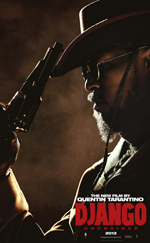
Django Unchained

Django Unchained - Dir. Quentin Tarantino (2012)


Django…Django, have you always been alone?
Django…Django, have you never loved again?

Film geeks had to be on pins and needles when word got out that Quentin Tarantino would write and direct a Western. The Spaghetti Western was a tremendous influence on Kill Bill and Inglourious Basterds so fans were eager to see QT tackle the genre outright. He does not disappoint with the vibrant and violent Django Unchained.

The titular Django (Jamie Foxx) is a runaway slave separated from his wife Broomhilda (Kerry Washington) by their wicked master. He is rescued from a chain gang by German bounty hunter Dr. King Schultz (Christoph Waltz), who requires Django's assistance in tracking down a trio of outlaws known as the Brittle Brothers. A newfound friendship quickly blossoms and Schultz agrees to help Django find his wife. Unfortunately, she is now in the possession of a particularly nasty plantation owner named Calvin Candie (Leonardo DiCaprio).

Just as he has done in the past, Tarantino litters the narrative with references to the movies he loves with Django Unchained serving as a fusion of Westerns and blaxploitation. Tarantino specifically riffs on Sergio Corbucci, director of the original Django, which was a classic Spaghetti Western. Much like Inglourious Basterds, Tarantino took the title and barebones premise of an older Italian picture and injected it with his own unique vision. Franco Nero, the original Django, makes a cameo appearance and receives special thanks in the opening credits. Django isn't the only Corbucci flick Tarantino pays homage to. The montage where Schultz trains Django in the snow covered mountains is a reference to The Great Silence, a rarity of the genre in that it was set during the dead of winter and not under a scorching desert sun. The theme of revenge recalls Navajo Joe, starring Burt Reynolds, as well as Giulio Petroni's Death Rides a Horse, which played a huge part in the genesis of Kill Bill. Another film Tarantino owes a debt to is the controversial Mandingo with its brutal depiction of slaves forced to fight one another. In true Tarantino fashion, Broomhilda's full name is Broomhilda von Shaft, after the German family that previously owned her, which points to her and Django being the ancestors of blaxploitation icon John Shaft.

Tarantino isn't known for providing his films with an original score. He prefers using existing music and the soundtrack is an eclectic collection of anachronistic pop tunes like Jim Croce's "I Got a Name" with hip-hop tracks by Tupac and Rick Ross. In addition, there are the usual pieces from Ennio Morricone and Luis Bacalov whose compositions are synonymous with the Western genre. The opening credits are set to the theme song of the original Django while the end credits use "Trinity (Titoli)," the theme from They Call Me Trinity, a comedic take on the Western starring Terence Hill, who also appeared in the similar My Name is Nobody.

Django Unchained isn't without its problems, not the least of which is Tarantino's atrocious attempt at an Australian accent. The movie certainly feels like one of his messiest works, which could be explained by several factors. QT reportedly took a lax attitude when it came to production and the picture fell behind schedule. The death of Tarantino's long-time editor Sally Menke has to be factored in as well. This is his first picture without Menke and her presence in the editing room is missed. Finally, a lot of material was cut from the original screenplay, including extended backstories for Broomhilda and some of Candieland's denizens. Django's wife suffers the most from these trims as she is reduced to a damsel in distress. It is truly disappointing to see her as such a cipher compared to the strong female characters Tarantino has written before (Jackie Brown, The Bride, etc.). Tarantino does manage to inject his own flair for dark and over-the-top humor exemplified by a Blazing Saddles-style sequence involving the Regulators, the precursors to the KKK.

All those faults are easily overlooked by a winning performance from Christoph Waltz, who earned a second Academy Award for Best Supporting Actor. Django Unchained lives and dies at the feet of the loquacious Dr. King Schultz. Never has the marriage between auteur and thespian been so perfect. Waltz was born to breathe life into Tarantino's stylish dialogue. He exudes an inordinate amount of charisma in every scene. At the same time, there's a subtle layer of shock and seething anger underneath Schultz's whimsical nature due to the prejudice he witnesses. Every hero needs a strong villain to face and Calvin Candie serves that role thanks to Leonardo DiCaprio, who is cast against type as the sinister Southerner. Much like Waltz as Hans Landa, DiCaprio possesses a disarming charm and cherubic visage that belies his propensity for sadism. However, the true antagonist in Django Unchained may just be Samuel L. Jackson as Stephen, the faithful servant to the Candie family. Judging by outward appearances, Stephen could be dismissed as a comical stereotype in the vein of Uncle Remus from "Song of the South." But, his hateful nature is quickly revealed to be downright frightening. In addition the leads, Tarantino rounds out his rich supporting cast with regular collaborators like Zoe Bell, Tom Savini, and Michael Parks alongside Jonah Hill, Walt Goggins, Don Johnson, Bruce Dern, James Remar, John Jarratt, and Tom Wopat.

Django Unchained is a vibrant example that Quentin Tarantino doesn't just make movies, he makes pop art. The film soars on the back of Tarantino's intricately written dialogue and a bravura performance from Christoph Waltz until it builds to a bloody crescendo. "Django Unchained" is my pick for the best film of 2012.

Rating: **** (*****)

Thursday, September 9, 2010

Machete

Machete - Dirs. Robert Rodriguez & Ethan Maniquis (2010)


”If you’re gonna hire Machete to kill the bad guy; you better make damn sure the bad guy isn’t you!”

As the summer movie season draws to a close, the studios can only offer movie-going audiences the scraps of its production slate. All the big blockbusters like Iron Man 2 and Inception have already been released, leaving the doldrums of August and September with films like The Switch and Vampires Suck. Thankfully, a pair of flicks has hit theaters to save us from the dregs. I’m speaking of Piranha 3D and Machete, both of which are throwbacks to the bygone days of drive-ins and B-movies. Also, both movies are drenched in violence, gratuitous nudity, and a wry sense of humor.

Machete began life as one of the mock trailers for Robert Rodriguez and Quentin Tarantino’s ode to exploitation films, Grindhouse. The money shot of the trailer featured Danny Trejo flying through the air on a motorcycle with a mini-gun attached to it as everything explodes behind him. If that didn’t make you want to see a full-fledged Machete film, then you must not have a pulse.

Trejo is one of the most recognizable character actors working today thanks to a body littered with tattoos and a weathered face that looks like he was carved from well-worn granite. He spent over a decade in prisons like San Quentin and Soledad before going legit and getting into the movie industry thanks to ex-con and Reservoir Dogs star Eddie Bunker. Trejo’s first job was for 1986’s Runaway Train as a bit player and boxing trainer for Eric Roberts. Since then, he’s seen as a heavy in films like Heat, Con Air, and Desperado, his first collaboration with Rodriguez. It was then that Rodriguez was inspired to write the original screenplay for Machete with Trejo using his prowess with bladed weapons for good, instead of evil.

The prologue begins with Machete, a hard-assed Federale, heading into a showdown with the ruthless drug lord Torrez (Steven Seagal with a noticeable paunch). The opening has about half a dozen decapitations and a naked woman pulling a cell phone out of a very secure area of her body. That pretty much sets the wild tone for the rest of the film. Torrez murders Machete’s wife and leaves him for dead. Also, every time Seagal draws his sword, we hear the bionic sound effect from The Six Million Dollar Man.

Of course, Machete survives and three years later, he has relocated to Austin, Texas where he ekes out a modest living as a day laborer. He befriends Luz (Michelle Rodriguez), a taco vendor who runs an underground network to provide work and safe harbor for illegal immigrants. Both of them are being watched by Sartana (Jessica Alba), a sympathetic agent for ICE (Immigration and Customs Enforcement).

One day, Machete is approached by wealthy businessman Booth (Jeff Fahey) for a lucrative job. Not knowing who he really is, Booth hires Machete to assassinate Senator McLaughlin (Robert De Niro), a Texas politician running a no-tolerance campaign against illegal immigrants. He compares them to parasites and terrorists and advocates an electrified border fence. The Senator is in league with Lt. Von Jackson (Don Johnson), a fanatical border patrolman and leader of a pack of vigilantes that make the Minutemen look like the Girl Scouts. As it turns out, Booth is actually McLaughlin’s campaign aide and is framing Machete to drum up support for his boss in the election. On top of that, all the bad guys are working for Torrez. It’s the kind of excessively complicated plot hilariously lampooned in another exploitation homage, Black Dynamite.

Just to get it out of the way, yes, Machete is a film touching upon hot button topics. While it is obvious where Robert Rodriguez’s sympathies lie, you could hardly call it a politically charged movie. It is hard to take any accusations against the film seriously since the film hardly takes itself seriously. It is doubtful Machete will incite a race war with Mexicans riding into battle in lowriders armed with rocket launchers.

Rodriguez shares directing duties with editor Ethan Maniquis and both thoroughly maintain the picture’s over-the-top tone. Machete dispatches his foes in all manner of gruesome methods. Machete doesn’t just use his namesake weapon; he also utilizes surgical implements and gardening tools. In one scene, he repels down the side of a building using a man’s intestines. Machete isn’t just a fighter; he’s a lover too, bedding down nearly every beautiful lady he encounters. Rodriguez accentuates every love scene by breaking out the 70’s porno music.

Rodriguez and Maniquis know how to shoot action and they know hot to shoot their lovely starlets. Michelle Rodriguez looks particularly sultry with an eye patch and half t-shirt while firing off a double-barreled shotgun. Then, there’s Jessica Alba whose shapely figure is on display during a shower scene though the naughty bits have been strategically hidden.

After making a career of playing anonymous henchmen, Trejo finally gets his chance to shine and he doesn’t disappoint. He fits seamlessly into the lead role. He may not have matinee idol looks, but he has a ‘Don’t F—k with Me’ aura about him. The craggily face and the badass presence are definitely reminiscent of Charles Bronson and Lee Marvin. He’s a man of few words, speaking only in short, terse sentences. Don’t ever ask Machete to send you a text message either. ”Machete don’t text.”

With Trejo as his star, Rodriguez fills out the supporting cast with an eclectic assortment of actors. The oddball selection shouldn’t work, but it does as just about everyone plays their parts to a tee. Don Johnson’s cruel border guard is far removed from the pastel wearing Sonny Crockett and Jeff Fahey is wonderfully odious as the crooked Booth. DeNiro affects a Southern accent not too dissimilar to Max Cady from Cape Fear Many of the director’s usual players are also present in Machete including: Cheech Marin as a shotgun-toting priest, Tom Savini as a hired gun who offers his services with 1-800-HITMAN, and former Spy Kid Daryl Sabara as a wannabe cholo. Lindsay Lohan is cast in type as a drug-addled socialite, but doesn’t seem to understand the joke.

Much like Grindhouse, Machete uses artificial scratches on the film stock to give it that vintage feel. It also recycles several scenes originally shot for the trailer.

Described as ‘Mexploitation,’ Machete is pure ultraviolent schlock. It’s popcorn entertainment for R-rated audiences.

Rating: ***