Tuesday, July 15, 2014

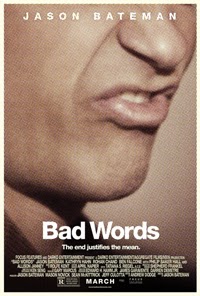
Bad Words

Bad Words - Dir. Jason Bateman (2014)


While he's directed episodes of several television series, Jason Bateman hasn't helmed a feature film until Bad Words, a subversive comedy set in the world of spelling bees. This is assuredly not a documentary in the vein of Spellbound or a feel-good drama ala Akeelah and the Bee.

Bateman is Guy Trilby, a 40-year old misanthrope who enters the Golden Quill, a national spelling tournament for children. It turns out Guy never finished junior high and he exploits a loophole in the rules that state no entrant must have passed the eighth grade. Much to the chagrin of tournament director Dr. Bernice Deagan (Allison Janney) and founder Dr. William Bowman (Philip Baker Hall), Guy is actually a genius and might just win the whole damn thing. Guy's only competition is Chaitanya Chopra (Rohan Chand), an affable 10-year old whose cheery disposition remains unwavering in the face of Guy's utter contempt. Luckily, Chaitanya is saved from Guy's more disreputable actions to disrupt the bee. At one point, he sprays ketchup on a girl's trousers and tricks her into thinking she's having her period.

The screenplay for Bad Words was written by newcomer Andrew Dodge. It made the Black List, a compendium for hot, but unproduced scripts, back in 2011. It's easy to see why studios were gun shy of Bad Words since the protagonist is an unrepentant jerk whose behavior borders on child abuse.

Jason Bateman has excelled at playing the straight man thrust into absurd situations. On Arrested Development, his Michael Bluth was the lone beacon of sanity surrounded by a family of lunatics. In Bad Words, Bateman actively plays against his nice guy image, but still spews every line of venom with his trademark deadpan delivery. He never shows one ounce of gratitude towards Jenny Widgeon (Kathryn Hahn), a hapless online reporter who sponsors Guy and even pays for his meals and accommodations. The two of them engage in casual, awkward sex in which Jenny repeatedly orders Guy not to look at her. Hahn is always terrific in these supporting roles, which require her to fearlessly leap into outrageous situations. Allison Janney and Philip Baker Hall are great foils for Bateman though you can't help feel that they are a bit wasted in such one note roles.

The main thrust of the film centers on the friendship between Guy and Chaitanya, which forms against all odds, but is thoroughly in line with movie conventions. Bateman's experience as a child actor likely helped coax a naturalistic performance out of doe-eyed and precocious Rohan Chand. It's all summed up in a montage set to the Beastie Boys as Guy and Chaitanya run amok in a spree of shoplifting, pranks, and a visit to a prostitute so the kid can see his first boobs. On one hand, you sort of root for the two to bond given Chaitanya's troubles with bullies and his ultra-stern father. Yet, it's a difficult task to remain in Guy's corner when he's hurling racist insults at the boy, ones that aren't even that creative like "slumdog" and "curry hole."

Can you spell, 'misfire?' Bad Words never had the convictions to go full force in creating a truly reprehensible protagonist. It tries hard to make Guy unlikeable while still making him likeable enough for that third act emotional payoff when all is revealed. Bateman has the talent to make it work, but the humor goes for pure shock value rather than anything creative.


Rating: ** (*****)

Sunday, July 13, 2014

Walk of Shame

Walk of Shame – Dir. Steven Brill (2014)


Everybody has a bad day, but chances are they were nothing like the bad day suffered by Elizabeth Banks in Walk of Shame, a raunchy comedy that's a mash-up of The Hangover and After Hours.

Banks stars as Meghan Miles, a news reporter who is in line for a promotion to lead anchor and about to get married. However, everything falls apart in quick fashion. Her handsome fiancé (Oliver Hudson) dumps her while the new promotion goes to someone else. Meghan decides to blow off some steam with her best friends, feisty Rose (Gillian Jacobs) and dim bulb Denise (Sarah Wright), for a night of drinking and debauchery. Meghan spends the night with handsome bartender Gordon (James Marsden). Since this is Los Angeles, he's not really a bartender, he's actually a writer. Either way, he's living in a hip loft that neither a bartender nor a struggling writer could afford.

Meghan receives a late night phone call from her producer (Willie Garson) that the anchor position is open once more after the prospective candidate was fired due to some embarrassing photos. Meghan tries to rush to the studio, but her car (with her purse and ID inside) has been towed away. She's locked out of the building and can't remember which apartment was Gordon's. Oh, and she forgot her cell phone after being frightened by her one night stand's cat. Meghan finds herself wandering the streets in a skin-tight yellow dress, which causes everyone to mistake her for a hooker.

Walk of Shame was written and directed by Steven Brill, whose resume includes Little Nicky, Mr. Deeds, and Drillbit Taylor. That will give you a good clue as to the level of sophistication at play here. Walk of Shame derives much of its humor from racial stereotypes and the humiliation of its starlet. Banks stumbles around and becomes the subject of scorn by judgmental bystanders and a pair of smug police officers (Bill Burr, Ethan Suplee). If they aren't lecturing her, then they're propositioning her, such as a devout Jew believing she was sent by the devil to tempt her or a horny kid who wants to get a look at her boobs. The only helpful individuals Meghan encounters are three gangsters who offer her shelter in a crack house before it's attacked by a rival gang.

To be fair, Banks does her best. Her beauty and winning personality still shine through the dull material. She's a bright woman who is forced to act foolishly for the sake of the screenplay. The central joke involving her figure hugging attire doesn't even work. In L.A., that's dressing conservatively. Out of all the contrivances that force Meghan into her precarious predicament, one is surprisingly clever. Even when she's able to make a call, Meghan can't remember anyone's number since they were saved in her old phone. Welcome to the 21st century. Marsden is well cast, but he isn't given much to do outside of being the genial love interest. Fans of stand-up comedy might enjoy the brief appearances by Bill Burr, Bryan Callen as a sketchy drug dealer, and Tig Notaro as an extremely unhelpful owner of an impound lot. There's also Ken Davitian as a taxi driver and Kevin Nealon as a traffic reporter with an odd personal life.

In more capable hands, Walk of Shame might have had something profound to say about slut shaming and internet infamy. Instead, we get another comedy that goes for the lowest hanging fruit available.


Rating: * ½ (*****)

Sunday, July 6, 2014

Maleficent

Maleficent - Dir. Robert Stromberg (2014)


"Let us tell an old story anew and we will see how well you know it."

So begins Disney's latest attempt to mine their rich archives and re-imagine a classic fairy tale, both of which have become big business. Alice in Wonderland scored over a billion dollars at the box office to get the ball rolling. The House of Mouse has a live-action version of Cinderella coming in 2015 along with remakes of The Jungle Book and Beauty and the Beast in development. Maleficent is Disney's most radical interpretation of the classic tale of Sleeping Beauty, told from the point of view of one of their most iconic villain.

In a medieval fantasy land, there was an enchanted forest known as the Moors, which neighbored the kingdom of man. In the Moors, lived a young fairy named Maleficent (played as an adult by Angelina Jolie) who came across a farm boy Stefan (who eventually becomes Shalto Copley) as he attempted to steal a gem. The two grow close, but further apart as time goes on. Stefan is driven by his ambition to one day become king, a Herculean task given his station in life. Yet, he manages to worm his way into King Henry's (Kenneth Cranham) inner circle, just as his forces suffer a debilitating loss as they attempt to conquer the Moors. The dying King decrees that the one who brings him the head of Maleficent will inherit the throne. Stefan betrays Maleficent by drugging her though he is unable to go through with it. Instead, he cuts off her wings and brings them to the King. Maleficent awakens in horror and the forest grows dark in sync with her pain and anger. Meanwhile, Stefan is crowned the new monarch, marries King Henry's daughter, and they have a child of their own, Aurora (Elle Fanning).

Maleficent makes a grand entrance during the baby's christening and places a curse upon her. On her 16th birthday, Aurora will prick her finger on the needle of a spinning wheel and fall into a deep sleep with true love's kiss the only thing that will awaken her. King Stefan orders all spinning wheels in the land destroyed and for Aurora to live in anonymity with three fairies: Knotgrass, Flittle & Thistlewit (Imelda Staunton, Lesley Manville & Juno Temple).

Maleficent marks the directorial debut of Robert Stromberg, a veteran visual effects artist and production designer who won Academy Awards for his work on Avatar and Alice in Wonderland. Maleficent is certainly dripping with eye candy though anyone who has seen those aforementioned films, along with Oz: The Great and Powerful (another of Stromberg's projects), will see nothing new. The enchanted forest is a glowing world of pixies, goblins, and living trees, but there's not a lot to differentiate it from Pandora or Wonderland. The score by James Newton Howard feels just as rehashed, trying too hard to sound like the work of Danny Elfman.

Maleficent is practically a one-woman show with Angelina Jolie giving a towering performance as the title role. Makeup by Rick Baker accentuates her otherworldly beauty with pronounced cheekbones, cat-like eyes, and her trademark crown of horns. Jolie clearly has a passion for the character and relates to the movie's themes as an adoptive mother and a woman who underwent a double mastectomy. The film positions Maleficent as a tragic figure demonized for decades by patriarchal oppression. The scene in which she loses her wings is an obvious metaphor for sexual assault, but the screenplay by Linda Woolverton (who turned Alice into a Joan of Arc-esque heroine) never fully follows through with these elements. Even at a brisk 97 minutes, the plot feels padded out. The disjointed nature could be chalked up to multiple rewrites (including uncredited work by Paul Dini) and reshoots supervised by John Lee Hancock (The Blind Side, Saving Mr. Banks). The pivotal moment when Maleficent places the curse on little Aurora stands as a highlight with Jolie really sinking her teeth into the role. The rest of Maleficent never lives up to the promise of this sequence.

The second act derails the entire movie as it focuses on Aurora being reared by the bumbling fairies. It's not that these characters are stupid; it's that they are Homer Simpsons stupid. They are so idiotic that there's no possible way Darwinism hadn't already done them in. Maleficent secretly observes them in bemusement while making sure the fairies don't accidentally poison Baby Aurora or allow her to wander off a cliff. Disney was able to cast three splendid actresses for the parts, but have them do nothing but forced slapstick. When they aren't slapping each other like the fairy tale Three Stooges, they're trapped in the uncanny valley as computer generated creatures that never look quite right. The filmmakers also had the opportunity to create a complicated villain in Stefan, but chose to turn him into a one-note baddie. Stefan descends into madness and you wonder if he cares at all about his wife or daughter. He becomes a paranoid shut-in who hears voices in his head. At this point, regicide would be entirely justified. Elle Fanning as little to do as Aurora who is rendered as little more than a wide-eyed china doll. The inclusion of the dragon and Prince Phillip (Brenton Thwaites) are simply perfunctory nods to the original animated picture.

In recent years, Disney has done a fine job in creating stronger female characters after decades of pretty princesses passively waiting for their Prince Charming. Maleficent falls in line with recent releases such as Brave, Tangled, and Frozen, but doesn't do anything interesting with the subject matter aside from presenting a special effects extravaganza. This is the same story as seen before in Wicked, Oz, and Once Upon a Time. There was an aura of menace and mystique with the original Maleficent that disappears in the 2014 version. Darth Vader, Wolverine, and Michael Myers didn't benefit from an origin story and neither did Maleficent.


Rating: ** (*****)

Saturday, July 5, 2014

Transformers: Age of Extinction

Transformers: Age of Extinction - Dir. Michael Bay (2014)


"A new era has begun. The age of the Transformers is over…"

Oh, where to even begin with this movie. We might as well start with the plot, such as it is. Transformers: Dark of the Moon concluded with the heroic Autobots repelling a Decepticon invasion that left Chicago devastated and 1200 humans dead. Age of Extinction picks up five years later as the American government has cut all ties with the Autobots. CIA agent Harold Attinger (Kelsey Grammer) heads up an off-the-books operation that involves hunting down all Transformers, regardless of whether they are Autobots or Decepticons. The robots are harvested for parts and shipped to Joshua Joyce (Stanley Tucci), the brilliant head of a technological conglomerate. Joyce has discovered an unstable metal dubbed "Transformium," which he and Attinger plan to use to create their own army of Transformers. In order to gather more of the metal, Attinger has struck an alliance with the bounty hunter Lockdown (Mark Ryan). In exchange for capturing Optimus Prime (Peter Cullen), Lockdown will give Attinger the Seed, a terraforming device that would create Transformium.

In Texas, Cade Yeager (Mark Wahlberg) is a down-on-his-luck inventor who is struggling to pay the mortgage on his farm and send his daughter, Tessa (Nicola Peltz), to college. He purchases a rundown semi-truck hoping to find something salvageable. The exasperated Tessa can only remark that he's just turning junk into other junk, which could be a perfect metaphor for this entire franchise. The truck turns out to be Optimus Prime and his presence alerts a CIA strike team led by the remorseless Savoy (Titus Welliver). Now classified as fugitives, Optimus and the few remaining Autobots must protect their new human allies.

The human protagonists from the previous movies are gone and forgotten with nary a fleeting reference. Not that the new characters are an improvement, they are all just as bland and uninteresting. Sure, Mark Wahlberg is a better protagonist than Shia LaBeouf, but his being an inventor bears no little impact on the plot. He never invents anything to defeat the Decepticons, he just grabs an alien gun and shoots stuff. On the other hand, producers are wise enough to fill the supporting cast with actors like Stanley Tucci, Kelsey Grammer, and Titus Welliver to lend some legitimacy to the ridiculousness. Grammer and Welliver play standard issue cardboard villains, but Tucci has fun hamming it up as an evil Steve Jobs. If you didn't get that reference, there's a black and white portrait of Tucci in a turtleneck sweater hanging prominently in the background.

As Michael Bay's latest ingénue, Nicola Peltz isn't given any opportunity to differentiate herself from Megan Fox or Rosie Huntington-Whiteley. Peltz is dressed in cutoff shorts just like Fox and even uses a tow truck to assist the Autobots during the climax. There are plenty of shots from between her legs as the camera leers at her thighs and buttocks. The way Michael Bay fetishizes Peltz feels dirty when you consider that her character is 17, despite the actress being 19 in real life. However, that's nothing compared to the sequence in which Bay justifies statutory rape. Tessa's boyfriend, Shane (Jack Reynor), a 20-year old Irish race car driver, pulls out a copy of a "Romeo & Juliet" law allowing the two of them to be together since they dated before he turned 18. Yes, one of the heroes in Age of Extinction, is a creep who carries around a photocopy of a law that allows him to have sex with an underage girl. In a film about giant robots from outer space, why is this subject even being broached?

Congratulations to Michael Bay for hitting all new lows though the usual trademarks of a Bay production are present here. We have the rampant misogyny represented by the fact that nearly every female character in the movie is thin and impossibly gorgeous. The only exception is the sassy, overweight black woman who serves as comic relief. Aside from Peltz, the only other actresses who receive any significant screen time are Sophia Myles as a geologist and Li Bingbing as an executive in Joyce's employ. They are just as one-note as everybody else in the whole series and both women appear and disappear whenever it's convenient for the plot. Li Bingbing's inclusion and an entire third act set in Hong Kong is a blatant attempt to pander to Chinese audiences, who have become increasingly vital to the wallets of studio executives. The product placement throughout Age of Extinction is equally forced with actors shoving Bud Lights and Beats speakers into your face in full IMAX 3D. One would think Bay was doing this with a hint of irony, but it's hard to tell anymore. Next, we have racist caricatures in the form of Drift (Ken Watanabe), an Autobot modeled after a samurai who speaks in Haikus composed of broken English.

Just as he couldn't be bothered to come up with unique personalities for the humans, screenwriter Ehren Kruger couldn't be bothered to do anymore with the Autobots. Hound (John Goodman) fulfills the exact same role as Ironhide that of the grizzled war veteran while Bumblebee gets surprisingly little screen time given his popularity. Lockdown is the most interesting villain in the series, a Transformer who owes no allegiance to either the Autobots or Decepticons. He works for the mysterious Creators (the Quintessons?) who originally built the Transformers as slave labor. Also, long-time fans might be pleased to hear Frank Welker return to voice Megatron who has now been upgraded to Galvatron ala Transformers: The Movie. The designs of the Transformers have also been improved so that the viewer can actually differentiate one robot from the other. The biggest additions to the robotic roster are the fan-favorite Dinobots. Prepare for Devastator-sized disappointment, folks, you will have to wait over two hours into the movie before the Dinobots appear, despite them serving as lynchpins of the marketing campaign.

If you're wondering how Kruger spent his time during the script writing process, it certainly wasn't crafting scintillating dialogue. Nobody was expecting David Mamet in a Transformers picture, but you'd think Kruger would at least put a modicum of effort beyond, "Take that bitch" or "Do you have a warrant?" "My face is my warrant." And it's always thrilling to hear Optimus Prime, the noble warrior that he is, running around rooftops screaming, "I'll kill you."

SPOILERS: At the end of the movie, Optimus shoots off into outer space with the aid of rocket boosters in his feet, which begs the question why didn't he use them before, instead of turning into a truck to slowly save the day? Also, he threatens to kill the Dinobots unless they join forces with him. Then, Optimus lets them loose on the Chinese countryside because it's always a great idea to have mechanical dinosaurs running around completely unfettered.

Story has never been Michael Bay's strong suit. It's traditionally been incidental to the visuals. The last three films suffered from action sequences that descended into incoherent visual noise, but Bay's camerawork seems to grown more patient in Age of Extinction. This allows Bay to make good use of 3D imagery, particularly during a set piece wherein the Cade and Tessa dangle precariously from grabbling cables high above Chicago, a city which shows no evidence of serving as ground zero for an alien invasion a few short years ago. Bay takes a page out of Terrence Malick's playbook by shooting the farm scenes at golden hour with actors silhouetted against the backdrop of a beautiful orange sky. The beauty is almost undone when you realize Bay's idea of small town Texas is a Bostonian, a surfer dude, an Irishman, and a girl who struts around the rural countryside in high heeled boots.

Transformers: Age of Extinction runs two hours and forty-five minutes, a punishing length filled with inane dialogue, illogical plot developments, and relentless stupidity. Revenge of the Fallen still stands as the worst of the bunch, but it has the excuse of being rushed into production during the writer's strike. Age of Extinction has no excuse. However, none of that will mean a damn thing because audiences still eat these movies up with a spoon. The fourth Transformers film scored over $300 million worldwide during opening weekend. If you enjoy Transformers, then more power to you. Personally, I find it sad that this is a resounding success while Edge of Tomorrow, a far better written blockbuster with one of the strongest female characters in recent memory, was a box office flop.


Rating: ** (*****)
Tuesday, June 24, 2014

Joe

Joe - Dir. David Gordon Green (2014)


Indie auteur David Gordon Green won critical acclaim for his first two films George Washington and All the Real Girls. The films were praised for their solemn depiction of small town America and beautiful, yet haunting, imagery reminiscent of Terrence Malick. It shouldn't be a surprise that Malick served as an executive producer on Green's Undertow, which owed a slight debt to Badlands and Days of Heaven. Green gained access to a star-studded cast that included Sam Rockwell and Kate Beckinsale on the low-budget tragedy Snow Angels. Then, Green did a complete 180 and moved into the realm of mainstream comedy. He directed Seth Rogen and James Franco in the smash hit Pineapple Express, but neither of his follow-ups, Your Highness or The Sitter, met with similar success. Cinephiles eagerly hoped Green would return to his roots, which he thankfully did with Prince Avalanche, a remake of a 2011 Icelandic comedy. Green's latest production, Joe, is much darker fare.

Joe is based on the 1991 novel by Larry Brown and centers on the titular Joe Ransom (Nicolas Cage), an ex-con who served time for assaulting a police officer. Joe is content with being a hard-working, blue collar, well…Joe. He's foreman for a group of day laborers whose job is to poison trees in order for the lumber company to chop them down and replace them with stronger pines that will yield a bigger profit. These men see nothing wrong with what they do; it's honest pay for an honest day's work. Nobody sees the irony either in removing the undesirable as deemed by those above their station.

Gary (Tye Sheridan) and his family have just arrived in town and are squatting in an old abandoned house. Gary gets a job working for Joe in order to support his strung out mother and his mute younger sister. They'll get no help from patriarch Wade (Gary Poulter), a drunken lout with a frightening propensity for cruelty and violence. He regularly beats Gary in order to take his wages. What Wade does to a homeless man just to get a swig of cheap liquor is truly chilling.

Just as he did with George Washington and All the Real Girls, Gordon has captured all the beauty and loneliness of this rural area in Texas. The sun baked cinematography of Tim Orr accentuates the countryside full of abandoned cars, rusted railroad tracks, and snarling dogs.

If this is a return to form for Green, it's also a welcome return to the Nicolas Cage of old, the one who scooped up numerous awards for his turn as a self-destructive alcoholic in Leaving Las Vegas. Cage has become a punch line due to his outlandish performances in turkeys like Ghost Rider: Spirit of Vengeance or the infamous Wicker Man remake. It's the rare filmmaker who can channel Cage's lunacy into positive directions as Werner Herzog did in Bad Lieutenant: Port of Call – New Orleans. Here, Cage knows when to restrain himself and when to let loose. He becomes the kindly father figure Gary desperately needs. There's a tender sequence in which the pair bond while searching for Joe's runaway pitbull. Yet, Joe possesses a seething rage that even he is afraid of. Joe can barely contain his own base impulses when confronted by law enforcement or his scarred and violent rival Willie-Russell (Ronnie Gene Blevins).

Tye Sheridan has quickly become one of the finest young actors working today. He's excelled at playing these southern boys in troubled relationships with their father since debuting in Malick's Tree of Life. Everything about his performance is natural. The same can be said for the non-professional actors Green hired to provide local color to the supporting cast. Each one of them has a face that conveys a lifetime of hardships that the most poetic dialogue in the world could never accomplish. Some of the best moments in Joe come when the day laborers are just hanging around and shooting the breeze. There's an easy camaraderie to these scenes that serve as a balm for the heartbreak that is to come.

That heartbreak, both on and off-screen, comes from Gary Poulter, a homeless man the casting director discovered at a bus stop in Austin. Poulter had never acted before and his legitimate alcoholism was a concern for the filmmakers, but he managed to turn in one hell of a performance as the monstrous Wade. Sadly, Poulter's demons got the better of him. He was found dead in February of 2013, two months after the film wrapped. No question Poulter bared his soul. He even got the chance to show off his surprising pop locking skills in a playful scene with Sheridan, which makes their violent relationship so much sadder. Imagine if this man weren't such a monster.

Joe is a prime example of exceptional filmmaking anchored by three outstanding lead performances. Critics have taken to calling the genre "New American Realism," these indie dramas about the underclass that have fallen through the cracks of society. This would unquestionably make for a fine movie marathon with Winter's Bone and Mud.


Rating: *** ½ (*****)

Monday, June 23, 2014

Alan Partridge: Alpha Papa

Alan Partridge: Alpha Papa - Dir. Declan Lowney (2013)


The name is Partridge, Alan Partridge.

The signature character of Steve Coogan may not be familiar to American audiences, but he's been a staple in British comedy for twenty years. He first appeared as an inept sports reporter on On the Hour, a spoof of the news broadcast on BBC Radio 4. Since then, Partridge has graduated from recurring character to lead on his own shows across radio and television along with his very own an autobiography I, Partridge. Coogan's portrayal of Partridge was certainly an influence in his brilliant turn as Tony Wilson in Michael Winterbottom's 24 Hour Party People, a comedic account of the burgeoning Manchester music scene. Now, Partridge has graduated to feature films with a self-titled comedy directed by TV vet Declan Lowney with a script by Coogan, Armando Ianucci (creator of The Thick of It and Veep), Peter Baynham (a co-writer of Borat), and Neil & Rob Gibbons.

Originally released last year in England as Alan Partridge: Alpha Papa, the movie finds Alan Partridge as the host of Mid-Morning Matters, an innocuous radio program on North Norfolk Digital. The station has just been bought by the massive conglomerate of Gordale Media. Fellow DJ Pat Farrell (Colm Meaney), who works the late night shift, is worried about his job and asks Partridge to speak with the new head honchos. When Partridge discovers the pink slip is going to either he or Farrell, he immediately throws his pal under the bus. He even writes "Just Sack Pat" in bold, red letters. Unfortunately, a disgruntled Farrell returns later that night brandishing a shotgun and taking the radio staff hostage. Unaware of his friend's duplicity, Farrell insists Partridge serve as an intermediary for the police's negotiators. Partridge may be woefully unqualified for the job, but that doesn't stop him from turning the tense situation into an opportunity to elevate his star status.

The plot is a bit slight and the hostage situation was clearly the type of action and drama that was necessary to carry the story to a feature length run time. Also, they're late in the game when it comes to lampooning corporate-owned media and awful morning talk radio. The movie really shines when it unleashes Coogan and allows Alan Partridge to just be Alan Partridge. Here's a guy who is self-serving, narcissistic, and with an overinflated opinion of himself. He's a precursor to the oblivious obnoxiousness of Ricky Gervais's David Brent on The Office. Coogan is on top of his game rifling off one-liners and non sequiturs, such as when he fills airtime with inane chatter ("We're asking, what is the worst monger? Iron, fish, rumor, or war?") or offering advice to his flunky Sidekick Simon (Tim Key) ("Never, ever criticize Muslims. Christians only and…sometimes Jews."). Coogan doesn't shy away from slapstick either. In one scene, he accidentally wanders out of the station and attempts to get back in and winds up standing like Buffalo Bill without his trousers.

Colm Meaney gives a wonderfully understated performance as the unstable Pat Farrell. Plus, the supporting cast includes Monica Dolan as a kindly co-worker inexplicably sweet on Partridge and Sean Pertwee as a humorless SWAT team leader.

Alan Partridge doesn't require any previous knowledge of the character. Coogan hits the ground running and you immediately get a sense of who this guy is. Best of all, the screenwriters didn't feel the urge for Partridge to grow as a human being or learn a valuable lesson. He's every bit the buffoon before and after.


Rating: *** (*****)

Sunday, June 22, 2014

Edge of Tomorrow

Edge of Tomorrow - Dir. Doug Liman (2014)


Live. Die. Repeat.

If you ever thought Groundhog Day would be infinitely improved if it had explosions, robotic mech suits, aliens, and a massive body count, then Edge of Tomorrow is the movie for you. The latest action opus starring Tom Cruise was based on the novel All You Need Is Kill by Hiroshi Sakurazaka, which was also adapted into a manga by Viz Media.

The Earth has been invaded by an alien race known as the Mimics. Nearly the entire continent of Europe has fallen to the relentless extraterrestrials. The United Defense Forces hope they will be able to turn the tide with new high-tech exoskeletons. Major William Cage (Cruise) is a glorified publicist for the military. His job is to sell the war and boost enlistment numbers. However, he's never been in combat and when General Brigham (Brendan Gleeson) orders him to the combat zone, Cage attempts to blackmail his way out. Brigham has him arrested, stripped of his rank, and labeled a deserter.

Sent to the frontlines in Normandy, Cage is exposed to the blood of an Alpha Mimic and gains the ability to reset time. Whenever he dies, he goes back to the morning when he awakens at the forward operating base in Heathrow. Of course, nobody will believe him with the exception of Sgt. Rita Vrataski (Emily Blunt), alternately nicknamed the "Angel of Verdun" and the "Full Metal Bitch. Vrataski has become the face of the military propaganda after leading the human forces to their first victory against the Mimics. As it turns out, Vrataski had temporal powers too, which were lost following a blood transfusion.

Edge of Tomorrow might be the best video game movie ever made that's not actually based on a video game. The screenplay by Jez and John-Henry Butterworth (with a rewrite by Christopher McQuarrie) plays with video game conventions by allowing their protagonist to respawn and begin the level all over again. This allows Cage to train indefinitely under the tutelage of Vrataski. He attempts to survive while saving his fellow troops through trial and error, memorizing situations and enemy movements. Despite some sequences being repeated, the movie never feels repetitive. The filmmakers find unique methods to double back over specific scenes to convey new information or show it from a different perspective. They are able to keep the audience on their toes by keeping them guessing as to whether or not Cage has done this a hundred times or just once.

The budding relationship between Cage and Vrataski serves as the heart of the film, a love story that doesn't fall into the standard issue clichés. They share a bond due to circumstances only the two of them could understand, the burden of dying and watching others die countless times. Vrataski is one of the best female characters to be featured in a major blockbuster in a long while. Emily Blunt is more than up to the task to simultaneously portray fierce and vulnerable, not to mention she's drop dead gorgeous. Meanwhile, Cage fits into the two personas that Cruise has excelled at for decades. Cruise isn't ashamed to start Cage as a smarmy and cowardly individual. This is the smirking, cocksure pretty boy we've seen before in Top Gun, Rain Man, The Color of Money, and many more. With Vrataski's help, he transforms into the steely action hero from Mission: Impossible and Jack Reacher. While the supporting cast has a few colorful characters, only Bill Paxton's Master Sgt. Farell stands out. He's a good ol' boy from Kentucky with a sharp tongue and little patience for shirkers.

Doug Liman cut his teeth on low-budget comedies Swingers and Go, before emerging as an incredible action director with The Bourne Identity and Mr. and Mrs. Smith. Unfortunately, production problems on those pictures along with the failure of Jumper left Liman struggling to hit a home run. He does so with Edge of Tomorrow, which he'll follow up with a big-budget version of Splinter Cell. Liman's direction is energetic and enhanced by the gritty cinematography of Oscar winner Dion Beebe. There's a clear homage to Saving Private Ryan with the chaotic invasion of Normandy and it's no coincidence the movie was released on the battle's 70th anniversary. Aliens is briefly referenced when Farell and his J Squad are surrounded by blips that happen to be coming from underneath their position. The digital effects are realistically rendered and the Mimic designed as undulating masses of tendrils ala the squiddies from The Matrix Reloaded.

There's a surprising layer of humor to Edge of Tomorrow that adds to the overall experience. Cruise becomes a human Wile E. Coyote as the film finds interesting ways for him to die. At one point, Cage tries to roll away only to be crushed by a passing truck. When he suffers a debilitating injury, Vrataski casually puts him out of his misery with a bullet to the head.

Edge of Tomorrow is easily the best blockbuster to emerge during this summer's always crowded marketplace. There's action, drama, and comedy built around two stellar performances from Cruise and Blunt. It's a shame the movie hasn't gained any traction at the box office likely due to the general public being burnt out on Tom Cruise. Or maybe it's the generic title, which sounds like the name of a daytime soap. Edge of Tomorrow deserves to be seen by a wider audience.


Rating: **** (*****)

Tuesday, June 17, 2014

Godzilla

Godzilla - Dir. Gareth Edwards (2014)


“The arrogance of men is thinking nature is in their control and not the other way around.”

He was an entire nation’s anxiety about Hiroshima, Nagasaki, and the atomic age distilled into one giant monster. His name was Gojira or Godzilla, as he is more commonly known. His debut film in 1954, released by Toho, spawned dozens of sequels, comic books, action figures, video games, and a host of knockoffs though only Gamera, created by Daiei, would come close to rivaling the big guy’s popularity. Though there’s a general awareness of Godzilla in the States, he doesn’t have the prolific presence he does in Japan. The original movie was released in the U.S. with American actors (such as Raymond Burr) edited in. There was an awful animated series from Hanna-Barbera, which featured the annoying presence of the ultra-cutesy Godzuki. Of course, nobody could forget the disastrous 1998 remake by Roland Emmerich, as much as we want to. So, the bar wasn’t set too high for the new 2014 attempt from Warner Brothers and Legendary Pictures.

Warner surprised Comic-Con attendees in 2012 with a specially made Godzilla teaser utilizing ominous voice-over by Robert Oppenheimer (“Now I am become death, the destroyer of worlds”). To direct, WB chose Gareth Edwards whose previous film, Monsters, was made on a budget of $500,000 with Edwards personally editing and creating visual effects on a laptop. Just how does he fare with a budget over 300 times bigger?

Godzilla starts promisingly enough with newsreel footage of bomb testing and redacted documents. From there, we’re taken to the Philippines in 1999 where scientists Ishiro Serizawa (Ken Watanabe) and Vivienne Graham (Sally Hawkins) are called to investigate a mining collapse. There, they discover a massive skeleton and two egg-shaped pods, one of which has just hatched. The creature, eventually dubbed a MUTO (Massive Unidentified Terrestrial Organism), makes its way to the Janjira nuclear power plant in Japan. The MUTO causes a violent earthquake as it feeds on the power. Plant supervisor Joe Brody (Bryan Cranston) orders an immediate evacuation, but is forced to watch his wife Sandra (Juliette Binoche) die while attempting to shut down the reactor.

In the present, Joe has become obsessed with the tragic accident that the government has written up as a natural disaster. His son, Ford (Aaron Taylor-Johnson), has tried to move on with his life. He’s a bomb disposal expert in the Navy with a beautiful wife Elle (Elizabeth Olsen) and a son named Sam (Carson Bolde). Ford is forced to fly to Japan when his dad is arrested for trespassing. Together, they break into the plant to retrieve research from their old home only to discover a research facility has been built around a cocoon.  A fully formed MUTO springs forth and Joe is killed in the resulting chaos. The other MUTO, a female kept at a repository outside Las Vegas, has also hatched with the two creatures looking to mate and breed. Their presence has awakened an alpha predator in Godzilla, who has slumbered deep beneath the ocean.

Edwards proves he is up for the daunting task of revamping Godzilla. Godzilla still remains relevant as a metaphor for the destructive power of Mother Nature thanks to the Fukushima meltdown, Hurricane Katrina, and the Indian Ocean tsunami, among other recent disasters. Spielberg is a clear influence on Edwards’ directorial choices (Ford Brody? C’mon!) as he teases and teases the ultimate reveal of the King of the Monsters almost to the point of frustration.  The first glimpses we see of Godzilla in the film are back spikes cutting through the Pacific Ocean and passing underneath naval ships. Just as Godzilla tussles with a MUTO, Edwards boldly cuts to news footage of the wrestling match of the century. When Edwards finally lets go of the reins, the action is everything you want from a monster movie. Godzilla whips a MUTO against a skyscraper with his tail and breathes atomic fire. And Godzilla’s eardrum shattering roar must be heard through an IMAX sound system. There are great beats throughout Godzilla, such as a chain reaction of explosions at a Honolulu airport or the sight of red smoke trailing a squad of paratroopers.

Godzilla stumbles when it comes to character development. The screenplay is credited to newcomer Max Borenstein, but featured rewrites from David S. Goyer, Drew Pearce, and Frank Darabont. This is a surprising fact given just how thin the characterizations are. Everyone is a standard archetype from the scientists and soldiers to Elizabeth Olsen as the wife worried for her husband’s safety. Olsen’s beautiful and expressive eyes are perfect to look up in fear at the mere sight of Godzilla. Yet, she’s wasted in the movie along with her fellow female cast members: Juliette Binoche, who’s barely in the thing, and Sally Hawkins, who’s only there to spout exposition. While the trailers make it appear that Bryan Cranston is the main protagonist, he’s merely a supporting character, which is a shame because his loony conspiracy theorist is one of the highlights. The lead goes to Aaron Taylor-Johnson, a fine actor playing one of the blandest heroes to date.

Godzilla starts off strong and packs a powerful third act, but everything in between is shaky. However, the film remains the type of pure spectacle you have come to expect from a summer blockbuster.


Rating: *** (*****)

Monday, June 16, 2014

Grand Piano

Grand Piano - Dir. Eugenio Mira (2014)


Tom Selznick (Elijah Wood) was a brilliant piano prodigy until he had a nervous breakdown while attempting to play a daunting piece composed by his mentor. Five years later, Selznick is set for his comeback performance with a piano custom made for his now-deceased teacher, who unfortunately went all Howard Hughes in his twilight years. The concert itself would be stressful enough without smarmy radio interviewers (voiced by Dee Wallace), snide comments from backstage workers, and Selznick being overshadowed by his gorgeous movie star wife Emma (Kerry BishĂ©). Then, the real bombshell drops when Selznick sees a warning in his music sheets written in bold, red letters. If he misses one note, he will die. If he attempts to warn anyone, his wife will die. Selznick finds out the hard way that there’s a sniper (John Cusack) in the box seats and he means business. Much of the story unfolds afterwards in real time.

That’s the premise for Grand Piano, which may remind you of Phone Booth or Speed on a stage. Yes, the concept is ludicrous and there are plenty of plot points that don’t make sense if you stick down to truly think about them. However, none of that matters because Grand Piano is just so damn fun. Damien Chazelle, who has recently earned acclaim for film festival darling Whiplash, wrote the script with direction by Eugenio Mira, who has clearly been studying his Hitchcock and DePalma. Grand Piano is the type of thriller Hitchcock plied his trade in and the concert hall setting is reminiscent of the climax to The Man Who Knew Too Much. Mira pays homage to DePalma, another Hitchcockian disciple, with split screens and several dazzling tracking shots, including one that follows Selznick through the backstage hallways and another that spins around him on stage. Mira stylishly pans from the orchestra pit and up into the catwalks. Everything is so impeccably blocked so that the audience is never confused about the geography.

Elijah Wood is perfect as Selznick and his doe-eyed expressions are exactly what is needed to convey fear and panic. There’s a great joy in seeing John Cusack cast against type as the obsessed sniper, imagine if his charming hitman from Grosse Pointe Blank went bad. Cusack doesn't appear on screen until the final act, before then he's just a menacing voice speaking through an earpiece Selznick is forced to grab in between movement breaks. Rounding out the cast are character actor Don McManus as the conductor, Downton Abbey's Allen Leech as one of Emma's friends, and Alex Winter of Bill & Ted fame as an all-too friendly security guard.

Grand Piano shouldn't be taken too seriously and the filmmakers luckily realize that too. This is an enjoyable B-movie stylishly made and perfect for midnight madness screenings.


Rating: *** (*****)

Sunday, June 15, 2014

3 Days To Kill

3 Days To Kill - Dir. McG (2014)


Luc Besson is partially responsible for Liam Neeson’s renaissance as an action hero. Now, the prolific French auteur has turned his sights on another aging screen idol in Kevin Costner. Besson serves as writer and producer on 3 Days to Kill while handing over directorial duties to the modern day Renny Harlin, McG.

Costner is CIA agent Ethan Renner, who just recently transferred to Paris to repair his estranged relationship with his ex-wife Christine (Connie Nielsen) and their daughter Zoey (Hailee Steinfeld). An assignment goes tragically wrong when Renner and his team are tasked with taking down the Albino (Tomas Lemarquis), a lieutenant in an organization led by the mysterious Wolf (Richard Sammel). Several agents are killed, a hotel explodes, and the Albino escapes when Ethan collapses in the street.

Doctors alert Ethan that he has an inoperable brain tumor and only has a few months to live. He wishes to spend what little time he has left with reconnecting with Zoey, who isn’t too eager to be with her formerly absentee father. Ethan is soon given an offer he cannot refuse. Vivi (Amber Heard) has been sent by her CIA handlers to kill the Wolf and offers Ethan an experimental serum that can extend his life in exchange for his assistance.

The script by Besson and Adi Hasak is overstuffed with subplots and scattershot in tone. 3 Days to Kill floats between being an action flick, a comedy, and a maudlin drama. In addition to Ethan’s troubles with terrorists and a rebellious daughter, he’s also got a family of Malian squatters in his apartment leading to some cutesy scenes between Costner and a little boy asking for high fives. Amber Heard appears as the femme fatale with an all-too convenient panacea. There’s really nothing to her character aside from a blatantly salacious scene where Ethan meets Vivi while she receives a private show with a stripper. Hailee Steinfeld is good, but you wish she had followed up her big debut in True Grit with movies on a similar level. The action itself isn’t memorable at all and the villains are just generic Euro-trash.

Costner’s sheer presence is the one thing that binds the mish-mash of Besson’s disparate ideas together. He doesn’t possess the physically imposing stature of Neeson, but he conveys the same world weariness with the folksy charm seen in Field of Dreams. When Costner rescues his daughter from would-be rapists and carries her off in his arms, you half-expect the soundtrack to start blaring Whitney Houston.

Costner’s performance is enough to save 3 Days to Kill from being a complete dud, but it’s certainly not enough to recommend.


Rating: ** (*****)