Showing posts with label thriller. Show all posts

Saturday, March 21, 2015

A Walk Among the Tombstones

A Walk Among the Tombstones - Dir. Scott Frank (2014)


The first few months of the year are generally a cinematic wasteland, a time when the studios dump their more forgettable fare into theaters. One of the few bright spots over the last couple years during these doldrums has been Liam Neeson's renaissance as an action hero. Okay, so they aren't exactly high art, but they have been enjoyable popcorn movies. If theatrical releases like Taken 3 and Run All Night weren't enough to whet your Neeson appetite, then you're in luck because A Walk Among the Tombstones is now available on DVD and Blu-ray.

While most of Neeson's action flicks are variations on the same theme, Tombstones is slightly different. Although, you do get the requisite scene in which Neeson warns the villains over the phone about his particular set of skills. This isn't the standard shoot 'em up where Neeson dispatches an army of anonymous henchmen with lethal precision. In fact, the opening sequence refutes that sort of myopic mayhem by showing its ugly consequences.

The film begins in 1991 with NYPD Detective Matt Scudder stopping off at his favorite dive bar for his usual coffee and two shots of hard alcohol. When a trio of thugs robs the place and murders the bartender, Scudder chases them into the streets and guns them down one by one. Tragically, one of his stray bullets strikes a 7-year old girl, killing her instantly.

Flash forward to 1999 and Scudder is now a recovering alcoholic who earns a living as an unlicensed private investigator. He reluctantly accepts a case from drug dealer, Kenny Kristo (Dan Stevens), whose wife was abducted, murdered, and brutally dismembered even after the ransom was paid. As Scudder digs deeper, he discovers the kidnappers have killed before and are targeting criminals knowing they won't contact the police.

Director Scott Frank has a notable resume with writing credits on Get Shorty, Out of Sight, and Minority Report along with an impressive directorial debut with The Lookout. Frank does an admirable job setting the mood for Tombstones with a dour look at the Big Apple. This is a time when New Yorkers were worried about Y2K, unaware that 9/11 would forever change their lives in less than two years. Death and violence are omnipresent. Tombstones may not be gratuitously gory; it can be gruesome, especially for those of female persuasion. This is a movie where women exist as little more than meat to be butchered. Another misstep on Frank's part is a muddled climax that is clumsily cut together and made more awkward by the inclusion of Neeson reading each step of Alcoholics Anonymous.

At least Neeson's presence is more than enough to keep you enthralled. He can do stoic and tortured in his sleep. Plus, it's nice to see Neeson do actual detective work rather than hooking them up to a car battery. And Tombstones isn't relentlessly macabre due to Scudder's budding friendship with a street-wise kid named T.J. (Brian "Astro" Bradley).


A Walk Among the Tombstones is about as involving and richly woven as a typical episode of Law & Order: SVU. Still, it's serviceable enough as a modern noir and a vehicle for Liam Neeson's brand of vengeance.


Rating: ** ½ (*****)

Friday, January 30, 2015

The Guest

The Guest - Dir. Adam Wingard (2014)


Director Adam Wingard has been making a name for himself on the horror scene with segments in the anthology films V/H/S and V/H/S/2. However, it was You're Next, a unique take on the home invasion thriller, that earned Wingard rave reviews. The majority of critics responded positively to its mixture of scares, dark humor, and over-the-top kills.

Wingard is back with The Guest, another genre bending film that's part-action, part-thriller, and an homage to the cult classics of the 1980's. The movie announces its intentions right off the bat with a synth-pop soundtrack (tunes by Sisters of Mercy, Front 242 & Clan of Xymox) and an opening title font straight out of a John Carpenter picture.

The Guest opens with a lone figure jogging in the middle of nowhere. This is David (Dan Stevens), a soldier recently released from a military hospital after serving in Afghanistan. He is paying respect to the family of Caleb Peterson, a deceased comrade from his tour in the Middle East. Before Caleb died, he made David promise to check in on his family. Although Anna (Maika Monroe) is a bit wary, the rest of the Peterson clan is more than welcoming to the handsome and humble young man. David becomes a surrogate son to Mrs. Peterson (Sheila Kelley), a drinking buddy to Mr. Peterson (Leland Orser), and a protector to little brother Luke (Brendan Meyer). When he sees Luke has been bullied, David quickly dispatches the tormentors with Jason Bourne-style efficiency.

In spite of David's good looks and quiet charm, Anna remains suspicious, especially when details from his back story don't check out. Then, there's the private security firm who are alerted when Anna pokes around too closely.

The Guest posits a scenario where the Terminator and Michael Myers aren't inhuman monsters, but an exceedingly handsome Adonis with a sympathetic story. The Petersons don't think twice about letting in someone with his All-American good looks into their home. Ironic since Dan Stevens is British. For those only familiar with Stevens as the pale and gaunt Matthew Crawley on Downton Abbey, his appearance in The Guest will be quite the surprise. Just as it is to Anna when a buff and toned David emerges from a steamy bathroom with only a towel wrapped around his waist. He's Captain America from the dark side. There's a sinister aura to David, but you don't want it to be true. He beats up bullies, dispenses sage advice, and provides Mrs. Peterson a shoulder to cry on. Surely, he's the hero of the film.

Wingard starts things off with a slow burn until the third act when the story goes completely off the rails and becomes an old school action flick. In fact, Wingard and screenwriter Simon Barrett toyed with the idea of including the Cannon Group logo much like Tarantino attaching the Shaw Brothers' logo to Kill Bill. The plot twists in The Guest are the type of absurd contrivances that might have popped up in the works of schlockmeisters such as Albert Pyun or Renny Harlin. The final act only gets better with the addition of Lance Reddick as a hardass military officer on the hunt for David.

This is when Wingard takes a page from the John Woo playbook as armed men storm the Peterson home. The troops unload their machine guns without ever reloading while Reddick's long, flowing trenchcoat ruffles against the wind in slow motion. David even draws a pair of automatic handguns as he's framed by laundry blowing back and forth. You half expect a flock of doves to glide into frame. Wingard puts a cherry on top with a climax set inside a hall of mirrors ala Lady from Shanghai and Enter the Dragon.

The Guest might stretch the boundaries of believability, but damned if it isn't a good time. Wingard has crafted an enjoyable blend of black comedy, action, and horror.


Rating: *** (*****)

Sunday, August 24, 2014

Enemy

Enemy - Dir. Denis Villeneuve (2014)


"Chaos is order yet undeciphered."

2014 was a good year for fans of doppelganger cinema. Richard Ayoade featured Jesse Eisenberg in dual roles in The Double and Denis Villeneuve does the same with Jake Gyllenhaal in Enemy. Villeneuve earned rave reviews for Incendies, which earned an Academy Award nomination for Best Foreign Language Film. The notoriety caught Hollywood's attention and Villeneuve made a big debut with Prisoners, an epic thriller starring Gyllenhaal and Hugh Jackman.

Enemy is a much smaller and intimate drama, loosely based on a novel by Jose Saramago. Villeneuve transplants the action from Portugal to Toronto and casts Gyllenhaal as history professor Adam Bell. Bell leads an uneventful life. He rarely goes out and gives the same lectures (dictatorships, totalitarianism) again and again to a sparse group of students. Even sex with his girlfriend Mary (Mélanie Laurent) seems to be perfunctory. One day, a colleague recommends Adam check out a movie titled Where There's a Will, There's a Way. To his shock, Adam notices a background character that looks exactly like him. After much research, Adam learns his duplicate is Anthony Claire, an actor based in Toronto. After several awkward phone conversations, Adam and Anthony set a meeting.

Any further revelations of the plot would spoil the film. Suffice to say, the lookalikes switch places to see how the other lives. Let's just say, this isn't The Prince and the Pauper. There's no happy ending and nobody learns a valuable lesson.

If Prisoners was an extended episode of Law & Order, Enemy could be described as a lost episode of Twin Peaks with a dash of David Cronenberg to spice it up. "Enemy" is an enigmatic picture that offers plenty of questions and no answers. This is the type of film that is ripe for discussion and multiple interpretations. The movie opens with an unsettling scene in which Anthony attends an underground erotic club involving women crushing tarantulas with their stiletto heels. Imagery of spiders and webs is a recurring theme within Enemy, perhaps as a metaphor for the way in which the twins have been ensnared by the women in their lives. Or maybe it's a symbol for the totalitarian governments Adam lectures about. Again, Villeneuve never spells it out for you.

The connection between Adam and Anthony is never made clear either. Is it a cosmic fluke or are the two simply related by blood? A sit-down with Adam and his mother (Isabella Rossellini) almost points to the latter.

Gyllenhaal turns in a pair of great performances as Adam and Anthony. The dual roles are certainly reminiscent of Jeremy Irons in Dead Ringers. Gyllenhaal is understated as Adam giving him a slight slouch and a subtle uneasiness. As Anthony, he's bolder and more confident. Sarah Gadon, who has been popping up in both David and Brandon Cronenberg's pictures, has the most substantial female role in Enemy as Anthony's pregnant wife Helen. She gives a quiet performance that conveys a world of sadness and desperation.

Enemy might not appeal to an audience seeking conventional cinema. This one is for the arthouse crowd. Villeneuve has crafted an eerie, thought-provoking thriller anchored by the engrossing performances of Gyllenhaal and Gadon.


Rating: *** (*****)

Monday, June 16, 2014

Grand Piano

Grand Piano - Dir. Eugenio Mira (2014)


Tom Selznick (Elijah Wood) was a brilliant piano prodigy until he had a nervous breakdown while attempting to play a daunting piece composed by his mentor. Five years later, Selznick is set for his comeback performance with a piano custom made for his now-deceased teacher, who unfortunately went all Howard Hughes in his twilight years. The concert itself would be stressful enough without smarmy radio interviewers (voiced by Dee Wallace), snide comments from backstage workers, and Selznick being overshadowed by his gorgeous movie star wife Emma (Kerry Bishé). Then, the real bombshell drops when Selznick sees a warning in his music sheets written in bold, red letters. If he misses one note, he will die. If he attempts to warn anyone, his wife will die. Selznick finds out the hard way that there’s a sniper (John Cusack) in the box seats and he means business. Much of the story unfolds afterwards in real time.

That’s the premise for Grand Piano, which may remind you of Phone Booth or Speed on a stage. Yes, the concept is ludicrous and there are plenty of plot points that don’t make sense if you stick down to truly think about them. However, none of that matters because Grand Piano is just so damn fun. Damien Chazelle, who has recently earned acclaim for film festival darling Whiplash, wrote the script with direction by Eugenio Mira, who has clearly been studying his Hitchcock and DePalma. Grand Piano is the type of thriller Hitchcock plied his trade in and the concert hall setting is reminiscent of the climax to The Man Who Knew Too Much. Mira pays homage to DePalma, another Hitchcockian disciple, with split screens and several dazzling tracking shots, including one that follows Selznick through the backstage hallways and another that spins around him on stage. Mira stylishly pans from the orchestra pit and up into the catwalks. Everything is so impeccably blocked so that the audience is never confused about the geography.

Elijah Wood is perfect as Selznick and his doe-eyed expressions are exactly what is needed to convey fear and panic. There’s a great joy in seeing John Cusack cast against type as the obsessed sniper, imagine if his charming hitman from Grosse Pointe Blank went bad. Cusack doesn't appear on screen until the final act, before then he's just a menacing voice speaking through an earpiece Selznick is forced to grab in between movement breaks. Rounding out the cast are character actor Don McManus as the conductor, Downton Abbey's Allen Leech as one of Emma's friends, and Alex Winter of Bill & Ted fame as an all-too friendly security guard.

Grand Piano shouldn't be taken too seriously and the filmmakers luckily realize that too. This is an enjoyable B-movie stylishly made and perfect for midnight madness screenings.


Rating: *** (*****)

Saturday, March 12, 2011

I Saw the Devil

I Saw the Devil - Dir. Kim Ji-woon (2010)


South Korea is the place to go for the true connoisseur of cinema seeking new and exciting films. Some of the best pictures of the past decade have come from South Korea, such as the war epic Tae Guk Gi, the off-beat rom-com My Sassy Girl, and the horror comedy The Host. There's one genre the South Korean filmmakers have lately been able to pull off better than anybody and that is the hard-assed, ultraviolent revenge movie. One need not look any further for prime examples than movies like The Chaser or Park Chan-wook's brilliant Vengeance Trilogy comprised of Sympathy for Mr. Vengeance, Oldboy, and Lady Vengeance. I Saw the Devil isn't quite as successful as its predecessors, but it does provide a gut-wrenching experience on a purely visceral level.

I Saw the Devil is an all-star collaboration with Kim Ji-woon in the director's seat. Kim first received international press during the Asian horror boom with A Tale of Two Sisters (which was remade by Dreamworks as The Uninvited), then followed it up with the gangster flick A Bittersweet Life and the wild Western homage The Good, the Bad, the Weird. His newest picture features Oldboy star Choi Min-sik and screen idol, Lee Byung-hun, who is probably more familiar to Western audiences as Storm Shadow in G.I. Joe: Rise of Cobra.

Choi is Kyung-chul, a merciless serial killer targeting young women. He bludgeons them then takes his victims to his hideout where he decapitates and dismembers them with a makeshift guillotine. Kyung-chul's latest victim is Joo-yun (Oh San-ha), the daughter of a local police chief and the fiancée to Lee's Soo-hyun, an agent for the National Intelligence Service (South Korea's CIA). Both men are horrified when Joo-yun's body parts are found scattered across a riverbank. Thanks to the father, Soo-hyun gathers a list of suspects and quickly zeroes in on Kyung-chul just as he is about to claim murder an abducted schoolgirl. This leads into the hook of I Saw the Devil.

Soo-hyun beats Kyung-chul into unconsciousness, but does not kill him. That would be too easy. Instead, he plants a tracking device inside Kyung-chul and releases him into the wild. Soo-hyun's plan for revenge is to punish Kyung-chul, let him go, follow, then punish him again before he can quench his murderous lusts. Rinse, lather, repeat. Predictably, Soo-hyun's hare-brained scheme of extreme cockblocking goes terribly wrong, placing his surviving loved ones in grave danger.

I Saw the Devil just barely misses the mark in qualifying for torture porn. Those of you with a weak stomach may be thankful that the grisliest stuff occurs off-screen or hidden in the shadows. Somehow this makes the attacks even creepier, including one (seen in silhouettes) in which Kyung-chul repeatedly smashes a wrench into a woman's skull. The squeamish should still be ready to cover their eyes at any moment, especially during a close-up where Soo-hyun uses a scalpel to sever his nemesis's Achilles tendon. It should be noted that the film went through extensive editing to remove violent content in order to receive a theatrical release in South Korea.

The story isn't an easy one to engage with and not just because the queasy violence. The film forces the audience to identify with two rather loathsome characters. If you're looking for someone to root for, forget about it. However, I Saw the Devil never asks you to, it simply drags you along for this twisted cat and mouse game. Any sympathy for Soo-hyun quickly turns to revulsion when you discover rescuing Kyung-chul's intended victims is completely incidental to the primary objective of tormenting the killer. When Kyung-chul traps a nurse, he forces her to strip and perform fellatio on him. Only then does Soo-hyun make his move. He could have easily prevented this happening at all. It isn't so much about saving lives as prevent Kyung-chul from taking them.

Therein lays the film's greatest weakness, an unshakable and unsettling misogynistic bent. Female characters exist solely to be slain or saved. They are terrified, frail, and naïve. This isn't a diverse collection of women either; they are all young and beautiful.

At nearly two and a half hours long, I Saw the Devil is about thirty to forty minutes too long. There's also a bizarre left turn into Texas Chainsaw Massacre territory in the middle of the picture when Kyung-chul meets two friends who not only happen to be serial killers too, but cannibals as well. The script by Park Hoon-jung attempts to convey the futility of revenge and the ways in which it eats away at the soul. Soo-hyun has stared into the abyss, the abyss has stared back, and he relishes it. But, the themes were already richly explored in Park's films. Here, it feels like empty and ponderous moralizing.

Despite the excessive runtime and rough treatment of women, the film has a remarkable visual style thanks to Kim Ji-woon. The dark mood manages to make Seven look like a Saturday morning cartoon show. Kim knows how to construct fantastic action sequences. The movie opens with a chilling scene of Joo-yun being assaulted on a snow covered road, but the centerpiece irrefutably is a scene where Kyung-chul stabbing two men to death as they ride in a taxi. Blood sprays everywhere like an overworked sprinkler system as the camera circles around and around in one take. Kim should definitely be considered one of the country's top directors alongside Park and Bong Joon-ho (Memories of Murder, The Host, and Mother).

I Saw the Devil is a nasty piece of work. The visuals are exceptionally stylish. If David Fincher did Hong Kong action, it might look something like I Saw the Devil. The acting is strong with Choi Min-sik portraying the wild-eyed mania that made him famous. His sheer animalism is contradicted by Lee Byung-hun's handsome and stoic visage. The contradictions are also apparent in a plot which alternates between enthralling and repugnant.

Rating: **

Sunday, January 16, 2011

Black Swan

Black Swan - Dir. Darren Aronofsky (2010)


Black Swan is a feverish concoction that recalls the early psychological thrillers of Roman Polanski along with the backstage drama of All About Eve and a dash of Powell and Pressburger's The Red Shoes. Filmmaker Darren Aronofsky continues exploring themes of addiction and the mental anguish that comes from naked ambition. In his debut film, Pi, a mathematical genius is driven to the brink of insanity due to an obsession with a numerical sequence that might allow one to contact God. His sophomore effort, Requiem for a Dream, followed a quartet of hopeful dreamers whose lives are utterly destroyed by their addictions.

Thematically, Black Swan matches up very closely to Aronofsky's previous picture, The Wrestler. On the surface, ballet and professional wrestling seem like they are worlds apart, one is considered highbrow and the other lowbrow. But, both are performance arts that require its participants to sacrifice a great deal in terms of physical well-being and personal lives. While The Wrestler focused on a downtrodden man past his prime, Black Swan centers on a young woman at the cusp of a burgeoning career.

Natalie Portman is Nina Sayers, a dancer for a prestigious New York company run by the artsy alpha male, Thomas Leroy (Vincent Cassel). For the new season, Leroy boastfully proclaims that his production of Tchaikovsky's "Black Swan" will practically reinvent the old standby. He chooses Nina as his new lead with reservations. In terms of grace and technique, Nina has all the skills necessary to dance the role of the White Swan. However, she lacks the raw sensuality to dance the role of her twin, the Black Swan. As Nina throws herself into her work, her grasp on reality gradually unwinds. Her unbalanced mental state is only exacerbated by the arrival of Lily (Mila Kunis), who threatens to steal her spot as the company's top star. Lily is everything that Nina is not. Lily is sexy and free-spirited whereas Nina is virginal and repressed.

Physically, Nina must remain thin and lithe while mentally, she is kept in a state of child-like regression by her overbearing mother (Barbara Hershey). The Sayers live in a cramped apartment with Nina's bedroom decorated in pink and littered with doodles and stuffed animals. It's clear that whatever psychological problems have plagued Nina for years and haven't sprung up overnight.

Much like David Cronenberg, Aronofsky blurs the line between reality and the protagonist's distorted fantasies. The director pulls the carpet out from under the audience multiple times as Nina slips further and further away from sanity. The film's much talked about lesbian sex scene between its starlets is a firm example. Perhaps, it really happened. Most red-blooded males certainly hope it did. Was it a complete dream or maybe a masturbatory desire? Also cribbed from Cronenberg is Aronofsky's fascination with extreme body horror as Nina finds herself gradually morphing into some sort of avian form.

The first and second acts of Black Swan are gripping thanks to the excellent performances of Natalie Portman and Mila Kunis. Aronofsky's long-time cinematographer, Matthew Labatique (who shot on Super 16mm with some DSLR work), gives the film a grainy look that only accentuates the moody atmosphere. But, the film's final act is where it goes completely off the rails. Black Swan switches from creepy psychological thriller to wildly over-the-top melodrama. Any semblance of subtlety is thrown right out the window. It's difficult to tell if Aronofsky wanted the movie to be taken seriously or treated as camp.

Rating: ** (*****)

Thursday, December 30, 2010

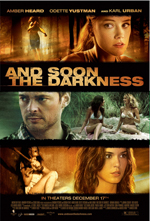
And Soon the Darkness

And Soon the Darkness - Dir. Marcos Efron (2010)


No movie is safe from the Hollywood remake machine. It doesn't matter if it's a renowned classic or a little-known cult film, it will be dusted off and redone for an audience too young to know about the original. This is the case with And Soon the Darkness, a remake of a British thriller from 1970 about a pair of young English ingénues terrorized in the French countryside. In his first feature film, director Marcos Efron (with co-writer Jennifer Derwingson) transplant the tale to South America and cast two of Hollywood's rising starlets, Amber Heard (Pineapple Express, Zombieland) and Odette Yustman (Cloverfield, You Again).

Heard and Yustman play BFFs, Stephanie and Ellie, two comely American girls on a cycling trip through Argentina. Stephanie and Ellie have split off from the rest of the tour group to adventure on their own. They arrive in a sleepy little village in the middle of nowhere. It seems peaceful enough, but appearances can be deceiving. The denizens walk around on eggshells while some eye the newcomers with suspicion. The fact that there are pictures of a missing girl plastered around town should be a red flag. However, our heroines don't notice anything is amiss. They get dolled up and hit the local bar for a night of drinks.

While Stephanie is the more responsible of the two, Ellie is the party girl. She flirts with the guys using what little Spanish she knows, downs shots, and sings along to "I Touch Myself" by the Divinyls. After a few too many drinks, the girls oversleep and miss the morning's bus out of town. What else is a pair of nubile gals to do then slip into their bikinis and sunbathe? Stephanie gets into an argument with Ellie over boyfriend troubles and storms off. When she heads back to apologize, Ellie is gone, leaving behind her cell phone. Stephanie tries to report her friend's disappearance to the local policeman (Cesar Vianco) who quickly dismisses the seriousness of the situation. Stephanie finds sympathetic help in Michael (Karl Urban), an American expatriate, who has lost someone too.

And Soon the Darkness presents nothing that hasn't been seen before, especially in the 'pretty American girls get abducted and tortured by evil foreigners' subgenre. Marcos Efron should at least be commended for not going the torture porn route and turning his film into another Hostel knock-off. Those of you who are gorehounds or just looking for a bit of T&A may be disappointing. The film does contain some violence, but nothing grotesque and there's no nudity whatsoever. There is a nice close-up of Yustman's posterior. Darkness is a competently made thriller with Efron lulling the audience (and his protagonists) into a false sense of security with gorgeous shots of the Argentinean landscape. The film's climax is exciting though not enough to bring you to the edge of your seat.

One of the movie's main weaknesses is the interminable amount of screen time that must be sat through before the action finally kicks in. This is the obligatory section of the movie where we are forced to get to know everyone. The characters are incredibly thin and it hardly helps that their conversations are vain and uninteresting. The lead actresses aren't called upon to do anything other than look pretty and scared. Karl Urban's appearance is a head scratcher. His role is so miniscule and meaningless you'll wonder why he even bothered to show up, unless it was for a free vacation. The same goes for Academy Award nominee Adriana Barraza (Babel) as the owner of the town's one and only hotel.

And Soon the Darkness might be considered perfectly acceptable cinema. It's a film that isn't overly stylish or overly indulgent. It isn't particularly inventive or captivating either. And Soon the Darkness offers only two hot looking leads and a story filled with predictable twists and cardboard characters.

Rating: * ½ (*****)

Friday, December 3, 2010

The Disappearance of Alice Creed

The Disappearance of Alice Creed - Dir. J Blakeson (2010)


The Disappearance of Alice Creed opens with stark efficiency as we watch a pair of crooks silently prepare for the perfect crime. First, the perpetrators steal a plain, white van, the kind that serial killers always use in the movies. Next, they proceed with workmanlike manner in purchasing various items such as a mattress, duct tape, and power tools. They line the bedroom walls of their dingy flat with insulation for sound proofing and install additional bolts and locks to the front door. They dress in matching outfits and black gloves before driving to their destination. Suddenly, they've wrapped some poor girl in a blanket and thrown her in the back of the van.

As we soon learn, the criminals are Vic (Eddie Marsan) and Danny (Martin Compston), partners who originally met while in prison. Danny is the young hotshot while Vic is the stone cold veteran. Their victim is one Alice Creed (Gemma Arterton), the daughter of a very wealthy man. Danny picked the girl and Vic has planned the entire operation down to every fine point. Vic and Danny tie Alice down to the bed, handcuffing her wrists to the bed post and placing a ball gag in her mouth. They strip her naked in order to take photos to send to her father. Once that's out of the way, Alice is dressed in a purple tracksuit then has a hood placed over her head. Vic and Danny exit the bedroom and dispose of all their clothing. Danny seems to be losing some of his nerve now that the girl is no longer "theoretical," but Vic sets him straight with a steadfast ruthlessness. The ransom from Alice's father will make them rich.

Anybody who's seen a good crime movie knows there's no such thing as the perfect crime. Twists and turns lie ahead as the film reveals more and more about the crooks and Alice, who is hardly the helpless lass the bad guys thought.

The Disappearance of Alice Creed marks the feature film debut for writer/director J Blakeson, whose most notable credit was as screenwriter of the direct-to-video sequel, The Descent: Part 2. The enigmatically named Blakeson keeps his direction simple without drowning the picture with a lot of flashy camera tricks. He allows the film to rest solely on the shoulders of his actors. The Scottish-born Compston (who has previously appeared in films like Red Road and The Damned United) does a good job of evolving his character beyond that of the rookie in over his head. However, it's Eddie Marsan who commands attention whenever he is on screen. Marsan has become a noted character actor following excellent turns in Happy Go Lucky and Sherlock Holmes. Here, Marsan comes across as an icy sociopath without resorting to cartoonish histrionics.

Blakeson keeps his focus on the villains in the first half of the movie with the title character serving as a supporting player. Usually, when the audience is asked to identify with the criminals, they are charming rogues as evidenced in the Ocean's franchise or the classic Rififi. Make no mistake about it; these guys will never be called charming. They are nasty, especially Vic.

Considering the film is named after her, it needs a capable actress to be Alice Creed. Blakeson has found his damsel in distress in Gemma Arterton. The lovely actress had only just appeared in Quantum of Solace when production began. Her star status rose this year following roles in the big-budget blockbusters Clash of the Titans and Prince of Persia. That's has certainly helped gain notice for Alice Creed, which debuted in 2009 at the London and Toronto Film Festivals. Arterton has a rough time of it in the first half as she's mainly restrained or blindfolded. In addition to the earlier nude scene, she's forced by her captors to pee in a pitcher while spread-eagled across the bed. To Blakeson's credit, he doesn't shoot these sequences in a salacious manner, but it's hard to completely leech away the inherent elements of exploitation cinema.

The Disappearance of Alice Creed is a bit of a mixed bag. Blakeson directs with a restrained assurance and the film starts off as a strong crime thriller. If only Blakeson had kept the script as clean as his direction. The plot suffers from a one too many left turns as the narrative becomes bogged down with shocking revelations. Alice Creed comes on strong, fizzles out and only just rights itself at the climax.

Rating: ** (*****)

Tuesday, October 26, 2010

Buried

Buried - Dir. Rodrigo Cortes (2010)


Are audiences willing to spend 90 minutes trapped inside a box with Ryan Reynolds? Director Rodrigo Cortes and writer Chris Sparling hope the answer is yes.

Reynolds is Paul Conroy, a civilian truck driver contracted to work in Iraq. Buried begins literally in the dark as Conroy awakens and fumbles for his lighter. To his horror, he has been buried alive. Terrorists attacked his convoy and demand a substantial ransom before revealing his location to the authorities. At Conroy's disposal, are the aforementioned lighter and a cell phone. He desperately attempts to contact anyone he can for help as well as his wife (Samantha Mathis).

Conroy reaches out to 911, the FBI, and the State Department as we listen in on his frantic calls. He is eventually put in contact with a special task force assigned to these abductions. We also bear witness to his chilling conversations with the kidnappers. Conroy's emotions run the gamut of fear, frustration, desperation, and anger. Though the unseen villains threaten his very life, the most frightening call is perhaps the one he receives from his employers who coldly fire him in order to absolve themselves from any lawsuit or hefty insurance payout.

Films like Buried have been attempted before. Open Water centered on a couple left alone in shark infested waters after their tour boat departs without them. Frozen was about three skiers forced to battle the elements when they are trapped on a ski lift after the resort shuts down for the weekend. Both movies were praised for their high concept premises, but neither had enough story to fill their feature-length run times.

It is a testament to the talents of Cortes and Reynolds that they are able to sustain suspense throughout Buried. Cortes wisely varies his camera angles to keep the movie fresh while maintaining a strong sense of claustrophobia and impending doom. Reynolds is also excellent, proving he can play more than just the smart-aleck. He does display his trademark flippancy on rare occasions, but he's able to convey a wider range than any previous roles. He's likable enough to gain sympathy necessary to make his predicament all the more harrowing.

Buried does cheat a little. Conroy's limited air supply is a danger, but it doesn't seem to factor in when he's constantly speaking and thrashing about. He's also burning precious oxygen with his Zippo. Still, it is a well-made thriller that doesn't need to resort to blood and guts to keep you on the edge of your seat.

Rating: ***

Wednesday, September 15, 2010

After.Life

After.Life - Dir. Agnieszka Wojtowicz-Vosloo (2010)


Helmed by a first-time director, After.Life managed to attract a talented cast despite its shortcomings. The picture was directed and co-written by Agnieszka Wojtowicz-Vosloo whose only previous experience was an award-winning short made during her time at NYU. It’s an ultimately forgettable film, yet it managed to snag some big-name talent.

Christina Ricci stars as Anna Taylor, a pretty, young schoolteacher in a rocky relationship with successful attorney, Paul Coleman (Justin Long). One dark and stormy night, Anna and Paul get into an argument with Anna stomping away in a huff. She loses control of her car and wakes up on a slab in the basement of a funeral home run by Eliot Deacon (Liam Neeson). Even though Anna can still walk and talk, Eliot says she is dead. You see, Eliot has the power to speak to the recently deceased. Anna’s soul is in a transitional state before crossing over to the other side. Eliot is there to help in said transition. Or is he?

Anna has her doubts while Paul is convinced Eliot is hiding something. Of course, the inept police force doesn’t believe him. There’s also a creepy, little boy named Jack (Chandler Canterbury) who may also possess similar abilities to Eliot.

Wojtowicz-Vosloo wisely chooses atmosphere over cheap scares and gore. She has a good command of production design with effective uses of warm and cold colors, such as red and violet. She has a good eye, but the screenplay, which was co-written with Paul Vosloo and Jakub Korolczuk, leaves much to be desired. The dialogue tends to be heavy-handed with corny lines like, ”You’re a corpse. Your opinion doesn’t count anymore.”

After.Life strives for ambiguity, but the results are steeped with obviousness. There’s no real mystery behind the movie even without all the easy to spot clues. In fact, the longer the film plays with the audience, the more frustrating it becomes. Vosloo tries to throw us for a loop with a few creepy dream sequences. However, once the character wakes up, it feels like the rug is pulled out from under us. The filmmakers seem to be showing off rather than advancing the plot.

As he always does, Liam Neeson lends some credibility to the role even if his performance won’t stick in your memory. Ricci has incredibly expressive eyes and excels well as the troubled girl in distress. Justin Long is the only weak link in the main cast. He gives an overwrought performance in a role very similar to his turn in Sam Raimi’s Drag Me to Hell. Long’s strong suit is comedy and he lays it on too thick when attempting more dramatic roles.

The central concept of a mortician communicating with the corpse he’s preparing would be an interesting premise for a short film. Here, the concept feels padded out with flat characters and little in the way of suspense to hold your attention.

Rating: *

Tuesday, May 18, 2010

The Ghost Writer

The Ghost Writer - Dir. Roman Polanski (2010)


Two of the masters of film tried their hands at the thriller genre at the beginning of 2010. While Martin Scorsese’s Shutter Island was undone by an M. Night Shyamalan style twist ending, Roman Polanski’s The Ghost Writer offers no such tricks. Based on the novel by Robert Harris, it relies on a strong cast of actors and old-fashioned storytelling.

Ewan McGregor stars as an unnamed ghost writer who is only referred to as The Ghost in credits. The Ghost lands a lucrative job handling the autobiography of former British Prime Minister, Adam Lang (Pierce Brosnan). The Ghost’s predecessor was Lang’s long-time aide whose body was found washed ashore. In addition, Lang is accused of abducting two British citizens suspected of being terrorists and handing them over to the CIA for torture. The Ghost digs deeper into the mysterious death as well as the accusations leveled against Lang.

The allusions to today’s political landscape are obvious and sometimes hammered home too hard. Lang, played with a fierce bluster by Brosnan, is loosely based on Tony Blair with just a dash of Bill Clinton thrown in for good measure. Lang is having an affair with his assistant Amelia Bly (Kim Cattrall) while his dutiful wife, Ruth (Olivia Williams) steadfastly stands by his side in public. He is portrayed as a glorified lackey to the American government with shady ties to a military-industrial conglomerate known as Hatherton. About as subtle as calling them Schmalliburton, I suppose.

Polanski instills a cold and sullen mood to the The Ghost Writer. The majority of the film is set in Martha’s Vineyard and there is a constant gloomy overcast, about as gloomy as the specter of scandal and death hanging over everyone’s head. Lang’s retreat is just as cold. It is an angular, ultra-modern hideaway ironically laden with expansive glass windows looking over the island coast.

The final verdict on The Ghost Writer hinges not on any on-screen happenings, but in Polanski’s own personal proclivities. While I certainly have no problem with separating the personal with the professional, it’s difficult to do so when it’s rubbed right in your face. Much of the story involves the International Criminal Court attempting to prosecute Lang as a war criminal. Lang must choose between fighting the charges in his native England and staying in America where he will not be extradited. If you know anything about Polanski, the parallels need no explanation. The subtext boils to an uneasy conclusion in which the accused is laid blameless and the fault is laid firmly at the feet of a woman.

Rating: **

Monday, May 17, 2010

Shutter Island

Shutter Island - Dir. Martin Scorsese (2010)


Martin Scorsese.

That’s all you need to know. Emblazon that name on the marquee and you’ve got my ticket money. He’s tackled gritty crime films, Merchant-Ivory style drama, and documentaries. Scorsese delves into new territory with the gothic thriller, Shutter Island, based on the novel by Dennis Lehane whose novels Mystic River and Gone Baby Gone have also been adapted to film. Shutter Island can best be described as Samuel Fuller’s Shock Corridor by way of M. Night Shyamalan.

Scorsese collaborates with Leonardo DiCaprio for the fourth time. Still hanging on to his Departed Boston accent, Leo takes the lead as U.S. Marshal Teddy Daniels. Along with partner Chuck Aule (Mark Ruffalo), Daniels is sent to Shutter Island to investigate the disappearance of a patient at Ashecliff, a former Civil War fort turned into an asylum for the criminally insane.

Daniels is still haunted by his service during World War II in which his unit liberated a concentration camp. Not to mention his wife (Michelle Williams) was killed in a fire caused by an arsonist who was once a patient at Ashecliff. Investigating further, he discovers clues leading to a deeper conspiracy involving the doctors experimenting on left-wing radicals.

There is no denying Scorsese’s abilities as a master filmmaker. He sets an uneasy mood almost immediately with a style that is a cross between noir and Hitchcock. Scorses heightens the creepy atmosphere by filling the supporting cast with several equally creepy actors. Really, nobody does creepy better than Jackie Earle Haley, Elias Koteas, and Max von Sydow.

Shutter Island essentially lives and dies by the twist ending. You either buy it or don’t. There’s no in between. Personally, I couldn’t. It was like the rug was pulled out from under me. Whatever I had invested in the film feels as if it had been a waste. Every other element of the picture is strong and Scorsese has created an uneasy, claustrophobic mood to the story, but the sharp left turn in the resolution undoes all the hard work.

Rating: **

Friday, December 11, 2009

Righteous Kill

Righteous Kill - Dir. Jon Avnet (2008)


Two of the most celebrated actors ever, Robert DeNiro and Al Pacino, both starred in The Godfather, Part II, but they wouldn’t appear together on-screen until Heat. Even then, they spent most of the film apart as adversaries. In Righteous Kill, DeNiro and Pacino share the majority of screen time together as New York City police detectives Turk and Rooster. The veteran partners investigate a series of vigilante murders targeting criminals who have escaped justice.

You’d think putting DeNiro and Pacino together on screen would easily equal electricity. It doesn’t, at least, not here. Both actors are given bland roles that could have easily gone to any other performer. They essentially sleepwalk through the film with as minimal amount of charisma as will do. Righteous Kill features a talented supporting cast to back them up, all of whom are wasted in one-dimensional roles. Carla Gugino appears as Turk’s girlfriend, a fellow officer into rough sex, a character reeking of tackiness and misogyny. Melissa Leo, so incredible in Frozen River, appears briefly in a throwaway role as a grieving mother.

The script was unoriginal and ridiculously predictable. The film opens with a video taped confession from DeNiro’s character admitting to the murders. These confessions are played throughout the film and hammered into our heads so many times; it becomes blatantly obvious he didn’t do it. The weak plot comes as a shock considering it was written by Russell Gewirtz who penned Inside Man, one of my favorite films from 2006. I suppose being directed by the man behind 88 Minutes canceled that out.

2008 was the year of the crappy cop movie thanks to stinkers like this, Street Kings and Pride and Glory. You’d be better served turning on any random episode of The Shield.

Rating: * 1/2

Tuesday, December 8, 2009

Pandorum

Pandorum - Dir. Christian Alvart (2009)


The cheesy critic in me is tempted to simply write, “Pandorum? More like Pan-Bore-Em,” and leave it at that. Pandorum was produced by Paul W.S. Anderson so I think it’s obvious to say this won’t be an existential examination of space travel as seen in 2001, Sunshine, or Solaris.

Pandorum opens sometime in the future as Corporal Bower (Ben Foster) and Lt. Payton (Dennis Quaid) awaken from suspended animation aboard a spaceship. Both men suffer from amnesia, a side effect of hyper-sleep, and have no idea who they are, where they are, or what their mission is. The ship is also suffering from power failure and they cannot raise the current crew on duty. As Bower explores the vessel, he discovers the ship has been infested by feral aliens who have been feeding on the other crew members.

As with Anderson’s Resident Evil movies, Pandorum features an ass-kicking female character with a funny accent. This time, it is German-born actress Antje Traue as Nadia, a genetics researcher charged with cataloguing the species preserved on the ship. I’m not exactly sure how a biologist knows martial arts and Parkour, but it’s one of the film’s least silly conceits.

Pandorum blatantly rips off several sci-fi and horror films like Alien, Dawn of the Dead, and even Anderson’s own Event Horizon. The creatures bare a resemblance to those in Neil Marshall’s The Descent, clad in the leather fetish outfits of The Road Warrior. Christian Alvart directs the film with the same crappy techniques that plague the majority of action films today. Pandorum is filled with shaky camera sequences and extreme close-ups edited together in a rapid, slipshod manner making it almost impossible to make out what’s going on.

Rating: *

Sunday, May 17, 2009

Angels & Demons

Angels & Demons - Dir. Ron Howard (2009)


Sony Pictures takes Dan Brown’s prequel to the controversial bestseller, The Da Vinci Code and turns it into a sequel to the film adaptation. Angels & Demons finds Tom Hanks’ Professor Robert Langdon on the side of the Catholic Church he crossed swords with in the previous film. He also has a more sensible hairstyle than the modified mullet he once sported.

The Pope has passed away and as the Catholic Church prepares to elect a new leader, four of the leading candidates have been abducted. Meanwhile, an experiment with a massive Hadron Collider has yielded trace amounts of anti-matter, a canister of which is stolen. Both crimes have been committed by the Illuminati, a secret society long thought extinct. The Illuminati plan to murder each the candidates as they lead up to destroying all of Vatican City with an anti-matter bomb. Once their number included great minds like Galileo and Bernini until the Church persecuted the group for teaching ideals countermanding their religious doctrine. Their goal now is to strike back in the ultimate battle of science versus religion.

Langdon is called to the Vatican and must decipher an assortment of clues and mysterious symbols to track down the Illuminati’s secret hiding place and save thousands of lives. Langdon finds assistance from Vittoria Vetra (Ayelet Zurer), the Italian scientist in charge of the experiment and the Camerlengo (Ewan McGregor), the Pope’s right-hand man and adopted son.

Many felt The Da Vinci Code lacked visual style and forward momentum with much of the film devoted to lengthy exposition. Director Ron Howard took that criticism to heart utilizing more flashy shots compositions and camera movement instead of the static, plain style of the original. He’s also picked up the speed considerably. The sequel is also more violent than its predecessor featuring scenes that include a man’s face being eaten by rats and at least two men set a fiery blaze. On the positive side, it has made Angels & Demons a quicker paced thriller. On the negative side, it just means those lengthy exposition scenes come faster and more frequently.
Ayelet Zurer inherits Audrey Toutou’s role as the sole female in the cast, but really adds nothing. She’s only there to explain things to the other characters (and the audience) when it comes to scientific and even medical elements. Despite the attempts to ground the story in reality, the plot still remains ludicrously absurd (or absurdly ludicrous, if you will). The villain, of course, has to come up with the most overly-Machiavellian plan possible when a simple ‘shoot the hero in the head’ would have sufficed. If only Howard could have found a way to film The Da Vinci Code with the pace and direction for the sequel. We might have had a halfway decent film.

At least, Code had Ian McKellan to add his presence and grativas to the ridiculousness around him. Here, Howard has to cast Stellan Skarsgard, Armin Mueller-Stahl and a genial Ewan McGregor to try and balance things out. Hanks performs well as an intellectual Indiana Jones, but gets no opportunities to display the trademark charm he has in the past. Angels & Demons is essentially your typical summer blockbuster masquerading as highbrow entertainment. It's a passable popcorn film that might be worth a rent on the weekends.
Rating: **

Friday, May 8, 2009

State of Play

State of Play - Dir. Kevin Macdonald (2009)


Just like Steven Soderbergh’s Traffic, State of Play was based on a BBC mini-series. Having not seen the origin British production, I can’t speculate as to how the American remake matches up to it. I will say that State of Play is a perfectly acceptable thriller that tries to evoke the themes of 70’s classics such as All the President’s Men with a hint of The Parallax View.

State of Play begins with a young African-American male with a history of drug problems and felonies being murdered in an alley late at night. The police probably would have let this one fade away if not for a bicyclist witnessing the shooting and also being killed. Cal McCaffrey (Russell Crowe) is the veteran reporter assigned to the case by the Washington Globe and his tough-as-nails editor Cameron Lynne (Helen Mirren). That very morning, Sonia Baker (Maria Thayer), the beautiful aide to Congressman Stephen Collins (Ben Affleck) is killed in a supposed accident on a subway platform. Collins is a rising star in political circles as he heads an investigative committee looking into the inner workings of PointCorp, a private security firm and obvious stand-in for Blackwater. Young and handsome, he’s the type of TV-friendly politico that John F. Kennedy Jr. may have been if not for his premature death. Alas, Collins is more John Edwards than John John as it comes out he was having an affair with Baker. Robin Wright Penn plays Collins’ dutiful wife, Anne, who reluctantly chooses to stand by her man for the big press conferences.

McCaffrey was once Collins’ roommate in college and it’s hinted at that he also had an affair with Anne years ago. Lynne wants to use McCaffrey’s relationship with the tarnished congressman to assist in the story being written up by the Globe’s online blogger, Della Frye (Rachel McAdams). McCaffrey and Frye begin working together in an adversarial capacity. The elder journalist feels she is a glorified gossip monger and can’t stand that she has a high-tech laptop and doesn’t seem to own a pen. Eventually she takes on a mentor role and teaches her to get out from behind a desk and use old-fashioned legwork to get the scoop.

Though the film takes a uniquely American point-of-view to the proceedings, it is the Scottish Kevin Macdonald (The Last King of Scotland) who helms the picture. Macdonald is backed up by a script written up by a team of crackerjack screenwriters all of whom are well-equipped to handle these ripped-from-the-headlines, twisty turny story. Among those who contributed to the script include Matthew Michael Carnahan (The Kingdom, Lions For Lambs), Tony Gilroy (Michael Clayton), Billy Ray (Breach, Shattered Glass), plus an uncredited rewrite from Peter Morgan (The Queen, Frost/Nixon). They manage to find some balance between the wealth of characters and subplots. There are a few bumps in the road that may take you by surprise and a few you can see coming. Perhaps, the weakest point in the film is the third act resolution which tries to fit in a few too many twists while wrapping all the dangling plotlines far too neatly.

The political scandals may make up the meat of the story, but the underlying themes of print versus online media are a far more fascinating aspect to State of Play. The clash between the old-school and the new-school. Further on point is the added effect of the economic slump to the financial viability of the newspaper. My local paper, the San Diego Union-Tribune, recently laid off just under 200 workers following similar layoffs last year. Filmmakers added an extra layer of resonance as we watch the latest headlines move through the massive printing press on its way to the public. If only there were a lame-legged newsie hawking copies on the local street corner, shouting ”Extry, extry.”

During early development, Brad Pitt and Edward Norton were attached to the roles of McCaffrey and Collins, respectively. We may not have gotten a Fight Club reunion, but Russell Crowe is more believable as the weary, slovenly McCaffrey than Pitt. It’s not a surprising role for Crowe following similar ones in American Gangster and Body of Lies. Affleck has the good looks for Collins, yet lacks the range of Norton to bring the character truly to life. Some of his line readings are flat. The best performances out of the A-list ensemble belong to supporting players Jason Bateman as a sleazy, drug-addled PR man and Jeff Daniels as an oily elder statesman.

State of Play isn’t the ingenious thriller the cast and crew had hoped it would be. It is, however, a popcorn film for those seeking something deeper than expensive CGI and loud explosions.

Rating: ***

Sunday, March 22, 2009

Knowing

Knowing - Dir. Alex Proyas (2009)


Nicolas Cage continues the downward slide into direct-to-video limbo land with another lackluster effort. It’s not as bad a stinker as Bangkok Dangerous, but isn’t nearly as good (relatively speaking) as either of the National Treasure films. To his credit, Cage tones down the odd mannerisms and dons a believable hair piece for his role of John Koestler, an astrophysics professor at MIT. The son of a pastor, Koestler has turned away from his religious upbringing following the death of his wife in a hotel fire. He is left alone to raise his son, Caleb (Chandler Canterbury). He hardly speaks to his younger sister, Grace (Nadia Townsend), and never speaks with his father.

Koestler boils the film’s themes down to a classroom lecture when he poses the question, is life a series of calculated & planned events or does shit just happen? Determinism vs. Randomness. Koestler believes shit happens and a lot of shit happens in Knowing.

In 1959, a class of elementary school students draws pictures to place inside a time capsule which won’t be opened until present day. One strange girl, Lucinda (Lara Robinson), hears whispering voices that compel her to jot down a page full of numbers. Flash forward to 2009 and Caleb receives Lucinda’s letter. Koestler discovers the numbers contain the dates of tragedies and disasters for the last fifty years along with the death tolls. 9/11, the Oklahoma City bombings, Hurricane Katrina, they’re all there. Soon, Koestler learns that the final numbers point to imminent catastrophes. Plus, there are a group of pale strangers with sinister intentions for his son.

If G.I. Joe has taught us anything, it is that knowing is half the battle. Knowing is half a film or, at least, two-thirds of one. The film is a hodgepodge of The Twilight Zone, Close Encounters, X-Files, and Left Behind. It ramps up suspense and creeps while building and building towards a big finish that can’t possibly live up to the expectations it sets. The predictable finale is heavy on the special effects, but light on any sense.

I’m a fan of Alex Proyas’s work. I loved The Crow and Dark City, both inspiring in their stylized Gothic/noir look. Yes, I even liked I, Robot. Not so much for the flimsy story, but more for the stunning eye candy. I’m not Proyas’s only fan. One of his biggest supporters is Roger Ebert who championed the cause to raise awareness for Dark City. Ebert gave Knowing four stars in his review and called it one of the best sci-fi films he’d ever seen. I must not have been watching the same picture. Visually, Knowing is a strong production. The film features two amazing set pieces. The first (shot uninterrupted) is a plane crash in which we follow Koestler through the rubble as he futilely attempting to help survivors, some on fire. Another major sequence is a subway crash in which two trains derail and cause massive damage. Both scenes are extremely visceral, but the film goes off its tracks just as badly, fizzling out to an anticlimactic finish.

Rating: * 1/2

Sunday, June 15, 2008

The Happening

The Happening - Dir. M. Night Shyamalan (2008)

The trees have it in for us.

The Village may have had an idiotic, twist ending, but at least it had an ending. Shyamalan's latest disasterpiece is all build and no payoff.

Shyamalan's keen sense of direction and suspense is enough to lift this above his last two bombs, but not enough to overcome laughable performances.

M. Night, swallow your pride. Hire a script doctor.

Thursday, April 24, 2008

Michael Clayton

Michael Clayton - Dir. Tony Gilroy (2007)

Riveting at every moment. Near-flawless effort from Tony Gilroy in his directorial debut.

Reminiscent of the socially relevant thrillers by Sidney Lumet, Alan J. Pakula & Sydney Pollack that marked the 70's